Mains: GS-II – Polity & Governance
Why in News?
The Union government is keen to kick off a fresh delimitation of Lok Sabha constituencies; in April 2026, it had moved an amendment to the delimitation bill, but could not pass it.
What is Delimitation?
- Delimitation – It is the process of fixing the number of seats and boundaries of territorial constituencies in each State for the Lok Sabha and Legislative assemblies.
- Article 81(1) – It states there can be no more than 550 members in the Lok Sabha, 530 from states and 20 from Union Territories.
- Article 81(2)(a) – The ratio of the number of Lok Sabha seats allotted to a state and the population of the State shall be the same for all states.
- Article 81(2)(b) – Ratio between the population of each constituency and the number of seats allotted to it shall be the same throughout the State.
- Article 82 – It states that after every Census is completed, the allocation of Lok Sabha seats to each state must be adjusted based on population changes.
- Past delimitation exercises – Delimitation has taken place 4 times - 1952, 1963, 1973 and 2002, with the number of seats fixed and readjusted during the first 3 exercises.
To know more about Delimitation, click here
Key proposals placed before Parliament in the previous Session
- Increase the size of the Lok Sabha up to a maximum of 850 seats;
- Distribute these seats among the States based on the 2011 Census through a fresh, countrywide delimitation of constituencies; and
- Reserve one-third of the total seats for women.
What happens if there is no Constitutional amendment?
- No need of constitutional amendment – For a fresh delimitation to happen, a Constitutional amendment is not required.
- The terms for the next delimitation are already written into the Constitution, principally in Articles 81 and 82.
A Constitutional amendment is required only if the existing constitutional provisions relating to delimitation are to be changed.
- Trigger for delimitation – A fresh delimitation will be triggered after the 2027 census data is published. This is because the Constitution mandates action after the first Census conducted post-2026.
- Mandatory delimitation after 2027 – If there is no Constitutional amendment at all, there will be a delimitation exercise that must begin after the release of 2027 Census data.
- If no amendment, two things will happen after the census -
- Reallocation of the existing strength of the Lok Sabha among the States and Union Territories on the basis of the population recorded in the new Census.
- Delimitation of individual constituencies within each State.
Can a fresh delimitation be completed before the 2029 Lok Sabha elections?
What will be the mandate of the next Delimitation Commission?
- Current seat distribution – At present, the distribution of the 543 Lok Sabha seats among the States is based on the population figures of the 1971 Census.
- When the benchmark changes from the 1971 population to the population recorded in the first Census after 2026, the seat distribution is likely to change.
- Likely impact – Southern States are likely to face a reduction in their share of Lok Sabha seats, while the Hindi-speaking States, particularly Uttar Pradesh, Bihar and Rajasthan, are likely to gain seats.
- The maximum number of Lok Sabha seats allowed by the Constitution is 550.
- Women reservation – A third of the Lok Sabha seats nationally, and one-third of the seats within each State, will be reserved for women.
- Mandated sequence if no amendment – In the absence of any Constitutional amendment, the following sequence is envisaged:
- The reallocation of Lok Sabha seats among States;
- The delimitation of constituencies within States; and
- The implementation of women’s reservation — all tied to the Census 2027.
How is the allocation of seats to each State determined?
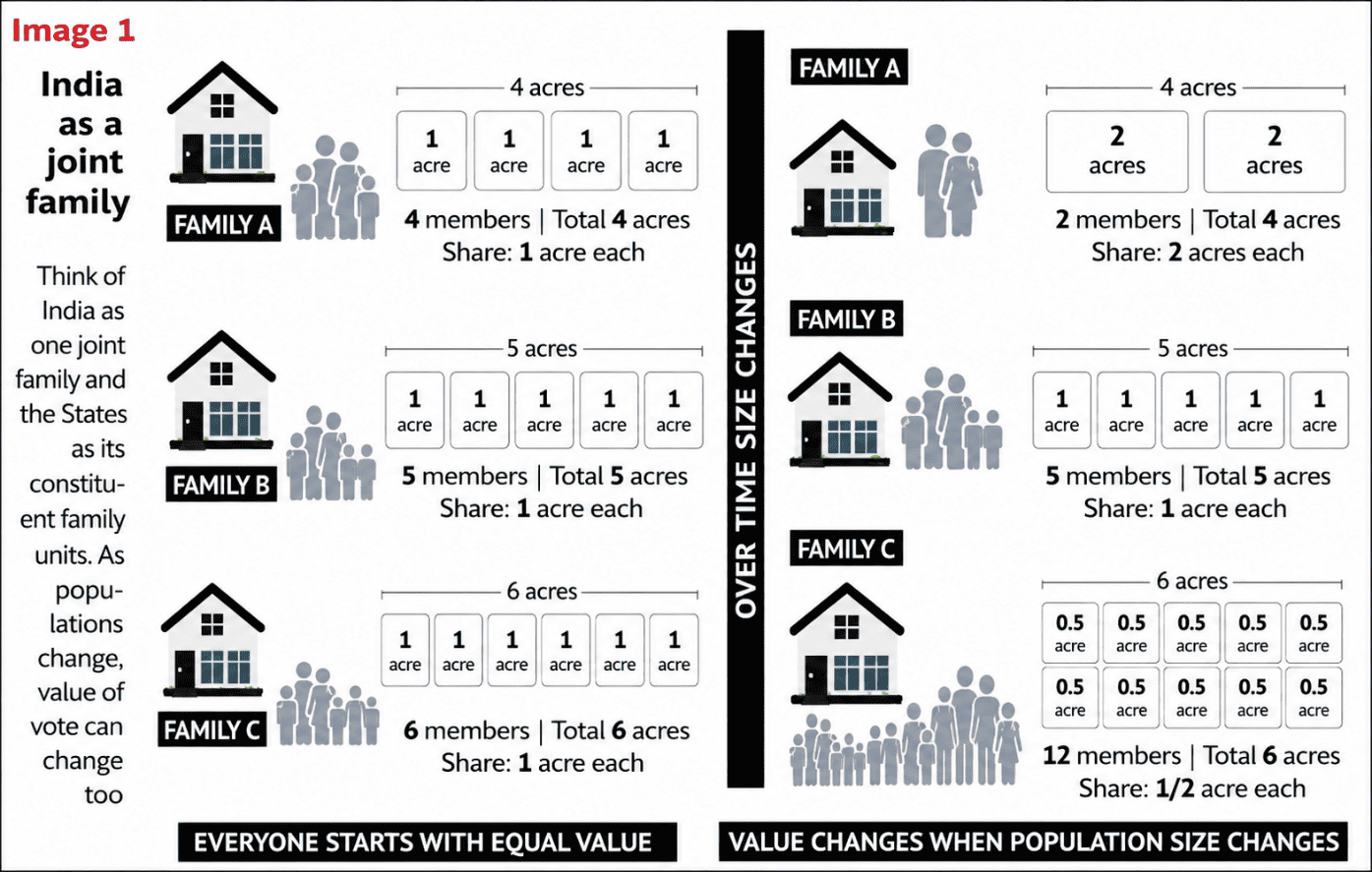
- Variation in representation – In 1967, an MP across most major States represented roughly four to five lakh electors.
- Today, an MP from Kerala represents about 14 lakh electors, while in Uttar Pradesh and Bihar, the figure is around 19 lakh, which shows how the value of each vote differs across States.
- Policy decisions – The above variation is the result of a deliberate decision by all parties, taken on two occasions, in 1976 and 2001, not to punish States that had stabilised their populations.
- The Constitution gives that leeway, that the size of Lok Sabha constituencies is not necessarily based on a national average, which today would be about 18 lakh voters per constituency.
- Flexibility of Article 81 – It requires seats to be allocated among States “so far as practicable”, on the basis of a national average.
- This leeway for variation allows for a balance between two principles that can be in tension:
- Federalism, or representation of States, and
- Democracy, or one vote, one value.
- Main issue – The debate on delimitation now needs to resolve the tension between
- Representation of States (federal balance).
- Equal value of votes (democratic fairness).
What is gerrymandering?
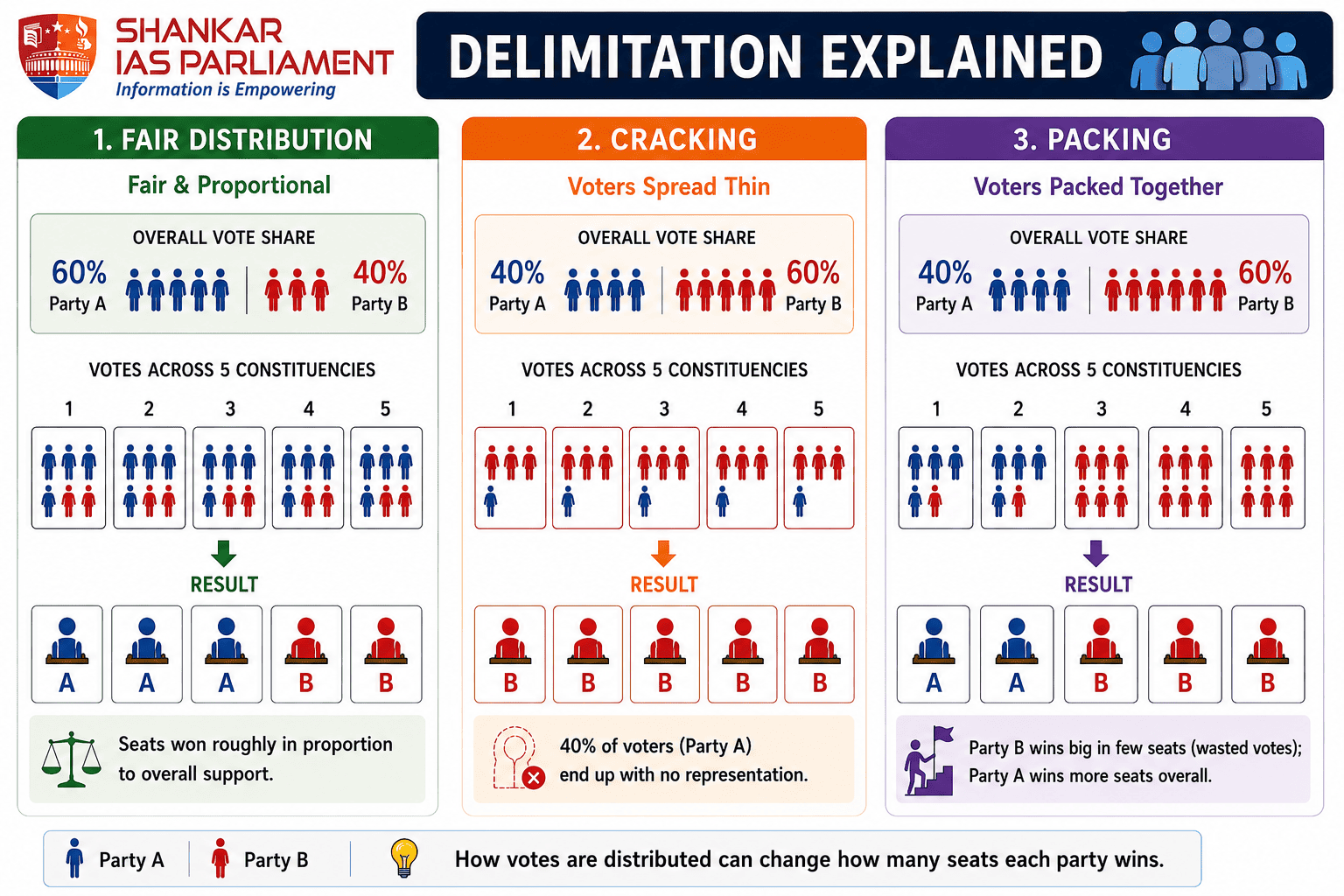
- Gerrymandering – It is the political manipulation of electoral district boundaries to give one political party or group an unfair advantage over others.
- The practice distorts fair representation by engineering election outcomes, often resulting in bizarrely shaped voting districts.
- Principle of equal numbers – The democratic principle of One Person, One Vote, One Value, the first requirement is that every Lok Sabha constituency should have roughly the same number of voters.
- Equal numbers not equal to equal value – Even if constituencies have equal numbers of voters, the value of each vote may still differ.
- Impact of grouping – Even if constituencies have the same number of voters, the way those voters are grouped can dramatically affect electoral outcomes.
- Thus, equal numbers alone do not guarantee equal value for every vote.
Reference
The Hindu | The stakes in India’s delimitation debate



