Prelims: Current events of national and international importance | Environment
Why in News?
Recently, new experiments highlight active recovery pathways for corals that have already expelled their symbiotic algae.
Key Findings
- Physical Contact & Algal Transfer
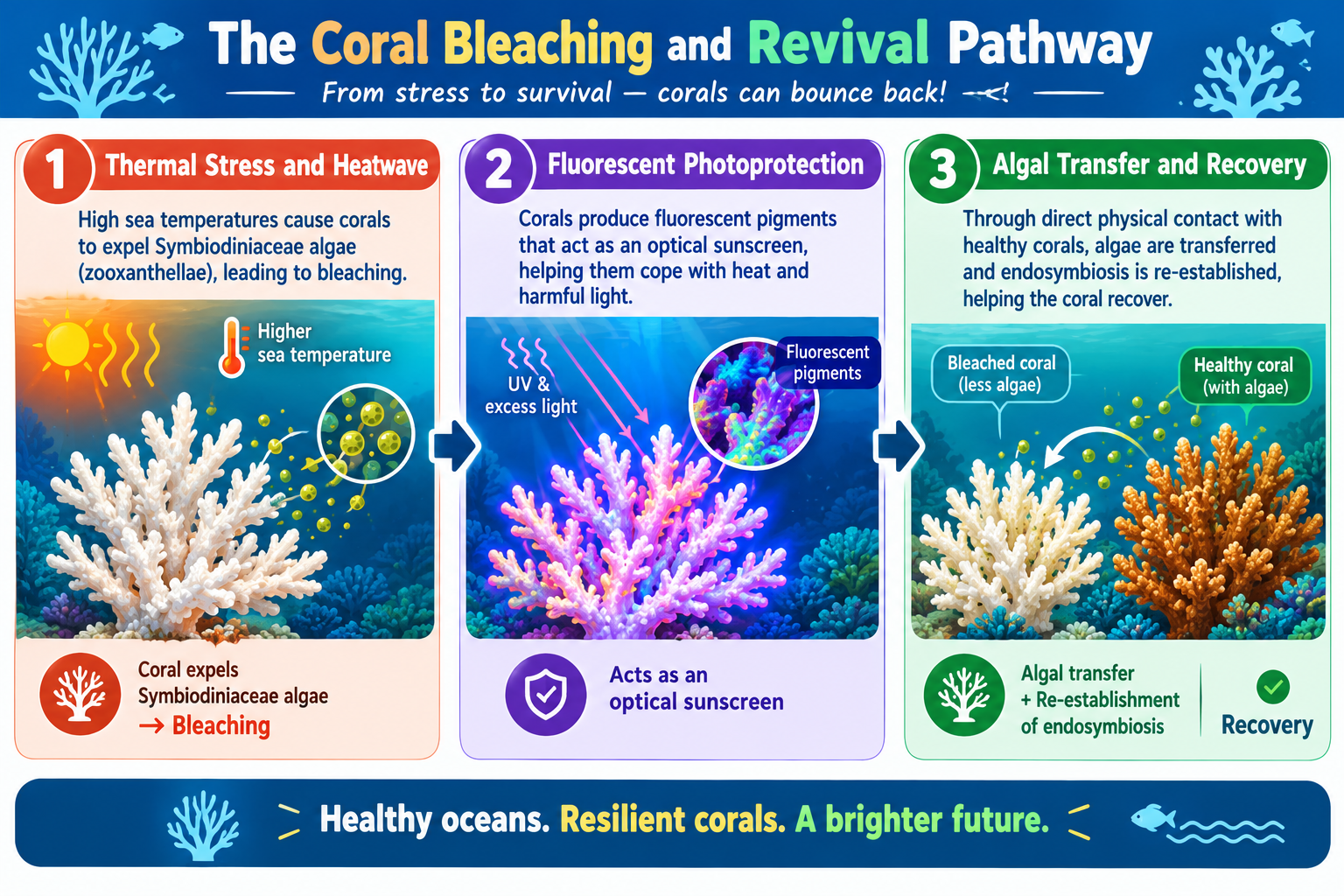
- Researchers demonstrated that placing bleached corals in direct physical proximity or contact with unbleached, healthy specimens allows for the transfer of symbiotic microalgae (Zooxanthellae / Symbiodiniaceae).
- This re-introduces the photosynthetic engine necessary for the coral animal's long-term survival and nutrient uptake.
- Colorful Bleaching
- When corals expel algae, excess light bounces off the stark white calcium carbonate skeleton, causing severe internal light stress.
- In response, corals produce vibrant fluorescent pigments—acting as an "optical sunscreen".
- This photoprotective layer creates a favorable light environment inside the tissue, aiding the return and survival of newly acquired algal symbionts.
Indian Context
- India features four major coral reef regions, all of which face heightened stress due to marine heatwaves (exacerbated by events like El Niño).
- Lakshadweep Archipelago - Ring-shaped coral atolls exceptionally vulnerable to rising sea surface temperatures.
- Andaman and Nicobar Islands- Rich fringing reefs, including those inside the Mahatma Gandhi Marine National Park.
- Gulf of Mannar & Palk Bay (Tamil Nadu) - Diverse fringing and patch reefs.
- Gulf of Kutch (Gujarat) - High-turbidity, shallow coral communities.
Significance for Coral Conservation Policy
- Active Restoration - Offers a novel scientific paradigm—moving beyond static protection or shading to active biological rescue and assisted re-symbiosis.
- Reef Rehabilitation Tool - Could inform future marine nursery designs where healthy "donor" corals are co-cultured alongside bleached corals to accelerate ecosystem recovery following marine heatwaves.
Reference
The Hindu | Bleached corals brought back to luminous life



