Prelims – Current events national and International importance | Environment
Why in News?
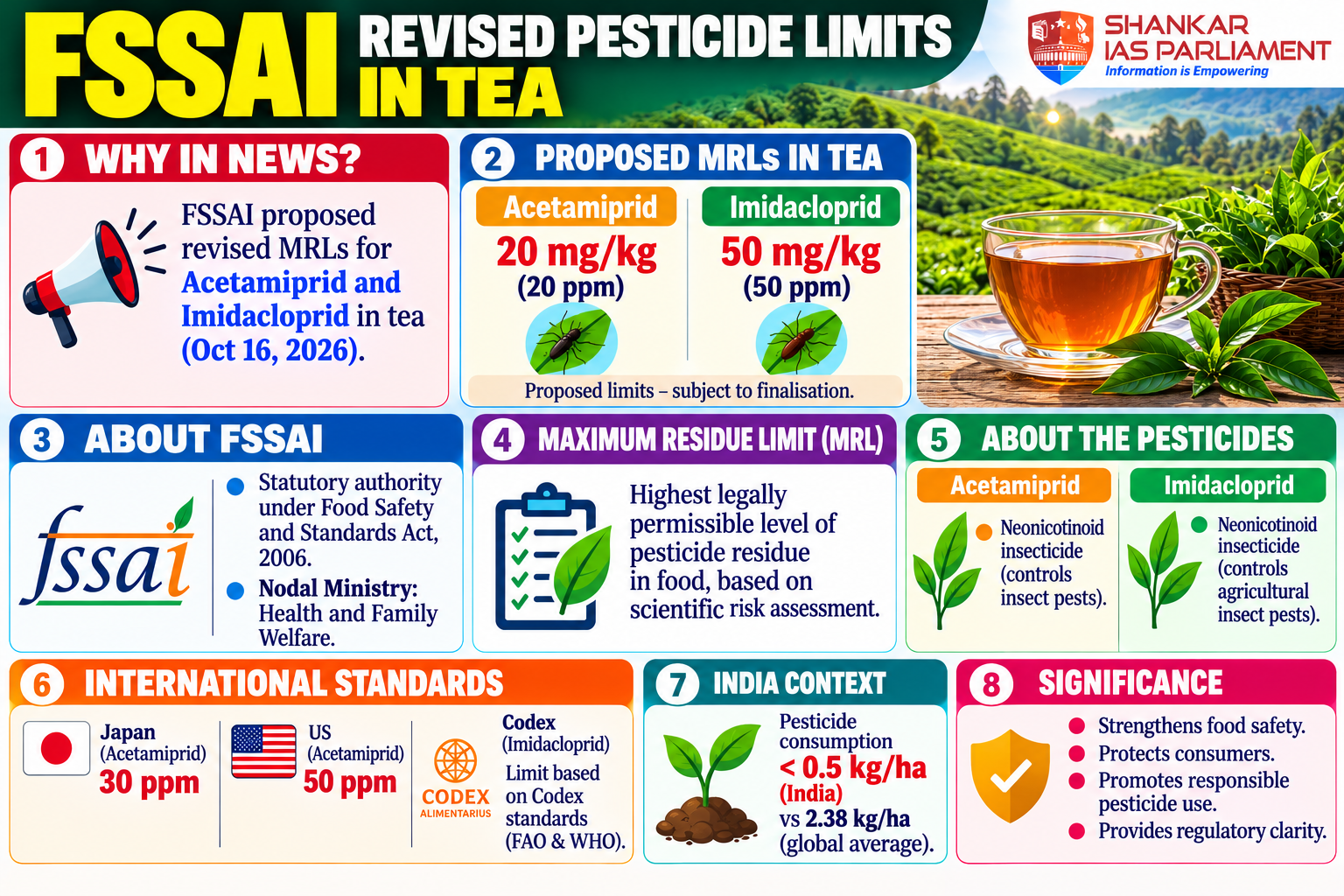
FSSAI proposed revised Maximum Residue Limits (MRLs) for Acetamiprid and Imidacloprid in tea under draft regulations published on October 16, 2026.
- FSSAI – It is the statutory authority established under the Food Safety and Standards Act, 2006,
- Nodal ministry – Ministry of Health and Family Welfare.
- Proposed MRLs in Tea –
- Acetamiprid – 20 mg/kg (20 ppm).
- Imidacloprid – 50 mg/kg (50 ppm).
- These limits are proposed standards and remain subject to finalisation.
- Maximum Residue Limit (MRL) – It is the highest legally permissible concentration of pesticide residues in a food commodity, established through scientific risk assessments.
- Acetamiprid – It is a neonicotinoid insecticide used to control insect pests in crops.
- Imidacloprid – It is a neonicotinoid insecticide used to control various agricultural insect pests.
- International Standards – The proposed Acetamiprid limit is lower than the cited limits of Japan (30 ppm) and the United States (50 ppm).
- The Imidacloprid limit has been formulated with reference to international Codex standards.
- Codex Alimentarius – It is a collection of international food standards developed by the Codex Alimentarius Commission, established by the FAO and WHO.
- Earlier Regulatory Measures – The FSSAI revised pesticide residue standards in 2024 and previously delisted 13 pesticides identified as having higher toxicity.
- India context – India's average pesticide consumption is reported to be below 0.5 kg per hectare, compared with the cited global average of 2.38 kg per hectare.
- Significance – Revised MRLs aim to strengthen food safety, protect consumers, promote responsible pesticide use and provide regulatory clarity to tea growers, processors and testing laboratories.
Reference
DD News| Revised Pesticide Residue Limits in Tea



