Mains: GS-II- Polity & Governance | Constitutional & Non constitutional bodies
Why in news?
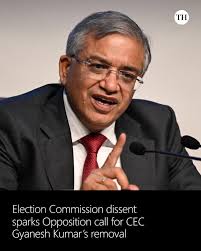
The opposition parties sought the removal of the CEC after the expose claimed that two of the three Election Commissioners had formally recorded objections at least 14 times over the last 10 months.
How are the CEC and ECs appointed?
- Article 324 – It vests the “superintendence, direction and control” of elections in the Election Commission of India (ECI).
- Article 324(2) – It provides that the President appoints the CEC and other Election Commissioners, subject to any law made by Parliament.
- Absence of Parliamentary law – For several decades, Parliament had not enacted a law laying down the procedure for these appointments.
- This led to a challenge before the Supreme Court on the question of how the independence of the ECI could be protected when its members were appointed by the executive.
What was the Anoop Baranwal case?
- Background – In January 2015, Anoop Baranwal filed a PIL on the ground that the existing system for appointing members of the ECI was unconstitutional.
- At the time, the executive enjoyed the power to make appointments.
- The PIL contended that the ECI’s independence has degraded over time and pleaded for the court to issue directions to set up an independent, collegium-like system for ECI appointments.
- Judgment – In March 2023, a five-judge Constitution Bench of the Supreme Court delivered its judgment in Anoop Baranwal v. Union of India.
- The Constitution Bench held that until Parliament made a law under Article 324(2), appointments to the Election Commission would be made on the recommendation of a three-member committee comprising the
- Prime Minister,
- Leader of the Opposition in the Lok Sabha and
- Chief Justice of India.
- Temporary arrangement – The court said the arrangement would operate only until Parliament enacted a law on the subject.
What happened after the judgment?
- Enactment of 2023 Act – Parliament enacted the Chief Election Commissioner and Other Election Commissioners (Appointment, Conditions of Service and Term of Office) Act, 2023, which came into force in January 2024.
- New appointment process – The appointment mechanism under the 2023 Act differed from the one prescribed by the Supreme Court in Anoop Baranwal – the Selection Committee consists of the
- Prime Minister,
- Leader of the Opposition in the Lok Sabha, and
- Union Cabinet Minister nominated by the Prime Minister.
- The President appoints the CEC and ECs on the recommendation of this committee.
- Search Committee – The Act provides for a Search Committee headed by the Union Law Minister, which prepares a panel of five persons for consideration by the Selection Committee.
- Challenge in SC – The 2023 law has been challenged before the SC - whether replacing the CJI with a Union Cabinet Minister is constitutionally valid.
- Split verdict – A Division Bench of Justices Dipankar Datta and S.C. Sharma delivered a ‘split’ verdict on the Union government’s plea seeking a larger bench reference of the challenges against the 2023 Act.
- Justice Datta – Did not find a reference to a Constitution Bench necessary.
- Justice Sharma – Held in favour of sending the case to a Constitution Bench, stating that several questions of substantial importance were at stake.
How can a CEC be removed?
- Constitutional protection – The Constitution gives the CEC a high degree of protection against removal.
- Article 324(5) – The CEC can be removed from office “in like manner and on the like grounds as a Judge of the Supreme Court”.
- Grounds for removal – The CEC can be removed only on the grounds of proved misbehaviour or incapacity and through the parliamentary procedure prescribed for the removal of a Supreme Court judge.
- Procedure for removal – The removal process involves
- A removal motion has to be passed by the required special majority in both Houses of Parliament.
- Only after Parliament passes the motion can the President issue an order removing the CEC.
- The procedure is set out in the Judges (Inquiry) Act, 1968.
- Protection for other ECs – The protection available to the other Election Commissioners is different: under Article 324(5), an Election Commissioner or Regional Commissioner cannot be removed from office except on the recommendation of the CEC.
Can a CEC be arrested?
- Section 16 of the 2023 Act – It provides legal protection to a person who is or was a CEC or Election Commissioner against civil or criminal proceedings in court arising from acts, decisions, or statements made in the discharge of their official functions.
- Protection beyond the tenure – The provision is significant because it extends protection even to a person who “is or was” a CEC or Election Commissioner.
- Whether the 2023 Act prevents arrest – Section 16 does not explicitly state that a CEC cannot be arrested.
- It says that no court shall entertain or continue civil or criminal proceedings in relation to conduct covered by the provision.
- The section does not use the words “arrest”, “investigation” or “police custody”, therefore it cannot simply be described as a blanket immunity from arrest.
- Scope of the protection – The protection is linked to acts done while, or in the course of, acting or purporting to act in the discharge of official duty or function.
Reference
The Hindu | What does the law say about CEC’s removal?



