Why in News?
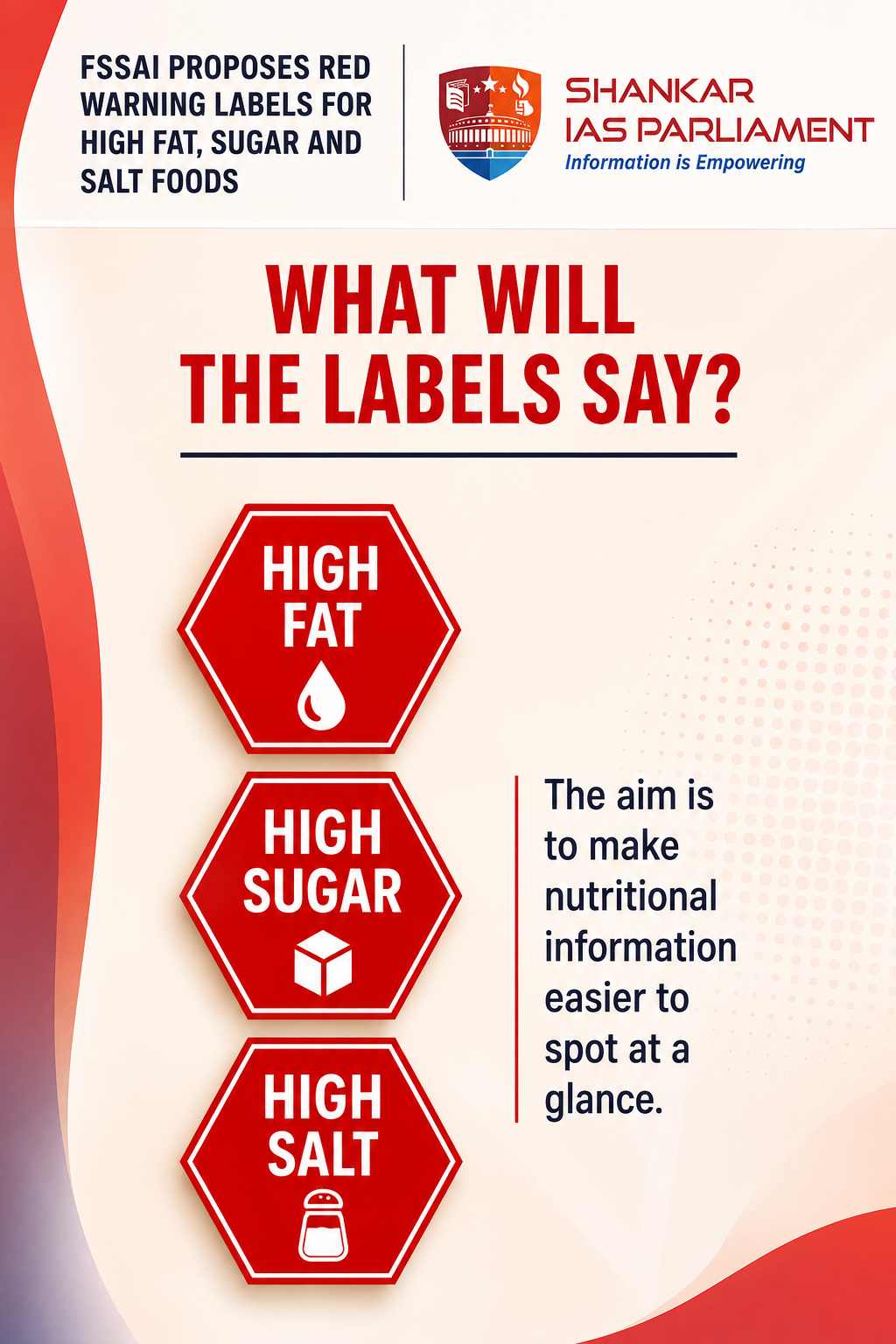
Recently, the FSSAI has proposed, in an affidavit filed in the Supreme Court, a red hexagonal warning label on the front of packaged food products, aimed at enabling consumers to identify potentially unhealthy packaged foods.
What is Front-of-Pack Labelling (FOPL)?
- FOPL – It provides simplified nutritional information on the front of food packages.
- It helps consumers quickly identify foods containing excessive levels of nutrients associated with health risks.
- It is an interpretive labelling system, as it goes beyond merely providing numerical nutritional information.
Why is FOPL important?
- Tackling non-communicable diseases – Excessive intake of sugar, salt and saturated fat is associated with Obesity, Diabetes, Hypertension, and Cardiovascular diseases.
- Consumer empowerment – Conventional nutrition panels can be difficult for consumers to interpret. A prominent warning can facilitate quick and informed food choices.
- Countering misleading health claims – Marketing terms such as “natural”, “multigrain” or “healthy” can create a perception that a product is nutritious.
- Warning labels can help consumers assess the actual nutritional profile.
- Encouraging product reformulation – Mandatory warnings could encourage manufacturers to reduce Added sugar, Salt, Saturated fat.
- This can promote the production of healthier processed foods.
What is the proposed FSSAI framework?
- Warning symbol – Red hexagon on the front of the package.
- Nutrients of concern – Added sugar, Added saturated fat, Salt.
- Phase I – Warning would apply to products high in two or more of these three nutrients.
- Phase II – Warning would be extended to products high in any one of the three nutrients.
- Highly sweetened beverages – Specified highly sweetened beverages would also come under the warning framework.
- Nutritional thresholds – Proposed to be based on the ICMR-NIN Dietary Guidelines for Indians, 2024.
- The framework refers to added sugar and added saturated fat, rather than total sugar and total fat.
- Single-ingredient foods and products inherently rich in these nutrients, including ghee, edible oil, jaggery and honey, are also proposed to be exempt.
Note – The framework is still a proposal and has not yet become a notified regulation.
What are the concerns associated with the FSSAI framework?
- Two-Nutrient Requirement – During Phase I, a product must be high in at least two nutrients to receive the warning.
- A product high only in sugar, salt or saturated fat could potentially escape the warning.
- Added vs Total Sugar and Fat – Using added sugar and added saturated fat rather than total sugar and total fat could leave certain products outside the framework.
- Ambiguity in definition – Scientific clarity is required regarding the definition of “high” levels.
- Absence of a Fixed Timeline for Phase II – FSSAI has not specified a firm deadline for moving from Phase I to Phase II.
- This could led to prolonged implementation of a weaker initial framework.
- Exclusions concerns – Exemptions for products such as ghee, edible oil, jaggery and honey need to be supported by clear scientific reasoning.
- Excessive exemptions could reduce the effectiveness of the system.
- Size and Visibility – Warning labels need to be sufficiently large, prominent and easily identifiable. A poorly visible warning may have limited behavioural impact.
- Language Accessibility – India’s linguistic diversity creates challenges regarding the language used on warning labels.
- Effective communication should account for regional and linguistic diversity.
What could be done?
- India-specific thresholds – Introduce scientifically robust and India-specific nutrient thresholds based on Indian dietary patterns and health outcomes.
- Single-nutrient warning mechanism – Consider imposing warnings when a product is high in any one nutrient of concern rather than requiring two nutrients.
- Time-bound implementation – Establish a clear and definite timeline for Phase II to prevent prolonged reliance on the initial framework.
- Visibility & prominence – Ensure warning labels are large, prominent and easily visible to enable quick consumer recognition.
- Multilingual accessibility – Develop appropriate multilingual communication mechanisms to make warnings accessible across India's diverse linguistic population.
- Evidence-based exemptions – Review product exemptions using scientific evidence and nutritional risk assessment.
- Periodic review of standards – Periodically revise nutrient thresholds based on changing dietary patterns, scientific evidence and health outcomes.
- Nutrition education – Combine FOPL with consumer awareness campaigns and nutrition education to improve interpretation and behavioural change.
- Industry reformulation – Encourage the food-processing industry to undertake voluntary as well as mandatory reformulation to reduce excessive sugar.
What is its significance for India?
- It strengthens India's approach towards preventive healthcare.
- It supports efforts to tackle the growing burden of NCDs.
- It improves nutrition literacy among consumers.
- It promotes informed consumer choice.
- It encourages food companies to undertake health-oriented reformulation.
- It strengthens the role of FSSAI in food safety and public-health regulation.
What lies ahead?
- FSSAI’s proposed red-hexagon label represents a shift from merely providing nutritional information to clearly communicating nutritional risk.
- A scientifically robust, visible and comprehensive FOPL system can empower consumers, and contribute to India's fight against non-communicable diseases.
References
- The Hindu| Red Hexagon Warning Labels for Packaged Foods
- The Indian Express| Red warning labels for unhealthy packaged snacks



