Mains: GS-II – Polity & Governance
Why in news?
Parliament adjourned sine die on August 13, at the end of the last sitting of the Monsoon Session; however, they have not been prorogued to date, making it the longest unprorogued period on record.
What are Constitutional provisions?
- Summoning of Parliament – Article 85 of the Constitution provides for summoning and prorogation of the Houses of Parliament.
- It states that the President shall, from time to time, based on the advice of the Council of Ministers, summon each House of Parliament.
- The gap between two sessions should not exceed six months.
- Hence, while there have to be at least two sessions of Parliament in a year, there are three sessions that are normally held as per our convention.
- The 3 sessions include
- Budget Session
- Monsoon Session
- Winter Session.
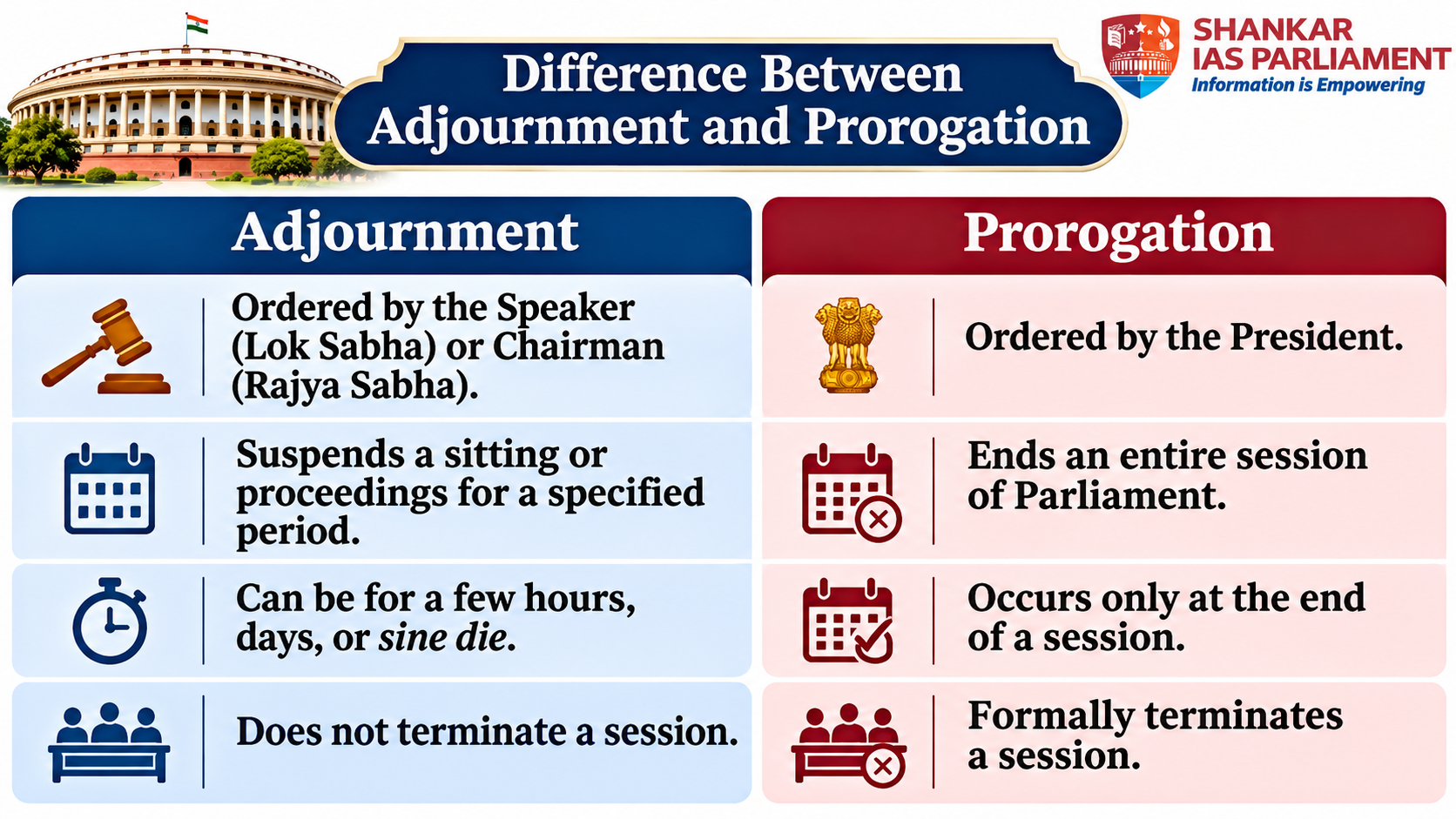
- Adjournment during a session – The Houses are adjourned from time to time during a session by the Speaker and Chairman in Lok Sabha and Rajya Sabha, respectively.
- Adjournment suspends the proceedings of the House for a specified period.
- Adjournment Sine Die – Usually on the last scheduled day of a session, the presiding officers adjourn the House sine die.
- It means the Houses have been adjourned indefinitely without a date being fixed for the next sitting.
- Prorogation of Parliament – After the Houses are adjourned sine die, the President, based on the advice of the Council of Ministers, prorogues the Houses at the end of each session.
- The term prorogued refers to the termination of one session, which usually happens within a few days of the Houses being adjourned sine die.
What is the current context?
- Longest gap between Adjournment & Prorogation – The monsoon session of Parliament was summoned from July 20 to August 13.
- However, even after the Houses have been adjourned sine die, they have not been prorogued by the President to date.
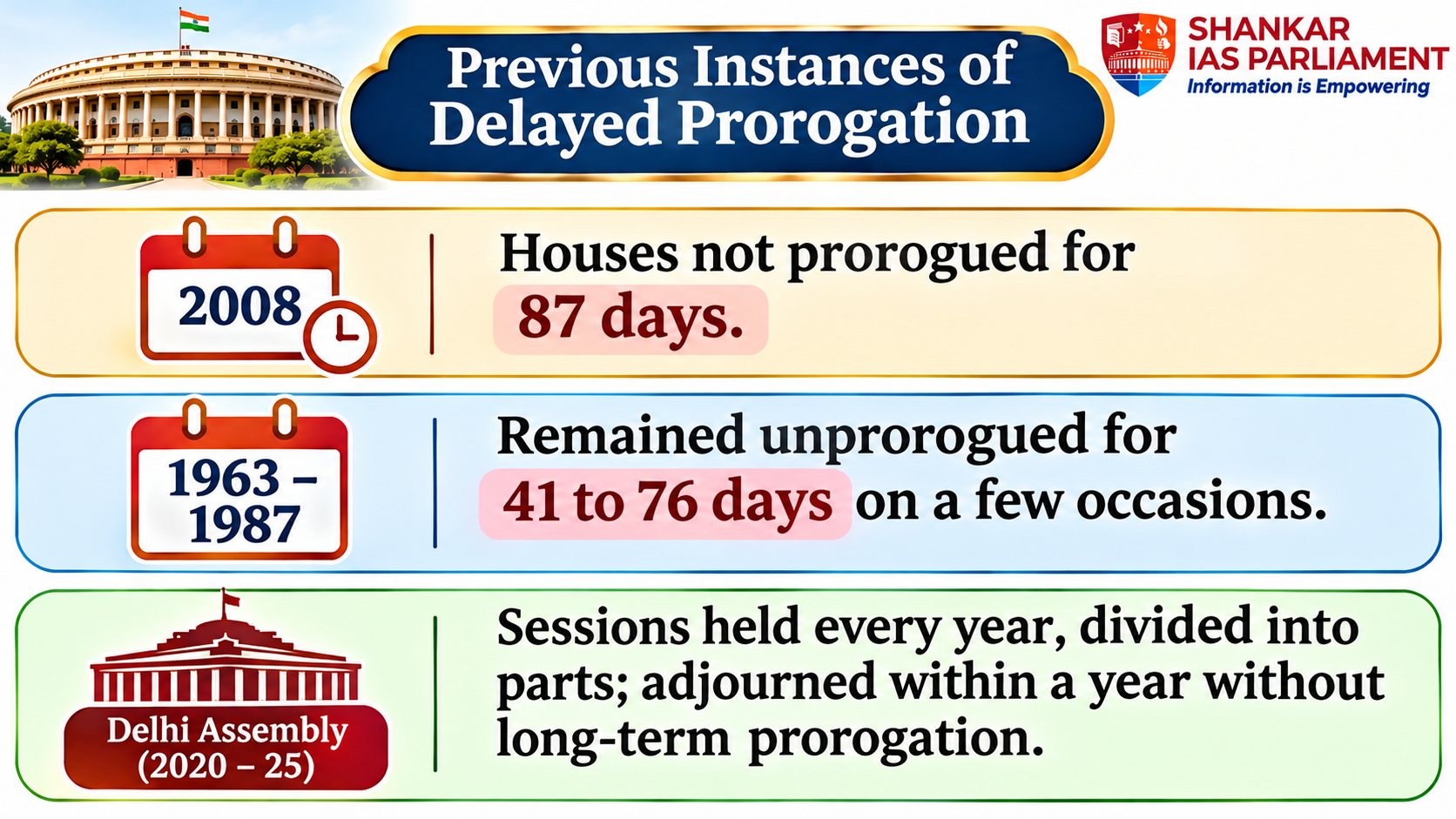
- This 100-day unprorogued period is the longest in Indian constitutional history.
- No minimum period for summons – Article 85 does not stipulate any minimum time period of notice for summoning a session of Parliament.
- Nevertheless, as per convention, there is at least 14 days’ notice that is provided before summoning a new session.
- Power to recall the Lok Sabha – On the other hand, Rule 15 of the Lok Sabha rules stipulates that the Speaker may call for a sitting of the House at any time after it has been adjourned sine die, provided the House has not been prorogued.
- Similar provision in the Rajya Sabha – The Rajya Sabha rules provide that the House shall sit on such days as the Chairman may from time to time direct.
- Like the Lok Sabha, this power can be exercised before prorogation.
- Short notice possible before prorogation – Neither the Lok Sabha nor Rajya Sabha rules specify a minimum notice period for reconvening a House after adjournment sine die.
- As a result, the presiding officers can convene a sitting at very short notice, sometimes with only two days' notice.
- Why Delaying Prorogation Matters? – Keeping Parliament unprorogued provides the government with greater flexibility to reconvene either House quickly if urgent legislative or national matters arise.
- Once a House is prorogued, a fresh session must be formally summoned by the President, which generally follows the usual notice procedures.
What are the past instances and implications?
- Speculation over the delay in Prorogation – There was speculation that the cabinet has on purpose kept the monsoon session live without prorogation, in order to convene it at short notice to consider and pass the contentious constitution amendment bill relating to delimitation.
- Winter Session weakens the argument – This speculation lost relevance as the usual time for the Winter Session approached.
- With a regular session expected soon, there is less need to reconvene the Monsoon Session separately.
- Parliamentary Privileges continue – It is to be noted that the members of Parliament or State legislatures would continue to enjoy their Parliamentary privileges even during such unprorogued periods.
- Declining number of Parliamentary Sitting days – In the midst of all these debates, one should not lose sight of the pertinent fact that the average number of annual sitting days of Parliament has reduced from around 135 days in the 1st Lok Sabha to 55 days at present.
- This should be increased, and the effective functioning of the houses ensured.
Reference
The Hindu | What does the Constitution say about proroguing Parliament?



