Prelims: Current Events of National and International Importance | Environment & Biodiversity
Why in News?
Wild sunflowers were reported in full bloom along roadsides in the Nilgiris in November 2026, particularly on routes connecting Udhagamandalam with Eppanadu and Kallatti.
- Location – Reported along roadsides in the Nilgiris district of Tamil Nadu, including the Ooty–Eppanadu and Ooty–Kallatti routes.
- Seasonal flowering – The report describes a seasonal mass bloom of wild sunflowers; the Nilgiris also experiences flowering of wild dahlias, everlasting flowers, cherry blossoms and jacaranda at different times.
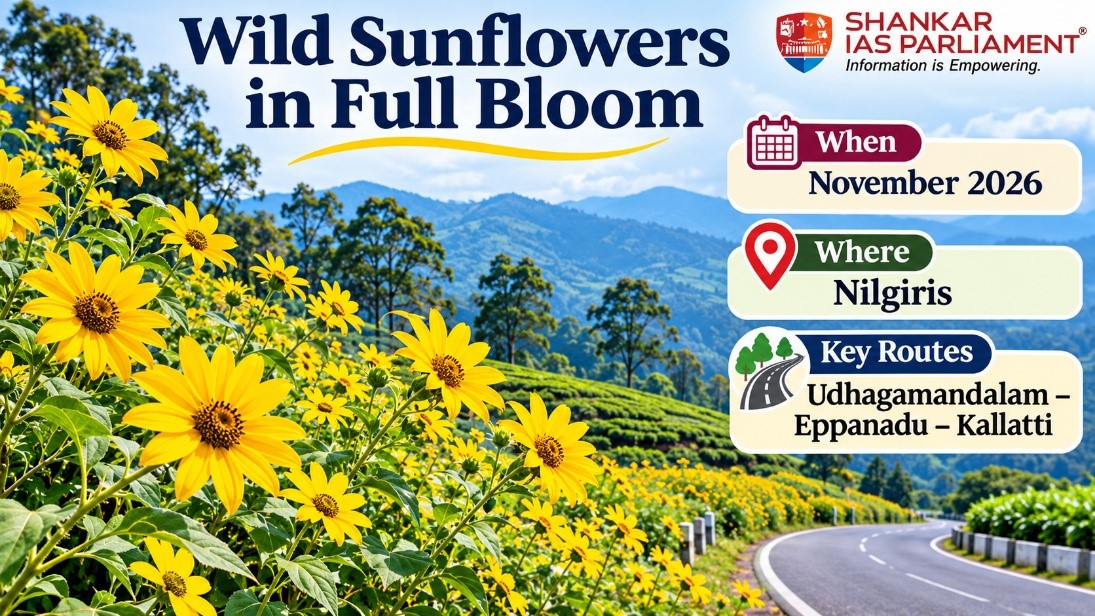
Wild Sunflower
- Scientific Name – Helianthus annuus.
- The wild sunflower is a branching annual plant native to North America and the wild ancestor of cultivated sunflowers.
- Family – Belongs to the Asteraceae (also called Compositae), commonly known as the aster/sunflower family.
- Habitat – It thrives in full sun and well-drained soils, commonly growing along roadsides, field edges, and open ground.
- Appearance – Unlike domesticated varieties bred for a single giant head, wild plants grow multiple branches with numerous smaller, 2-to-5-inch yellow blooms.
- Growth – It reaches roughly 2 to 10 feet tall with rough, hairy stems and leaves.
- Blooms – Produces many daisy-like flower heads with yellow rays and dark centres.
- Inflorescence – A sunflower “head” is a capitulum: numerous small florets are arranged on a common receptacle.
- Outer ray florets are showy; central disc florets are generally fertile.
- Pollination & movement – Young sunflower buds show heliotropism (tracking the Sun); mature flower heads generally remain east-facing. Insect pollinators, including bees, visit the flower heads.
- Phytoremediation – Sunflower has been studied for its capacity to take up certain contaminants, including heavy metals, from soil; this is a plant-based remediation approach.
- Ecological Role & Uses – It supports bees, butterflies, and birds that feed on its nectar and seeds.
- It offers drought tolerance and disease resistance for breeding programs, though it can act as a weed in crop fields.
Reference
The Hindu | Wild Yellow Flowers in the Nilgiris



