0.1346
7667766266
x

UNEP Recognises India's Ganges River Dolphin Recovery Programme

iasparliament Logo
October 31, 2026

Prelims: Current events of national and international importance | Environment

Why in News?

Recently, the UNEP recognised India’s Ganges River Dolphin Recovery Programme as a world restoration flagship.

  • The programme was named one of 35 UN World Restoration Flagships for its impact on ecosystem restoration, biodiversity conservation, and job creation.
  • Recognised in – UNEP’s report titled "Nature's Comeback – Scaling Ecosystem Restoration for People and Planet."
  • Jointly published by
    • UNEP – United Nations Environment Programme.
    • FAO – Food and Agriculture Organization of the United Nations.
    • Secretariat of CBD – Convention on Biological Diversity.

UN World Restoration Flagships

  • The initiative recognises large-scale ecosystem restoration projects worldwide.
  • It highlights successful restoration efforts that support biodiversity conservation, climate resilience, and sustainable livelihoods.
  • The report identifies 35 flagship initiatives globally.

India's Ganges River Dolphin Conservation Programme
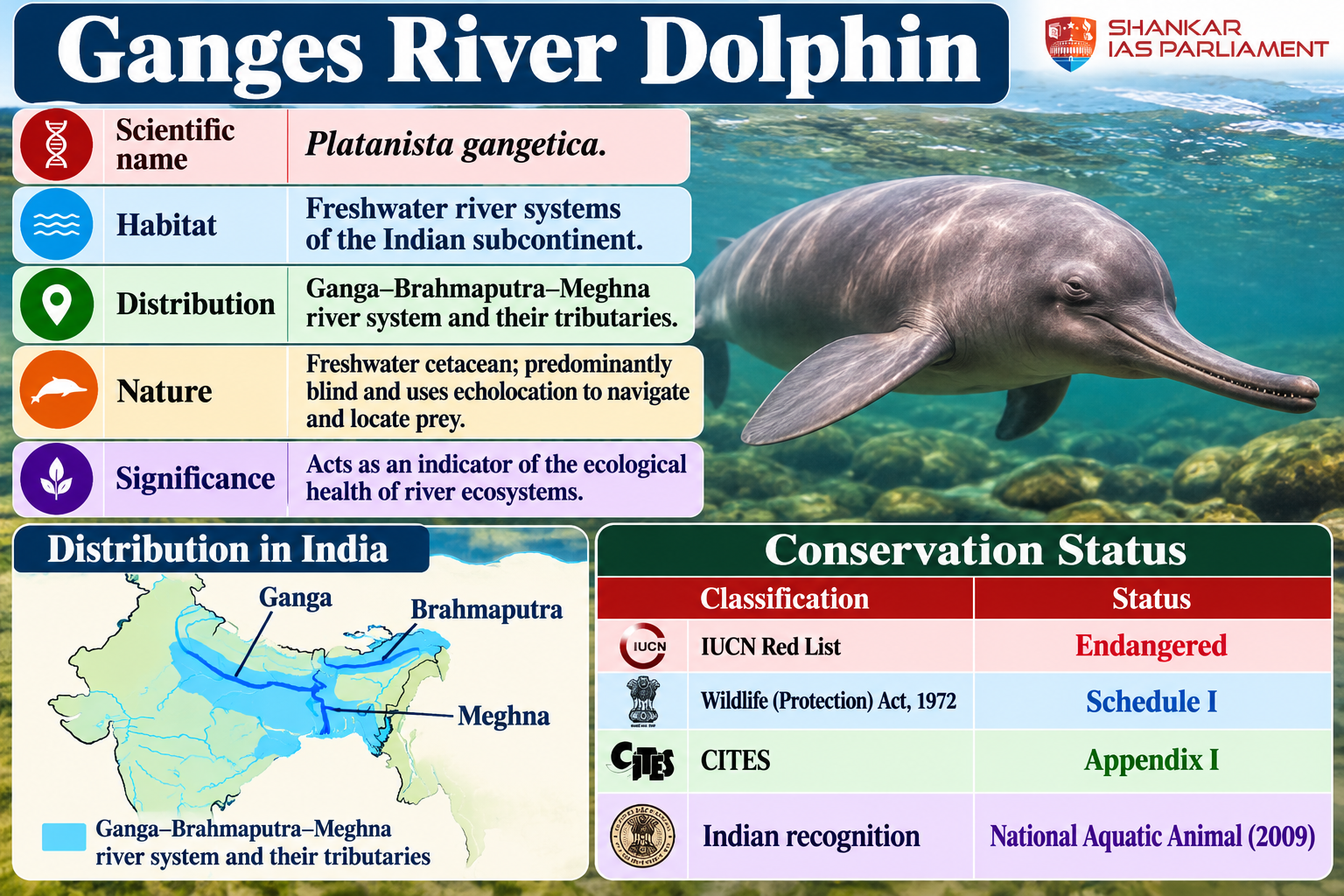
  • Comprehensive Action Plan (2022–2047)
    • India has launched a long-term Comprehensive Action Plan for dolphin conservation, spanning 2022 to 2047.
    • It focuses on the recovery and conservation of river dolphins.
  • Significance
    • It promotes biodiversity conservation and species recovery.
    • It supports the restoration of river ecosystems.
    • The initiative generates green employment opportunities.
    • It improves the ecological health of freshwater habitats.

https://www.shankariasparliament.com/uploads/files/ganges-river-dolphin-conservation-infographic.png

UNEP Report – Major Global Findings

  • Global Restoration Progress
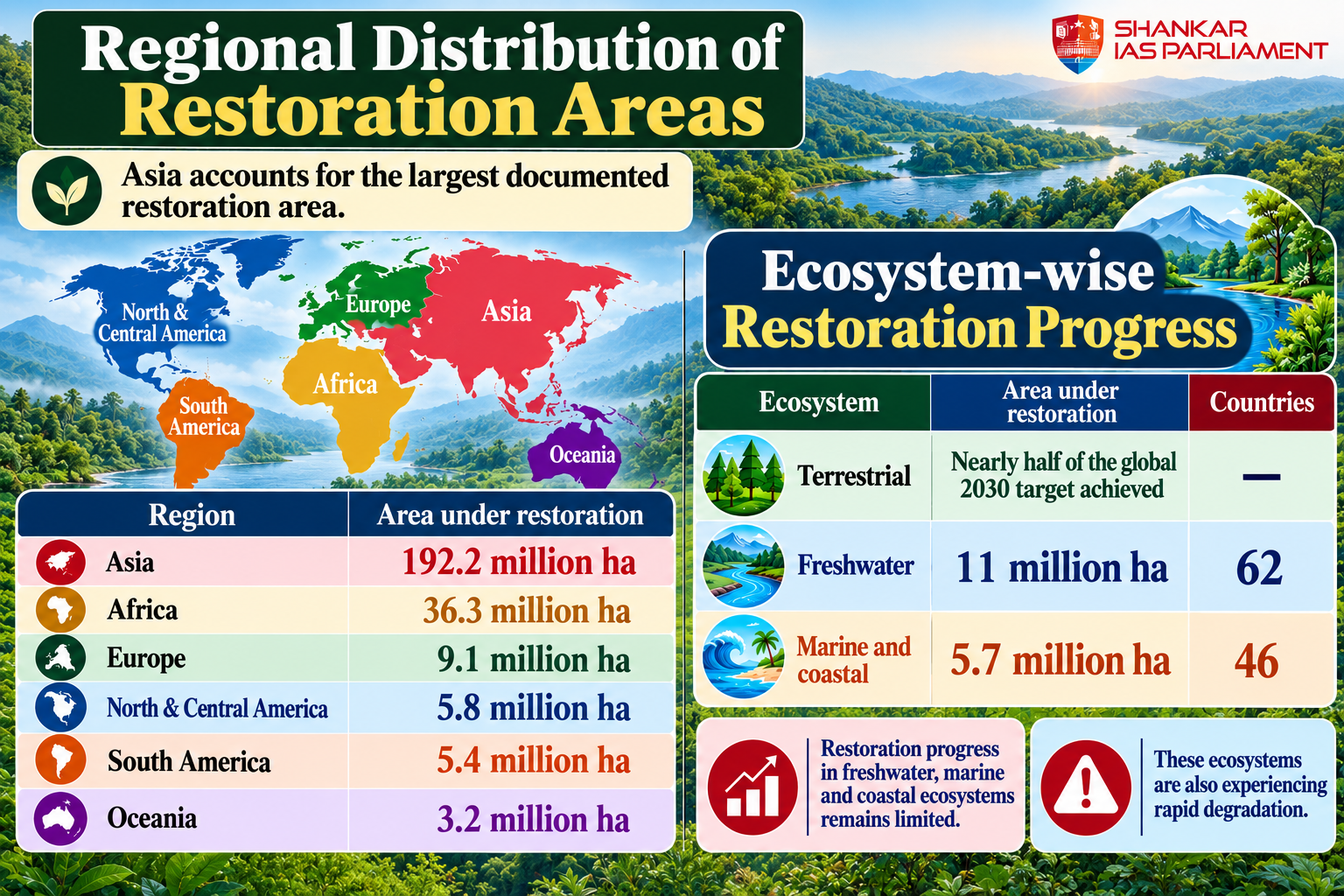
    • Ecosystem restoration spans 252 million hectares across 149 countries, making it the largest documented global restoration effort.
    • Restoration initiatives have created over 1 million green jobs worldwide.
  • Ecosystem Restoration Potential
    • Restoring 15% of global priority areas could capture and store 30% of historical CO₂ emissions since the Industrial Revolution.
    • It could also help prevent 60% of species extinctions worldwide.
  • Country-level Progress
    • China possesses the largest terrestrial area undergoing restoration, totaling 127.4 million hectares.
    • Substantial areas of restoration have also been documented in Mongolia and Kazakhstan.

regional-restoration-areas-infographic.png

Other Species Recovery Initiatives Mentioned in the Report

Species

Region

Mountain Gorilla

East Africa

Jaguar

Brazil's Atlantic Forest

Golden-headed Lion Tamarin

Brazil's Atlantic Forest

Snow Leopard

Kyrgyzstan

Saiga Antelope

Kazakhstan's Altyn Dala

Wild Horses

Kazakhstan's Altyn Dala


Global Frameworks

UN Decade on Ecosystem Restoration (2021–2030)

  • The initiative is led by the United Nations Environment Programme (UNEP) and the Food and Agriculture Organization (FAO).
  • The primary objective is to prevent, halt, and reverse ecosystem degradation on a global scale.
  • It promotes the restoration of degraded terrestrial, freshwater, and marine ecosystems.

Kunming–Montreal Global Biodiversity Framework (2022)

  • This framework was adopted at the fifteenth meeting of the Conference of the Parties to the Convention on Biological Diversity (CBD COP15).
  • Target 2 aims to ensure that by 2030, at least 30 percent of degraded terrestrial, inland water, marine, and coastal ecosystems are under effective restoration.

Global Restoration Target

  • The global commitment encompasses the restoration of approximately one billion hectares of degraded ecosystems.

Reference

IE | UNEP Honours India’s Ganges Dolphin Recovery

There are no reviews yet. Be the first one to review.

ARCHIVES

sidetext