Prelims: Current events of National and International Importance| Science & Technology
Why in News?
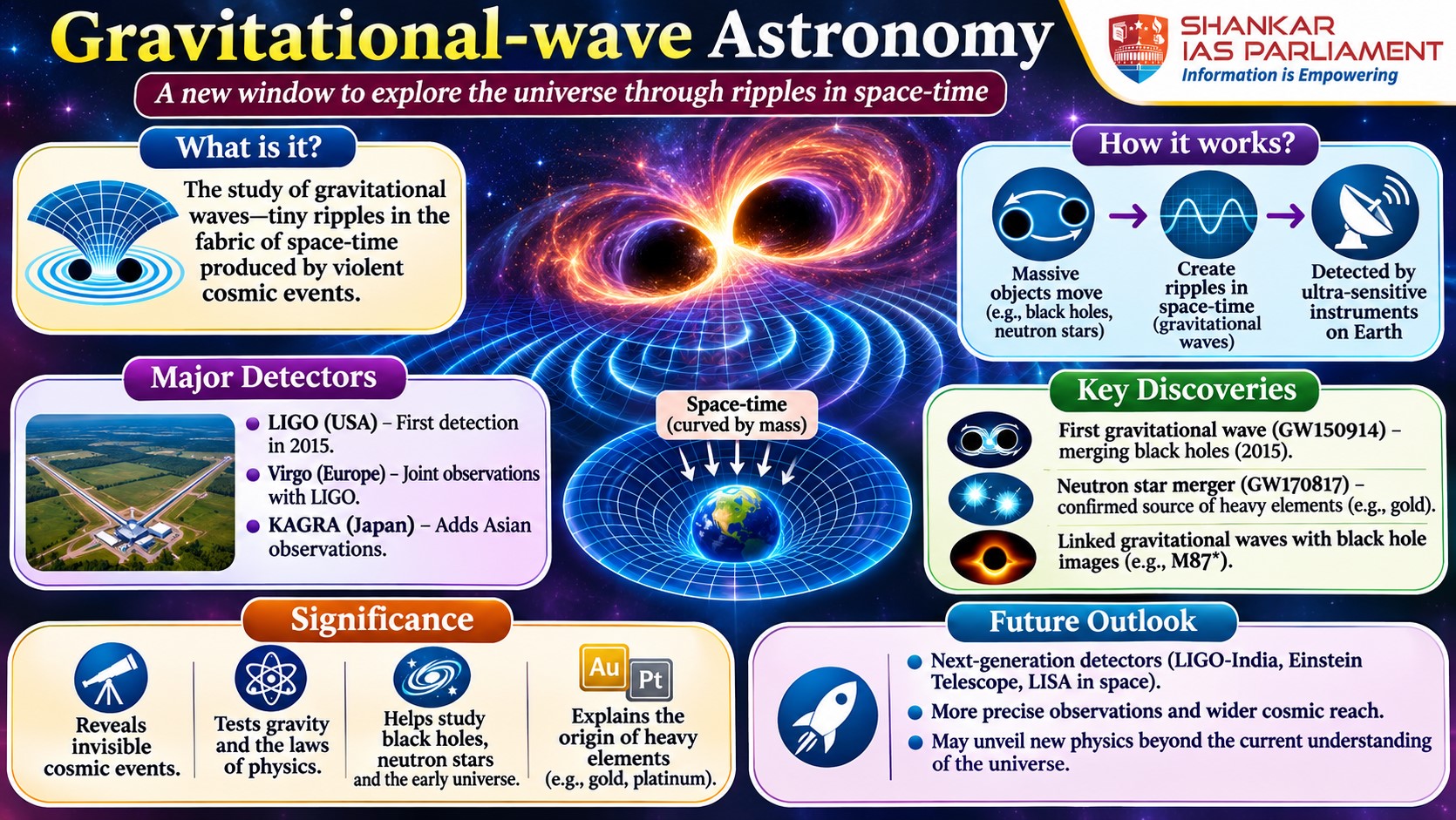
Gravitational-wave astronomy has officially transitioned into its statistical era, moving past isolated, one-off detections to analyzing large-scale patterns across a massive catalogue of hundreds of events.
- The 390-Event Catalogue– The field's data bank has expanded to 390 candidate events (including 161 newly detailed signals) collected collaboratively by the LIGO (United States), Virgo (Italy), and KAGRA (Japan) detector networks.
- Population-Level Insights– Instead of just dissecting individual black hole or neutron star collisions, researchers can now use statistical distributions to map out how stellar and black hole populations rise, fall, and evolve across cosmic time.
- High-Precision Localization & Physics Tests– Recent runs have yielded ultra-precise sky localizations (such as signal GW 240615 narrowed down to 6 square degrees) and high signal-to-noise detections like GW250114, which verified black hole overtones, Einstein's general relativity, and Stephen Hawking’s 1971 area theorem.
Reference
The Hindu| Transition of Gravitational-wave astronomy



