Prelims: Current events of national and international importance | Geography
Why in News?
Recently, National Oceanic and Atmospheric Administration (NOAA) has warned that the ongoing El Niño could intensify into a super El Niño, raising concerns over India’s monsoon performance.
ENSO (El Nino–Southern Oscillation) cycle
- It is a natural, recurring climate pattern characterized by fluctuations in ocean temperatures and atmospheric pressure across the Equatorial Pacific Ocean.
- It significantly alters global weather, temperatures, and rainfall.
|
3 – Phases
|
|
El Nino – The Warm Phase
|
|
La Nina – The Cool Phase
|
|
ENSO-Neutral
|
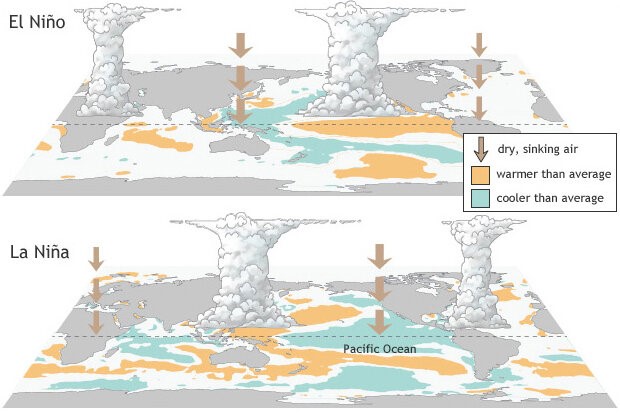
El Nino
- El Nino - El Nino is a naturally occurring climate phenomenon characterized by warmer-than-average sea surface temperatures in the central and eastern tropical Pacific Ocean.
- Super El Nino – Exceptionally strong warming episodes with adverse climatic impacts.
|
Temperature
|
|
0.5 to 1 degree Celsius – Weak
|
|
1 to 1.5 – Moderate
|
|
1.5 to 2 – Strong
|
|
Beyond 2 degrees – Very strong (Super).
|
- Process – Weak trade winds fail to push warm water west, causing the eastern Pacific to heat up and warmer water further weakens winds, amplifying El Nino.
- Climate Change – A warmer baseline ocean adds extra heat, making recent events stronger than earlier ones.
- Past events – Crossed the 2° threshold — 1972-73, 1982-83, 1997-98 and 2015-16 (extreme draughts).
Impact on India’s Monsoon
- Rainfall Deficit – About 15 El Nino years since 1950 saw below‑normal monsoon;
- Distribution Issues – Delayed onset, prolonged dry spells, and uneven rainfall more damaging than overall reduction.
- Agriculture Economy – Deficient monsoon affects food security, crop yields, and fiscal planning.
- El Nino yearly cycle — Developing in spring, peaking in winter, and fading by next spring.
- Its impact on India’s monsoon is felt mainly July–September, not June., a dry June (35% deficit) doesn’t guarantee monsoon failure.
- Indian Ocean Dipole (IOD) Role – Positive IOD can offset El Nino drying. Current forecasts suggest weak IOD, limiting buffering capacity.
Global Impact
- Extreme Events – Past super El Ninos linked to droughts in Australia, forest fires in Indonesia, coral bleaching and record global temperatures.
- Cyclones – Alters tropical cyclone distribution, suppresses Atlantic hurricanes but increases Pacific typhoons.
Reference
Super El Nino | The Hindu



