China - Indian Ocean Region Forum
China convened the first ‘China-Indian Ocean Region Forum’ bringing together 19 countries from the region except India.
- The first Indian Ocean Region Forum on Development Cooperation (IORFDC) was held in Kunming city in China.
- Representatives from 19 countries including all countries from South Asia except India attended this event.
- The forum was organised by the China International Development Cooperation Agency (CIDCA), China’s new development aid agency.
- In this forum, China proposed to establish a marine disaster prevention and mitigation cooperation mechanism between China and countries in the Indian Ocean region (IOR).
- China also proposed the establishment of a blue economy think tank network for China and countries in the IOR.
- The new China-led forum could be seen as a counter measure to India’s IORA
Indian Ocean Rim Association
- The Indian Ocean Rim Association (IORA) is a dynamic inter-governmental organization.
- It is aimed at strengthening regional cooperation and sustainable development within the Indian Ocean region.
- It has 22 Member States and 10 Dialogue Partners.
- IORA’s apex body is the Council of Foreign Ministers (COM) which meets annually.
References
- The Hindu - China’s Indian Ocean forum: India lone absentee
- Hindustan Times - China gathers India Ocean countries for forum
PSLV-C54
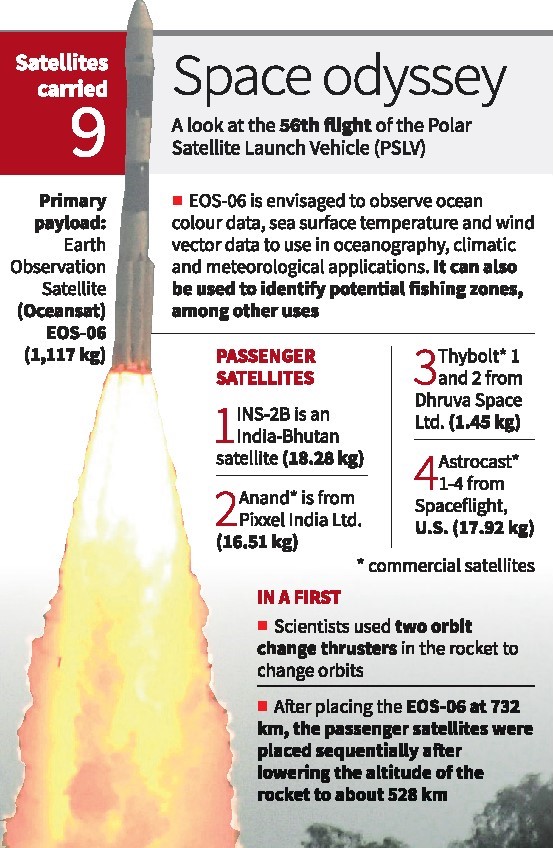
ISRO’s PSLV-C54 placed Earth Observation Satellite (EOS-06) and eight co-passenger satellites in orbits.
Significance of PSLV-C54
- It is one of ISRO’s longest missions, where it successfully placed nine satellites, including EOS-06 in multiple orbits.
- For the first time, ISRO used two orbit change thrusters in the PSLV rocket to change orbits.
- The mission placed satellites in two different sun synchronous orbits.
The other 7 commercial satellites (Astrocast 1-4 from the US, Thybolt -1&2 and Anand) were roped in for launch via NSIL.
India-Bhutan SAT
- The ISRO NanoSatellite-2 for Bhutan (INS-2B) was built by the joint collaboration of Indian scientist and Bhutanese scientists.
- The INS-2B has two payloads and will provide high-resolution images to Bhutan for the management of the country’s natural resources.
OCEANSAT-3
- The Earth Observation Satellite-6 (EOS-06) is the third-generation satellite in the Oceansat series.
- This is to provide continuity services of Oceansat-2 spacecraft with enhanced payload specifications as well as application areas.
- EOS-06 is envisaged to observe ocean colour data, sea surface temperature and wind vector data to use in oceanography, climatic and meteorological applications.
- The satellite also supports value added products such as potential fishing zone using chlorophyll, SST and wind speed, and land based geophysical parameters.
- So far India has launched several Ocean Observatory Satellites including Oceansat series.
References
- The Hindu - PSLV-C54 places earth observation satellite in orbit
- Hindustan Times - ISRO successfully launches India-Bhutan SAT
- Indian Express - PSLV-C54 carried earth observation satellite
- ISRO - PSLV-C54/EOS-06 Mission
Sacred Grooves
The Tamil Nadu’s Hindu Religious and Charitable Endowments (HR & CE) Department, which administers 1,500 temples in the arid northern region, have started recreating sacred groves to protect the forest patches.
- Sacred forests or groves comprise patches of natural vegetation from a few trees to several acres that are dedicated to local deities or tree spirits.
- These spaces are protected by local communities because of their religious beliefs and traditional rituals that run through several generations.
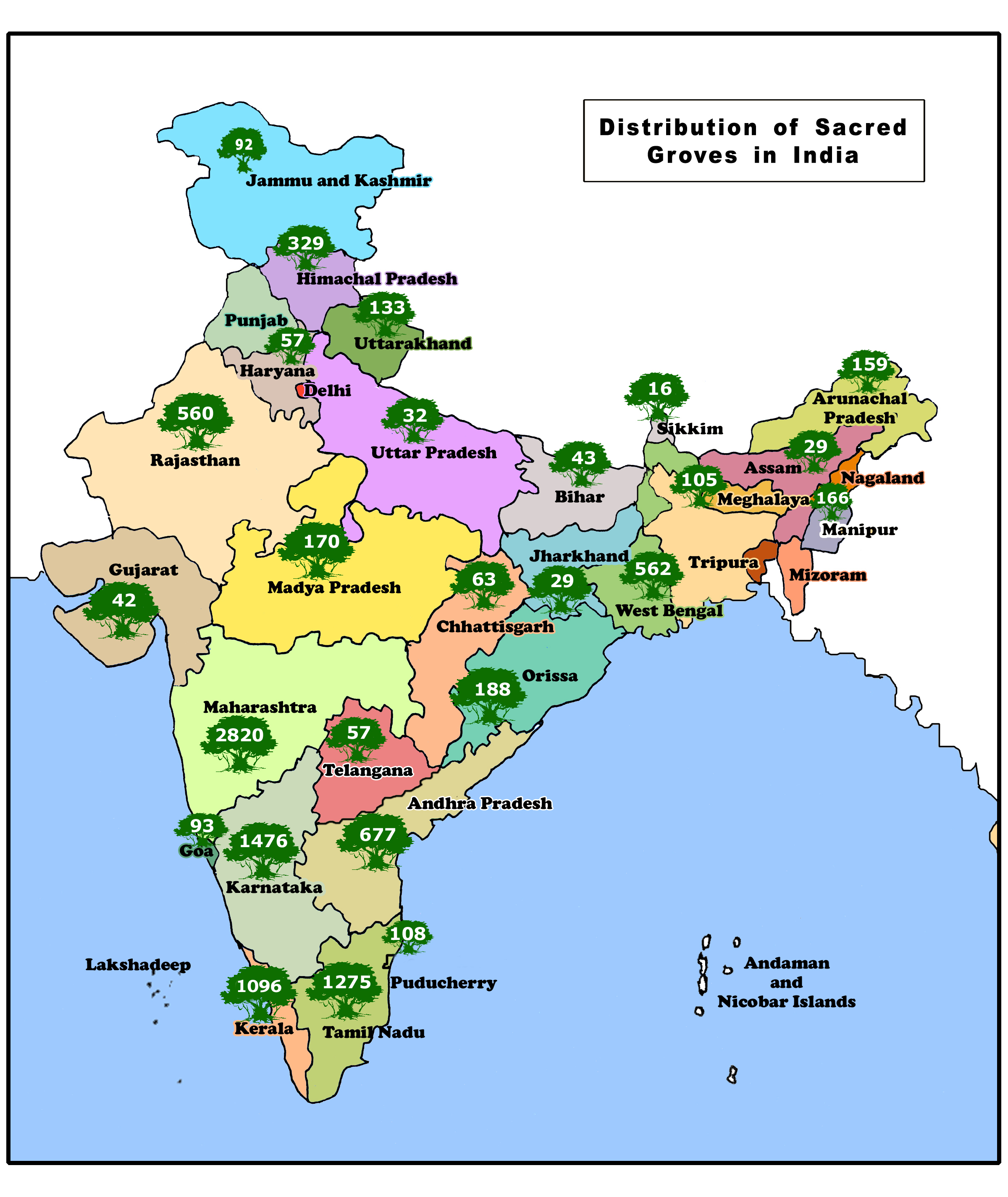
- In India, sacred groves are found all over the country and abundantly along the Western Ghats.
- The degree of sanctity accorded to the sacred groves varies from one area to another. Eg: In some forests, even the dry foliage and fallen fruits are not touched.
|
Significance
|
Threats
|
- The vegetation cover of the sacred groves improves the soil stability of the area and prevents soil erosion.
- They are important repositories of floral and faunal diversity that have been conserved by local communities in a sustainable manner.
- The groves are often associated with ponds, streams or springs and the vegetative cover helps in the recharging aquifers.
|
- Disappearance of the traditional belief systems.
- Transformation of the primitive forms of nature worship into formal temple worship.
- Rapid urbanization and developmental interventions.
- Invasion by exotic weeds and commercial forestry.
- Increasing livestock grazing and fuelwood collection.
|
References
- The Hindu - Recreating sacred groves in Tamil Nadu
- ENVIS – Sacred Forests
Bluebugging
Apps that let users connect smartphones or laptops to wireless earplugs can record conversations, and are vulnerable to hacks.
- Bluebugging is a form of hacking that lets attackers access a device through its discoverable Bluetooth connection.
- Once a device or phone is bluebugged, a hacker can listen to the calls, read and send messages and steal and modify contacts.
- Susceptible Devices - Any Bluetooth-enabled device can be bluebugged.
- Wireless earbuds are more susceptible to such attacks and can record conversations.
Process of bluebugging
- It works by exploiting Bluetooth connectivity in devices by pairing with the device via Bluetooth.
- For bluebugging to happen, the device’s Bluetooth must be in discoverable mode.
- Once a connection is established between the hacker and the device, hackers can use brute force attacks to bypass authentication.
- They can install malware in the compromised device to gain unauthorised access to it.
Other Bluetooth cyber-attacks
- There are 3 main Bluetooth cyber-attack types - Bluebugging, Bluejacking and Bluesnarfing.

References
- The Hindu -What is bluebugging?
UNESCO Asia-Pacific Awards
The heroic restoration of the Chhatrapati Shivaji Maharaj Vastu Sangrahalaya Museum in India, has received the Award of Excellence in UNESCO Asia-Pacific Awards 2022 for Cultural Heritage Conservation.
- The UNESCO Asia-Pacific Awards for Cultural Heritage Conservation programme is awarded every year since 2000.
- It has been recognizing the efforts of private individuals and organizations in restoring, conserving, and transforming structures and buildings of heritage value in the region.
- In 2022, 13 projects from 6 countries have been acknowledged for awards, including 4 from India.
|
Heritage property Awarded
|
Award
|
|
Chhatrapati Shivaji Maharaj Vastu Sangrahalaya Museum, Mumbai
|
Award of Excellence
|
|
Stepwells of Golconda Fort, Hyderabad
|
Award of Distinction
|
|
Domakonda Fort, Telangana
|
Award of Merit
|
|
Byculla Station, Mumbai
|
Chhatrapati Shivaji Maharaj Vastu Sangrahalaya Museum
- The Chhatrapati Shivaji Maharaj Vastu Sangrahalaya Museum (CSMVS) is a part of the ‘Victorian gothic and art deco ensembles of Mumbai World Heritage Site’ in India.
- The museum got the award for its impressive restoration of a major civic institution in the historic city of Mumbai.
- The museum was established as the Prince of Wales Museum of Western India in 1922.
- The premier art and history museum is an autonomous institution unaided by the government but supported by public-private partnerships.
Stepwells of Golconda
- The 17th century Qutb Shahi tombs complex which comprises several stepwells (baoli), is located near the Golconda fort in Telangana.
- The Idgah baoli (stepwell) is among the 7 wells inside the Qutb Shahi tombs complex that was restored as part of the conservation effort.
Domakonda Fort
- The Domakonda Fort is a private property and was built in the 18th century with an amalgam of styles including stucco work, arched pillars, flat ceiling, and a courtyard with a water garden pond.
Byculla Station
- The Byculla railway station in Mumbai is part of Central Railways, received an award of merit for its conservation efforts.
References
- UNESCO Asia-Pacific Awards for Cultural Heritage Conservation
- The Hindu - Restoration of Mumbai's century-old museum
- Indian Express – CSMVS wins UNESCO award for conservation



