Domestication of Chickens
Researchers have found that an association with dry rice farming likely started a domestication process, which has led to chickens becoming one of the world’s most numerous domesticated animals.
- Previous efforts claimed that
- Chickens were domesticated up to 10,000 years ago in China, Southeast Asia, or India, and
- Chickens were present in Europe over 7,000 years ago.
- The new studies show these claims are wrong.
- It says that the driving force behind chicken domestication was the arrival of dry rice farming into south-east Asia where their wild ancestor, the arboreal red jungle fowl (Gallus gallus spaedicus) lived.
The red jungle fowl is a tropical bird in the pheasant family. Charles Darwin first proposed that chickens may have descended from the red jungle fowl because of their similar appearances.
- Dry rice farming acted as a magnet drawing wild jungle fowl down from the trees and thereby kick-starting domestication of the jungle fowl.
- This domestication process was underway by around 1,500 BC (Bronze Age) in the Southeast Asia peninsula.
- The research suggests that chickens were then transported first across Asia and then throughout the Mediterranean Europe along routes used by early Greek, Etruscan and Phoenician maritime traders.
- Another study found that the domesticated fowl arrived in Mediterranean Europe around 2,800 years ago and then appeared in Africa 1,100 and 800 years ago.
- Reason - Archeologists have found people being buried with chickens, rather than discarded as scraps, making a domestic relationship clear.
- Because the birds were buried with humans, it suggested that they had a cultural or social significance and were sacred creatures instead of a food source.
- This means that a desire for meat did not drive the domestication of the chicken.
The oldest bones of a definite domestic chicken were found at Neolithic Ban Non Wat in central Thailand, and date to between 1,650 and 1,250 BC.
Reference
- https://www.thehindu.com/sci-tech/when-and-where-were-chickens-domesticated/article65537060.ece
- https://www.smithsonianmag.com/smart-news/researchers-pinpoint-date-when-chickens-were-first-domesticated-180980212/#:~:text=The%20earliest%20chicken%20remains%20came%20from%20between%201650%20B.C.E.%20and,years%20ago%2C%20Science%20News%20reports.
- https://www.pnas.org/doi/10.1073/pnas.2121978119
Darjeeling Himalayan Railway
The Darjeeling Himalayan Railway has recorded its highest ever monthly revenue generation.
- The Darjeeling Himalayan Railway (DHR) or the Toy Train is a 141-year-old mountain railway system that started operating in 1881.
- Located in the foothills of the Himalayas, it is a 2-ft gauge railway that runs in West Bengal.
- This railway system comes under the Guwahati-headquartered Northeast Frontier Railway (NFR).
- The NFR currently operates a daily service between New Jalpaiguri and Darjeeling and 12 joyride services between Darjeeling and Ghum (India’s highest railway station).
- The DHR also introduced special services such as Steam Jungle Tea Safari, Red Panda and Him Kanya.
- The DHR is a UNESCO World Heritage Site since 1999.
|
Mountain Railways Declared as UNESCO World Heritage Sites
|
|
Darjeeling Himalayan Railway
|
West Bengal (1999)
|
|
Nilgiri Mountain Railways
|
Nilgiri Hills of Tamil Nadu (2005)
|
|
Kalka Shimla Railway
|
Himalayan foothills of Himachal Pradesh (2008)
|
Reference
- https://www.thehindu.com/todays-paper/tp-miscellaneous/tp-others/record-earnings-for-darjeeling-toy-train/article65555424.ece
- http://dhr.in.net/about-us.php
- https://darjeeling.gov.in/tourist-place/joy-ride-in-darjeeling-himalayan-railway-popularly-known-as-toy-train-from-darjeeling-to-darjeeling-via-batasia-loop-ghoom/
Zmiinyi Island
Ukraine has caused “significant losses” to the Russian military in airstrikes on the Zmiinyi Island in the Black Sea.
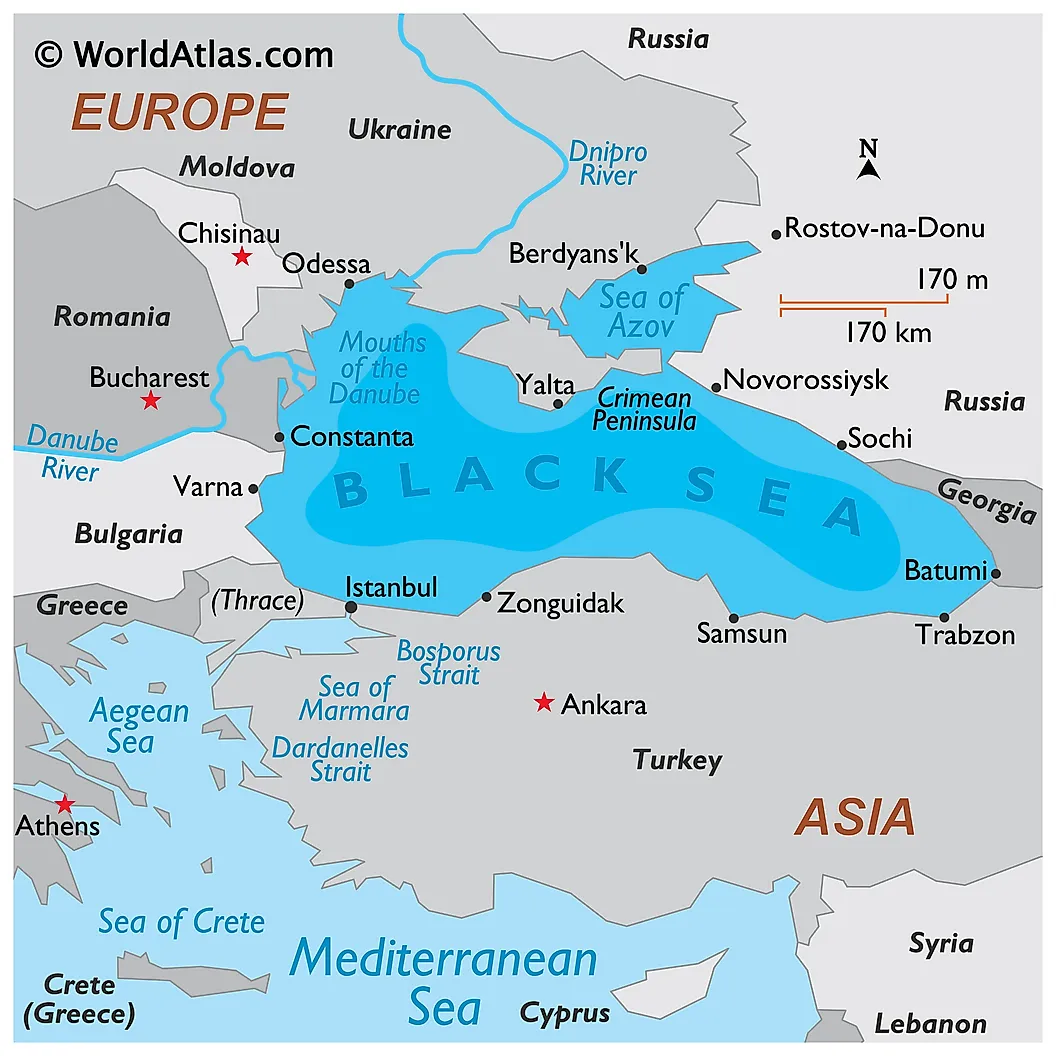
- Located in the Black Sea, the Zmiinyi Island is also known as the Snake Island or the Serpent Island.
- It is a small piece of rock less than 700 metres from end to end.
- It belongs to Ukraine.
- The island has been known since ancient times and is marked on the map by the village of Bile that is located on it.
- Snake Island lies close to the mouth of the River Danube, which delineates Romania's border with Ukraine.
- It is also roughly to the southwest of the port city of Odessa.
The Black Sea
- The Black Sea is an inland sea situated at the south-eastern extremity of Europe.
- It is bound by Ukraine to the north and northwest, Russia to the north east, Georgia to the east, Turkey to the south, and Bulgaria and Romania to the west.
- It is connected to the Atlantic Ocean by the Bosporus, the Sea of Marmara, the Dardanelles, the Aegean Sea, and the Mediterranean Sea.
- The Crimean Peninsula thrusts into the Black Sea from the north, and just to its east the Kerch Strait links the sea to the smaller Sea of Azov.
- Features - The Black Sea is a remarkable feature because its lower levels are almost biologically dead—not because of pollution but because of continued weak ventilation of the deep layers.
- It has traditionally been Russia’s warm water gateway to Europe.
- History - The ancient Greeks named the sea - then on the fringe of the Mediterranean world - as the Pontus Axeinus (Inhospitable Sea).
- As later explorations revealed that the shores of the sea are more hospitable and friendly, the Greeks changed its name to Pontus Euxinus, the opposite of the earlier designation.
- In the past, the Turks called it the Karadenız, as they only saw the inhospitable aspect of the Black Sea.
- Related Links - Aegean Sea, Montreux Convention
Reference
- https://indianexpress.com/article/explained/everyday-explainers/explained-importance-snake-island-black-sea-ukraine-bombed-russia-7985298/
- https://www.britannica.com/place/Black-Sea
- https://www.bbc.com/news/world-europe-61406808
Pragati Maidan Integrated Transit Corridor Project
The Prime Minister dedicated to the nation the main tunnel and 6 underpasses of Pragati Maidan Integrated Transit Corridor Project.
- The Pragati Maidan Integrated Transit Corridor project is a part of the ITPO-Pragati Maidan Redevelopment Project.
- Started in 2017, the project has been entirely funded by the Central Government.
- But, it was executed by the Delhi government's Public Works Department (PWD).
- The key aims of this project are,
- To de-congest traffic around the Pragati Maidan Trade Centre and
- To remove bottlenecks on Bhairon Marg, Ring Road, ITO-W point and Mathura Road and make it signal free.
- The main Tunnel connects Ring Road with India Gate via Purana Qila Road passing through Pragati Maidan.
- It will serve as an alternative route to Bhairon Marg.
- Along with the tunnel, there will be 6 underpasses - 4 on Mathura Road, one on Bhairon Marg and one on the intersection of Ring Road and Bhairon Marg.
Reference
- https://pib.gov.in/PressReleasePage.aspx?PRID=1835255
- https://www.business-standard.com/article/current-affairs/pragati-maidan-integrated-transit-corridor-to-cut-commute-time-by-15-mins-122061900592_1.html#:~:text=According%20to%20a%20statement%20from,by%20the%20Delhi%20government's%20PWD.
- https://indianexpress.com/article/explained/explained-the-new-corridor-project-the-purpose-it-will-serve-7979153/
New Advisory on Type-1 Diabetes
The Indian Council of Medical Research (ICMR) has published the country’s first-ever list of basic dos and don’ts to ensure the safety of Type-1 patients during travel.
As per the International Diabetes Federation, India has the highest number of incident and prevalent cases of Type-1 diabetes in the world.
- The ICMR guideline document provides advice on care of diabetes in children, adolescents and adults with Type-1 diabetes.
- This document states that individuals with Type-1 diabetes need support
- To survive, using insulin and other therapies, and
- To live their entire life without stigma, restrictions, or disabling complications due to their illness.
- The ICMR’s pre-travel advice for children and adolescents living with Type-1 diabetes includes,
- Never wearing brand new shoes for a trip, instead carry comfortable shoes to avoid straining the feet while on travel,
- Alternating between two pairs of shoes to decrease the risk of blisters and calluses,
- Travelling with flash cards to navigate language barrier,
- Storage of insulin and how to minimise glucose fluctuation.
- The patients should inform the physician in advance, preferably 4 to 6 weeks before the planned travel.
- They should have medications and blood testing materials for the whole trip plus reserve supplies for at least 2 to 4 weeks if unforeseen circumstances extend the travel.
- Patients with a medical identification bracelet should have information on the disease, use of insulin, and disclose any allergies.
Type-I Diabetes
- Type-I diabetes is a chronic condition in which the pancreas produces little or no insulin.
- It is once known as juvenile diabetes or insulin-dependent diabetes.
Insulin is a hormone needed to allow sugar (glucose) to enter cells to produce energy.
- Although type 1 diabetes usually appears during childhood or adolescence, it can develop in adults.
- Causes - The type 1 diabetes is thought to be caused by an autoimmune reaction (the body attacks itself by mistake).
- Usually, the body's own immune system mistakenly destroys the insulin-producing (islet, or islets of Langerhans) cells in the pancreas.
- Different factors may contribute to type-1 diabetes. These include,
- Genetics,
- Exposure to viruses and
- Exposure to other environmental factors.
Diet and lifestyle habits don’t cause type 1 diabetes.
- Symptoms include increased thirst, frequent urination, extreme hunger, unintended weight loss, fatigue, bed-wetting in children who previously didn't wet the bed during the night, and blurred vision.
- Despite active research, type 1 diabetes has no cure. Treatment focuses on managing blood sugar levels with insulin, diet and lifestyle to prevent complications.
Reference
- https://www.thehindu.com/todays-paper/tp-national/new-advisory-on-type-1-diabetes/article65521915.ece
- https://www.mayoclinic.org/diseases-conditions/type-1-diabetes/symptoms-causes/syc-20353011
- https://www.cdc.gov/diabetes/basics/what-is-type-1-diabetes.html



