Mangrove Alliance for Climate
At the 27th Session of Conference of Parties (COP27), the Mangrove Alliance for Climate (MAC) was launched with India as a partner.
- Mangrove Alliance for Climate (MAC) is an intergovernmental alliance that works on a voluntary basis for planting, conserving and restoring mangroves.
- Members – MAC is led by the United Arab Emirates (UAE) and Indonesia and includes India, Sri Lanka, Australia, Japan, and Spain.
- Aim - To educate and spread awareness worldwide on the role of mangroves in curbing global warming and its potential as a solution for climate change.
- Mangrove are trees and shrub that can live in intertidal water in coastal areas and host diverse marine life.
- They are mainly found in tropical and sub-tropical latitudes.
- Significance of Mangrove - Mangrove trees can grow in saline waters and are excellent carbon sinks.
- 80% of the global fish populations depend on mangrove ecosystems.
- Threats - infrastructure projects, shifting coastlines, coastal erosion and storms.
Mangroves can sequester up to 4 times more carbon than tropical rainforests.
India and mangrove
- India contributes to nearly half of the total mangrove cover in South Asia.
- Sundarbans is the world’s largest mangrove ecosystem in the world.
- The highest percentage of mangrove cover in India - West Bengal, Gujarat and Andaman and Nicobar islands.
- Maharashtra, Odisha, Andhra Pradesh, Tamil Nadu, Goa and Kerala too have mangrove.
References
- The Indian Express - What is the Mangrove Alliance for Climate?
- Business Standard - What is the Mangrove Alliance for Climate?
Vanuatu
Climate change is an existential threat in the islands of the Pacific says Vanuatu led group of small Pacific islands.
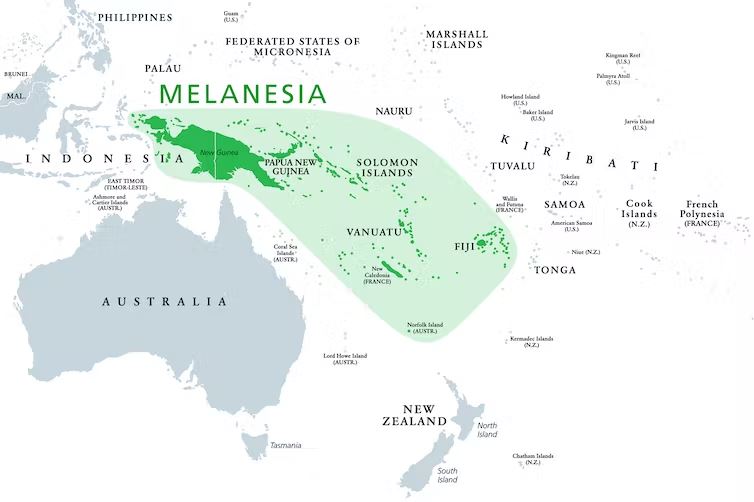
- Vanuatu, officially the Republic of Vanuatu, is a Melanesian island nation located in the South Pacific Ocean.
- The capital of the Republic of Vanuatu is Port Vila.
- Vanuatu is a Y-shaped archipelago of 83 islands and is north-east of Australia.
- Vanuatu is recognized as a distinct terrestrial ecoregion, known as the Vanuatu rain forests.
- Vanuatu is part of the Australasia Eco zone.
- Vanuatu is under existential threat affecting livelihoods, security and well-being due to climate change.
- Its sea level is rising at twice the average global rate, and would continue to rise through the 21st century.
- But, it contributes less than 0.0018% of global greenhouse gas emissions and is a carbon-negative country.
Melanesia
- Melanesia has about 2,000 islands in the South Pacific Ocean.
- Melanesia is a biodiversity hotspot and the climate of Melanesia is tropically humid.
- Bismarck Archipelago, Fiji, Maluku Islands, New Caledonia, New Guinea, Solomon Islands, Torres Strait Islands and Vanuatu are traditionally considered as part of Melanesia.
References
- Down To Earth - Why a chain of tiny Pacific islands wants an ICJ’s opinion
- The Hindu - Vanuatu’s big plea does little to arrest climate change
CE20 Cryogenic Engine
The Indian Space Research Organisation (ISRO) has successfully conducted the hot test of CE20 cryogenic engine.
- CE20 cryogenic engine is indigenously developed for LVM3.
- A 3D printed LOX and LH2 turbine exhaust casings were also inducted in the engine for the first time.
- The hot test was conducted at an uprated thrust level of 21.8 tonne for the first time.
- LVM-3 can carry up to 4 tonnes to a geostationary orbit and up to 6 tonnes to a Low Earth Orbit.
- This uprated thrust level will enhance the LVM3 payload capability up to 450 kg with additional propellant loading.
- LVM3 is the heaviest launch vehicle of ISRO.
LVM3 is a three-stage vehicle with two solid motor strap-ons, a liquid propellant core stage and a cryogenic upper stage.
References
- The Hindu - ISRO’s cryogenic engine passes hot test
- Hindustan Times - ISRO successfully conducts hot test of CE20 cryogenic engine
- ISRO - Successful CE20 uprated Engine Hot Test
African Carbon Markets Initiative
A new initiative putting carbon credits up for sale in African countries was launched during the COP27 to the UNFCCC in Egypt.
- Carbon Credit - A carbon credit is a special permit that gives the user or buyer express rights to emit a given amount of carbon dioxide or other greenhouse gases.
- Carbon credits trading is one of the many technical interventions used to reduce the amount or concentration of greenhouse gases in the atmosphere.
- Africa and Carbon credit - Africa currently produces only a tiny percentage of its carbon credit potential.
- Carbon markets unlock billions in climate finance needed to support economies of African countries.
- The Initiative - African Carbon Markets Initiative is led by a 13-member steering committee of African leaders, Chief Executive Officers (CEOs) and carbon credit experts.
- African Carbon Markets Initiative (ACMI) aims to
- Rally the world towards more ambitious climate action,
- Expand Africa’s participation in voluntary carbon markets and
- Create jobs while protecting biodiversity.
- Target - The African voluntary carbon markets targets to provide 300 million carbon credits every year by 2030 and 1.5 billion credits annually by 2050.
- The initiative intends to promote demand for
- Existing credits,
- Credits under development,
- Yet to come products and innovative project types.
- The carbon credit raised from ACMI would meet Africa’s contentious climate finance needs.
References
- Down To Earth - African countries launch ‘game-changing’ carbon credits initiative
- The Guardian - Nigeria, others launch new Africa carbon markets initiative at COP 27
LOFTID Mission
NASA completed the technology demonstration of its Low-Earth Orbit Flight Test of an Inflatable Decelerator (LOFTID) mission.
- The Low-Earth Orbit Flight Test of an Inflatable Decelerator (LOFTID) orbital flight test was the next step of the HIAD program.
- The LOFTID mission demonstrates the re-entry of the inflatable decelerator Hypersonic Inflatable Aerodynamic Decelerator (HIAD) from the Lower-Earth Orbit.
- In LOFTID a small re-entry vehicle is attached to the HIAD aeroshell.
- After reorienting towards earth, the shell inflates and separate from the upper stage of the rocket to enter the atmosphere.
- LOFTID demonstrates the inflatable aeroshell, heat shield’s ability to slow down and survive re-entry.
- LOFTID could potentially help land astronauts on Mars in the future.
HIAD Aeroshell
- Aeroshell is a type of heat shield used for atmospheric re-entry.
- Traditionally NASA relied on rigid aeroshells but over a decade has developed inflatable aeroshells.
- This inflatable aeroshell is called Hypersonic Inflatable Aerodynamic Decelerator (HIAD).
- HIAD is a large deployable inflatable aeroshell protected by a flexible heat shield.
- The inflatable structure is made with a stack of pressurised concentric rings that are strapped to form a cone-shaped structure.
- Advantages of HIAD - The HIAD allows to carry much heavier payloads.
- The drag is more than rigid aeroshell due to their large size.
- The deceleration process starting at higher altitudes than traditional aeroshells.
- The entire system is foldable, packable, and deployable thus take up less room on rockets.
- The technology is scalable to both crewed and large robotic missions to Mars.
References
- The Indian Express - NASA completes LOFTID technology demonstration
- The New York times - NASA Launched an Inflatable Flying Saucer
- NASA - Low-Earth Orbit Flight Test of an Inflatable Decelerator
- NASA - Hypersonic Test of Inflatable Decelerator



