National Party Status
The Aam Aadmi Party (AAP) became the ninth political outfit to secure national party status.
- The Election Commission of India (ECI) has laid down the technical criterion for a party to be recognised as a national party.
- A party may gain or lose national party status from time to time, depending on the fulfilment of these laid-down conditions.
- The ECI’s Political Parties and Election Symbols, 2019 handbook lays down the criteria for a party to be recognised as National Party.
- First a political Party has to be registered with ECI to be recognised as National or State party.
- Criteria for National Party Status - A party will be considered as a national party,
- If it is ‘recognised’ in four or more states; or
- If its candidates polled at least 6% of total valid votes in any four or more states in the last Lok Sabha or Assembly elections and has at least four MPs in the last Lok Sabha polls; or
- If it has won at least 2% of the total seats in the Lok Sabha from not less than three states.
- Criteria for State Party Status - A party will be recognised as a state party, if
- at least 6% vote-share in the last Assembly election and have at least 2 MLAs; or have 6% vote-share in the last Lok Sabha elections from that state and at least one MP from that state; or
- at least 3% of the total number of seats or three seats, whichever is more, in the last Assembly elections; or
- at least one MP for every 25 members or any fraction allotted to the state in the Lok Sabha; or
- have at least 8% of the total valid votes in the last Assembly election or Lok Sabha election from the state.
AAP as the 9th National Party
- The AAP party has already fulfilled the criteria for recognition as a state party in 3 states (Delhi, Punjab and Goa).
- In 2022 Gujarat Assembly elections, AAP got the required votes to be recognised as State Party.
- Gujarat will be the 4th state where AAP is recognised as State party fulfilling the criteria to be recognise AAP as a National Party.
- After being recognised as a national party, the AAP can claim ‘the broom’ as a reserved symbol for itself across the country.
- To know about how symbols are allocated to Recognised and registered parties, Click here
The other 8 National Parties in India
- BJP
- Congress
- Trinamool Congress
- CPI(M)
- CPI
- Nationalist Congress Party (NCP)
- Bahujan Samaj Party (BSP)
- Meghalaya’s National People’s Party (NPP) (recognised in 2019)
References
- India Express - National Party in India
- NDTV - How AAP Became A 'National Party'
- Deccan Herald - AAP to secure national party status
Atacama Desert
World’s trash piles up at Chile’s Atacama Desert making it the world’s dumping yard.
- Mountains of discarded clothes, shoes, and scrapped tires have been dumped in the Atacama Desert.
- These trash are mostly second-handed and unsold clothing from Europe, Asia, and the US.
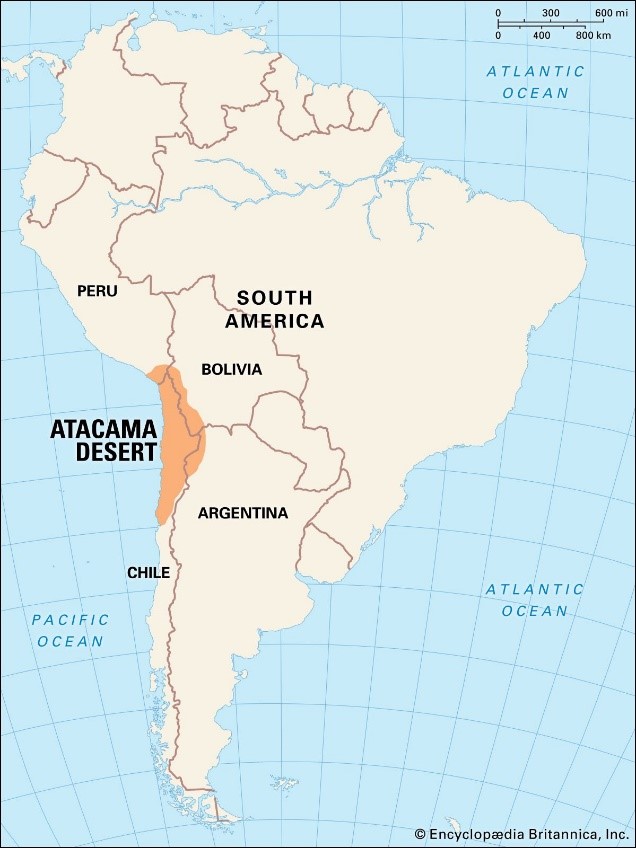
- Atacama Desert in Chile, South America lies to the west of Andes Mountains.
- The desert consists mainly of salt pans.
- The Atacama Desert is the driest nonpolar desert in the world.
- Though dry and arid the desert is relatively colder than other major non-polar deserts.
- The desert is extremely arid due to the cool north-flowing Humboldt Ocean current and to the presence of the strong Pacific anticyclone.
- The most arid region of the Atacama Desert is situated between the Andes and the Chilean Coast Range making it a two-sided rain shadow region.
- Blooming Desert - Atacama receives less than a millimetre of rain each year. It rarely receives heavy rainfall and a mass blooming happens after that.
- The ‘desierto florido’ (literally, ‘blooming desert’) phenomena occurs at the Atacama Desert on average once every 5-10 years, from mid-September to mid-November.
- Observatories – Due to cloud less sky and high altitude an array of observatories are located in this desert.
- Atacama Large Millimetre Array/submillimetre (ALMA) and European Space Observatory's Very Large Telescope are located in this desert.
References
- The Hindu - World’s trash piles up at Chile’s Atacama desert
- Live Science - About the Atacama Desert
- Hindustan Times - Atacama is blooming following heavy rains
Americium
The European Space Agency scientists are developing batteries made of Americium to power space missions.
- Americium (Am) is a synthetic chemical element of the actinoid series of the periodic table.
- It was the fourth transuranium element with atomic number 95.
- It is not found naturally in the environment and can be extracted from reprocessed nuclear fuel used in civil power plants.
- Americium has never been used as a fuel and now will be used to make new batteries.
- Americium, a by-product of plutonium decay is made into fuel pellets, which form the core of the batteries.
- This battery can be used as an alternative to solar cells in space.
- It is expected to operate space missions in the dark side of the Moon or areas far-off from the Solar System where solar power is limited.
Current batteries used in space rely on plutonium-238, which is challenging and expensive to produce.
Americium’s advantage over plutonium-238 (Pu-238)
- It is cheaper and more abundant.
- It has a longer half-life than Pu-238, so it lasts longer.
- It is also easier and less expensive to produce than Pu-238.
- Drawback - Unfortunately it also yields less potential energy than Pu-238.
References
- The Hindu - Battery from nuclear waste
- Nature - How nuclear waste will help spacecraft explore the Moon
- Live Science - Americium
Districts as Export Hub (DEH) Initiative
One District One Product Initiative (ODOP) is operationally merged with ‘Districts as Export Hub (DEH)’ Initiative.
- DEH is an initiative of the Directorate General of Foreign Trade (DGFT), Department of Commerce, with the Department for Promotion of Industry and Internal Trade (DPIIT) as a major stakeholder.
- Under the initiative, products and services (including GI products, agricultural clusters, toy clusters etc.) with export potential have been identified in all districts.
- Districts Export Action Plans are being prepared for identified products and services for overseas markets.
- These plans improves supply chains, market accessibility and handholding for increasing exports of identified products.
- Under DEH, State Export Promotion Committee (SEPC) and District Export Promotion Committee (DEPC) has been constituted in all the 36 States/UTs.
One District One Product (ODOP) Initiative
- Central Government has initiated One District One Product (ODOP) in all States/UTs of the country.
- It is a transformational step towards realizing the true potential of a district, fuelling economic growth, generating employment and rural entrepreneurship, taking us to the goal of Aatmanirbhar Bharat.
- ODOP has been identified for the prestigious Prime Minister’s Award for Excellence in Public Administration in Holistic Development in April, 2022.
References
- PIB - ODOP merged with DEH Initiative
- Districts as Export Hubs - Official
Discontinued MANF Scholarship
The Centre stops Maulana Azad National Fellowship (MANF) scholarship for research scholars from minority communities, since MANF overlaps with various other schemes for higher education.
- The Maulana Azad National Fellowship (MANF) is a scholarship for students from minority communities.
- It was formulated as part of implementing the Sachar Committee recommendations. It is funded by Union Ministry of Minority Affairs.
- The scheme was open to candidates who
- belong to one of the Minority Community i.e. Muslim, Sikh, Parsi, Buddhist, Christian & Jain and
- Pursuing higher studies such as regular and full time M.Phil/Ph.D. degrees in Sciences, Humanities, Social Sciences and Engineering & Technology.
- The reservation for differently abled students shall be made as per provision laid down by the Government of India.
- Selection - Candidates are selected through Junior Research Fellow- National Eligibility Test (JRF-NET) exam conducted by the National Testing Agency.
- Coverage - The scheme covers all Universities/Institutions recognized by the University Grants Commission (UGC) as under:
- Central/State Universities (including constituent and affiliated institutions) included under Section 2(f) of UGC Act, 1956 and having valid accreditation from NAAC.
- Deemed Universities under Section 3 of UGC Act i.e. Institution for higher education notified by Central Government to be deemed University, in consultation with UGC and having valid accreditation from NAAC.
- Institution fully funded by State / Central Government and empowered to award degrees.
- Institutions of National Importance as notified by Ministry of Human Resource Development (mhrd.gov.in/institutions-national-importance).
- Implementation - The Fellowship will be implemented by the Ministry of Minority Affairs through the University Grants Commission (UGC).
Reference
- The Hindu - Centre stops Maulana Azad scholarship
- MANF - Introduction
- Minority Affairs - Maulana Azad National Fellowship



