Maternal Mortality Ratio
India has improved its maternal mortality ratio (MMR) to 97 deaths per lakh in 2018-2020 from 130 deaths per lakh in 2014-2016.
- The Maternal Mortality Ratio (MMR) is defined as the number of maternal deaths during a given time period per 100,000 live births.
- The Registrar General of India released a Special Bulletin on MMR.
- India has accomplished the National Health Policy (NHP) target for MMR of less than 100/lakh live births.
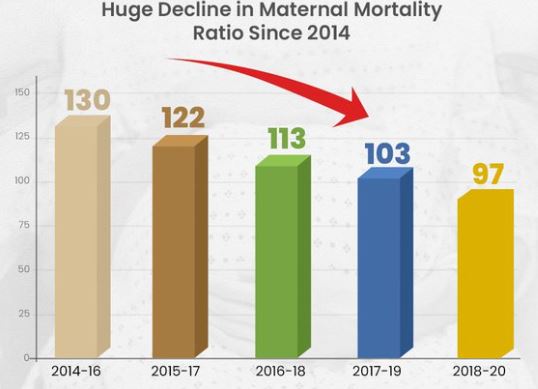

- India is on the right track to achieve the SDG target of MMR less than 70/ lakh live births by 2030.
- 8 States have achieved Sustainable Development Goal (SDG) target for MMR.
|
Highest MMR
(SDG 3.1 achieved states)
|
Lowest MMR
|
|
Kerala (19)
|
Assam (195)
|
|
Maharashtra (33)
|
Madhya Pradesh (173)
|
|
Telangana (43)
|
Uttar Pradesh (167)
|
|
Andhra Pradesh (45)
|
Chhattisgarh (137)
|
|
Tamil Nadu (54)
|
Odisha (119)
|
|
Jharkhand (56)
|
Bihar (118)
|
|
Gujarat (57)
|
Rajasthan (113)
|
|
Karnataka (69)
|
Haryana (110)
|
Other key Findings
- Institutional births across the country have increased to 88.6% in 2019-2021 from 78.9% in 2014-2016.
- Anaemia levels among women between the ages of 19 and 49 have increased to 57% in 2019-2021 from 53.1% in 2015-2016.
References
- PIB - Decline in the National Maternal Mortality Ratio
- Down To Earth - India improves maternal mortality ratio
Tiangong Space Station
China launched three astronauts to its Tiangong space station which is China’s first in-orbit crew rotation.
- The 3 astronauts were carried by the Shenzhou-15 spacecraft will live and work on the Tiangong space station for 6 months.
- Shenzhou-15 (Divine Vessel) mission was the last of 11 missions needed to assemble the ‘Celestial Palace’.
- Tiangong is China’s permanent space station that will operate in low-Earth orbit at an altitude from 340 km to 450 km.
- Tiangong Space Station is named after the Chinese word for ‘heavenly palace’ or ‘celestial palace’.
- The station has a designed lifespan of at least 10 years.
- The Chinese space station has 3 modules
- Tianhe core module (heavenly river)
- Crew module and the laboratory cabin modules Wentian (quest for heavens) and
- Mengtian (dreaming of heaven).
- Tiangong weighs about 66 tons with all 3 modules.
- China has planned a Xuntian space telescope which will co-orbit with Tiangong, with a slightly different orbital phase.
China will have the only spaces station in orbit after ISS expires in 2024.
International Space Station
- The International Space Station (ISS) is a joint program of 5 Space agency the United States (NASA), Russia (Roscosmos), Japan (JAXA), Canada and 10 member states of the European Space Agency.
- It has been in operation since 1998 and due to be retired in 2024.
- ISS is equipped with 16 modules and weighs around 450 tons.
References
- Indian Express - China’s new ‘Heavenly Palace’ space station
Andromeda galaxy and Galactic Cannibalism
Scientists discovered by studying a star cluster in Andromeda galaxy that Andromeda may be a cosmic cannibal.
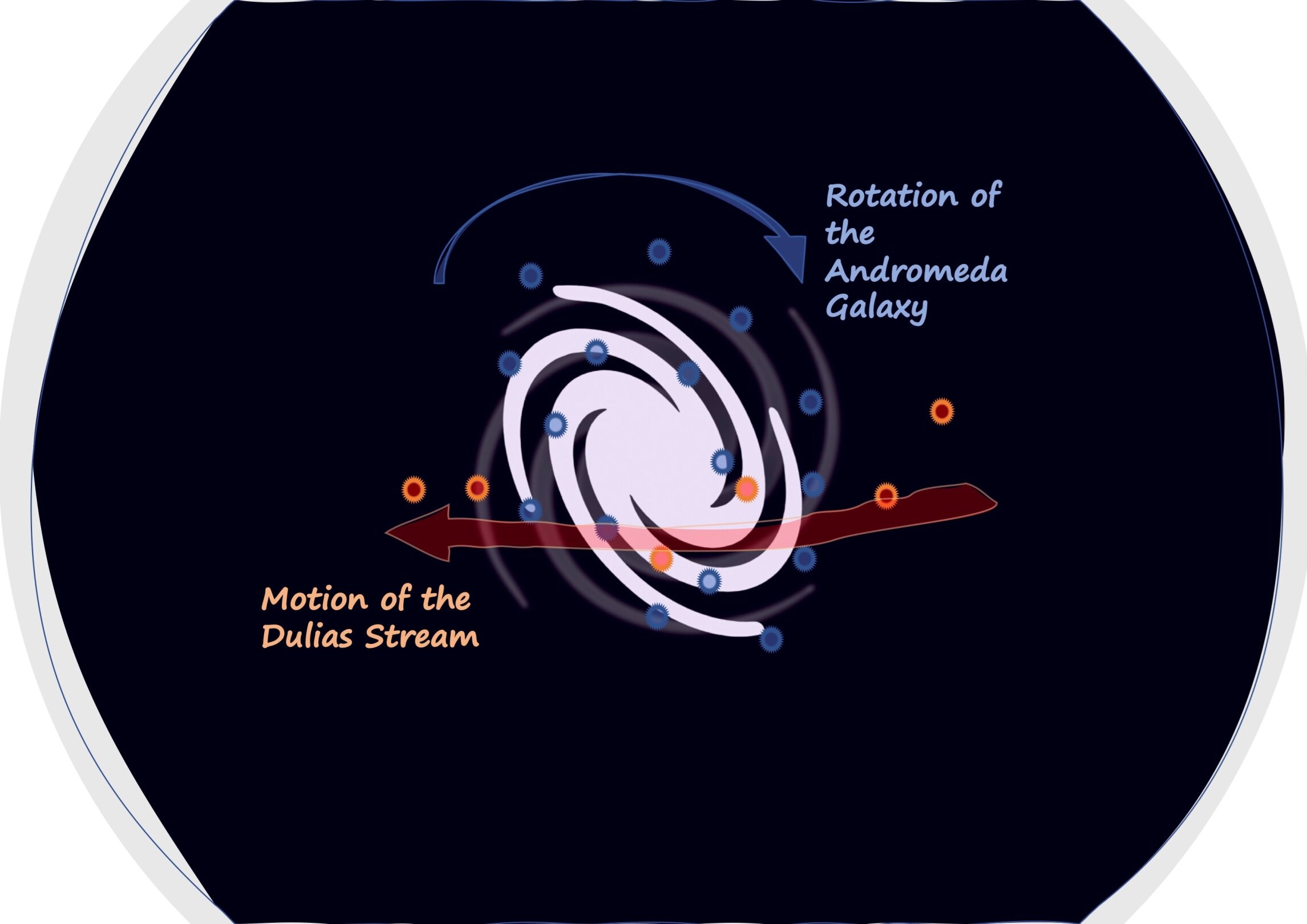
- The Dulais Structure is a dark stream of stars (globular clusters) in Andromeda. (Dulai means Black stream in Welsh)
- The Dulais Structure is dark stream illuminated by star clusters that orbit unlike any other clusters in Andromeda.
- This means the star clusters are from the leftovers of a massive feeding event called galactic cannibalism.
Galactic Cannibalism is a feeding event of galaxy in which larger galaxies consume smaller galaxies or globulars to grow.
Andromeda Galaxy
- The Andromeda Galaxy also known as Messier 31, is the nearest major galaxy to the Milky.
- Andromeda is a spiral galaxy approximately 2.5 million light-years from Earth.
- It is the largest galaxy of the Local Group, which also contains the Milky Way, the Triangulum Galaxy, and other smaller galaxies.
References
- Indian Express - Andromeda galaxy’s ‘cannibalistic’ nature
- Space - Galactic cannibal Andromeda feasts on smaller galaxies
- Science Alert - Andromeda engaged in 'Cannibalism' again
Rainbow of fruit and vegetables
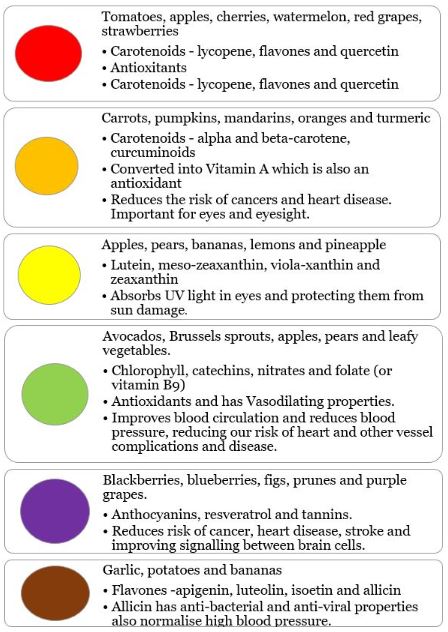
Coloured fruit and vegetables, and also herbs, spices, legumes and nuts provides a plethora of phytonutrients.
- Each colour of coloured fruit and vegetable signifies different nutrients
- The nutrients found in plant foods are broadly referred to as phytonutrients.
- There are at least 5,000 known phytonutrients.
References
- The Hindu - Nutrients in coloured fruit and vegetables
State of Global Water Resources 2021
The World Meteorological Organization (WMO) released its first State of Global Water Resources 2021.
- State of Global Water Resources is an annual report released by the World Meteorological Organization headquartered at Geneva.
- The report was released in order to assess the effects of climate, environmental and societal change on the Earth’s water resources.
- The report aims to support monitoring and management of global freshwater resources in an era of growing demand and limited supplies.
- The report focusses on three major areas:
- Streamflow - the volume of water flowing through a river channel at any given time.
- Terrestrial water storage (TWS) - all water on the land surface and in the sub-surface.
- The cryosphere (frozen water).
UN-Water reported that 74% of all natural disasters between 2001 and 2018 were water-related.
- Major Indian river basins (the Brahmaputra, Ganges and Indus) exhibit a gradual decline in TWS over the period 2002-2021.
- The total water storage of the Ganga-Brahmaputra and Indus basins declined in 2021.
- But they witnessed more water flowing in the river channels due to glacial melt.
The Indo-Gangetic Plain (IGP) is a crucial hotspot as about half a billion people live in the plain across Pakistan, Nepal, India and Bangladesh.
References
- Down To Earth - Water storage declined says WMO
- WMO - State of Global Water Resources 2021
- The Times Of India - WMO reports on freshwater availability



