Prelims: Current events of national and international importance | Environment
Why in News?
Recently, a major study revealed that losing plant species diversity in grasslands could reduce their global CO2 uptake through photosynthesis by 15% by 2050.
Key Scientific Findings
- In extreme regional cases such as the tropical grasslands of Paraguay, India, and parts of sub-Saharan Africa, strongly reduced plant diversity could slash carbon absorption by up to 50% by mid-century.
- Functional Niche Complementarity
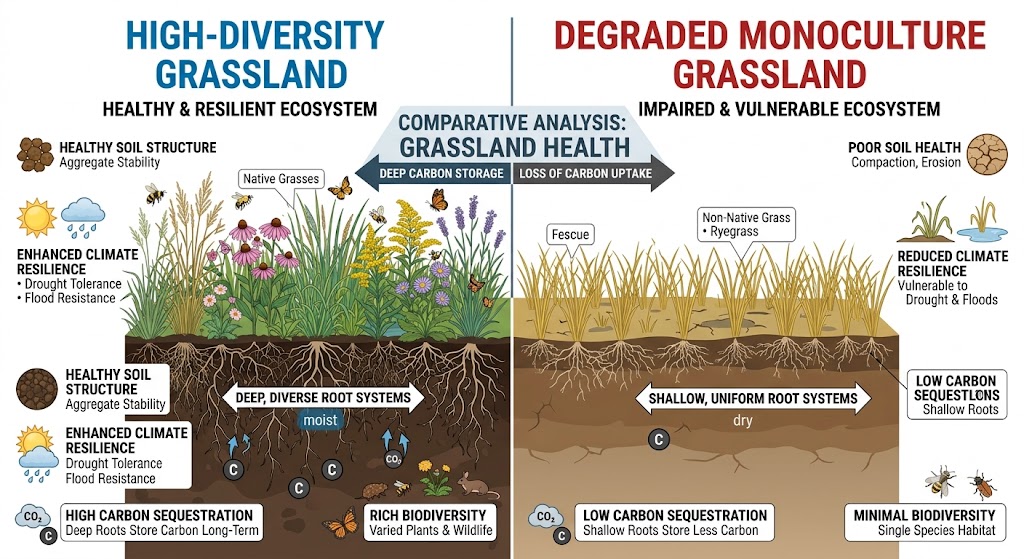
- Biodiverse grasslands feature a mix of deep-rooting and shallow-rooting species, C3 and C4 photosynthetic pathways, and nitrogen-fixing legumes.
- This variety maximises water, nutrient, and solar radiation efficiency across varied microclimates, driving higher overall carbon sequestration rates.
- Biodiversity as "Insurance"
- Diverse plant communities act as a buffer against weather shocks (e.g., severe droughts, heatwaves). When stress kills off specific sensitive species, resilient neighbouring species expand to maintain ecosystem-level photosynthesis.
- Vulnerability of Monocultures
- Monocultures or species-poor pastures lack ecological redundancies, making them prone to structural productivity crashes during prolonged heatwaves or rainfall deficits.
Implications
- Grasslands as Climate Real-Estate
- Grasslands (including meadows, steppes, savannas, and pastures) cover nearly 25% to 30% of the Earth's ice-free land surface.
- Unlike forests, where carbon is heavily stored in above-ground biomass vulnerable to wildfires, grasslands store most of their carbon underground in deep root networks and organic soil matter, making them more reliable long-term carbon sinks.
- Impact on the Global South & India
- Tropical and semi-arid grasslands in developing nations (such as India's Banni grasslands, Deccan thorn scrub savannas, and Terai-Duar inundation grasslands) face severe degradation due to overgrazing, invasive alien species (e.g., Prosopis juliflora, Lantana camara), and land-use conversion.
- A drop in grassland primary productivity directly degrades forage quality for pastoralist communities, threatening rural livestock economies and food security.
Policy Mandates
- Highlights the hazard of converting natural open grassy ecosystems (OGEs) into monoculture tree plantations under misplaced carbon credit schemes, which destroys native plant diversity and worsens water security.
- Emphasizes that grassland restoration must prioritize re-establishing native multi-species plant diversity rather than merely expanding total green cover percentage.
Reference
Down to Earth | Loss of diversity in grasslands



