Prelims: Current events of national and international importance | Science & Technology | Space
Why in News?
NASA’s BioSentinel spacecraft, launched in 2022, traveled beyond Earth's magnetic field and passed the Moon to investigate the effects of deep-space radiation on living organisms.
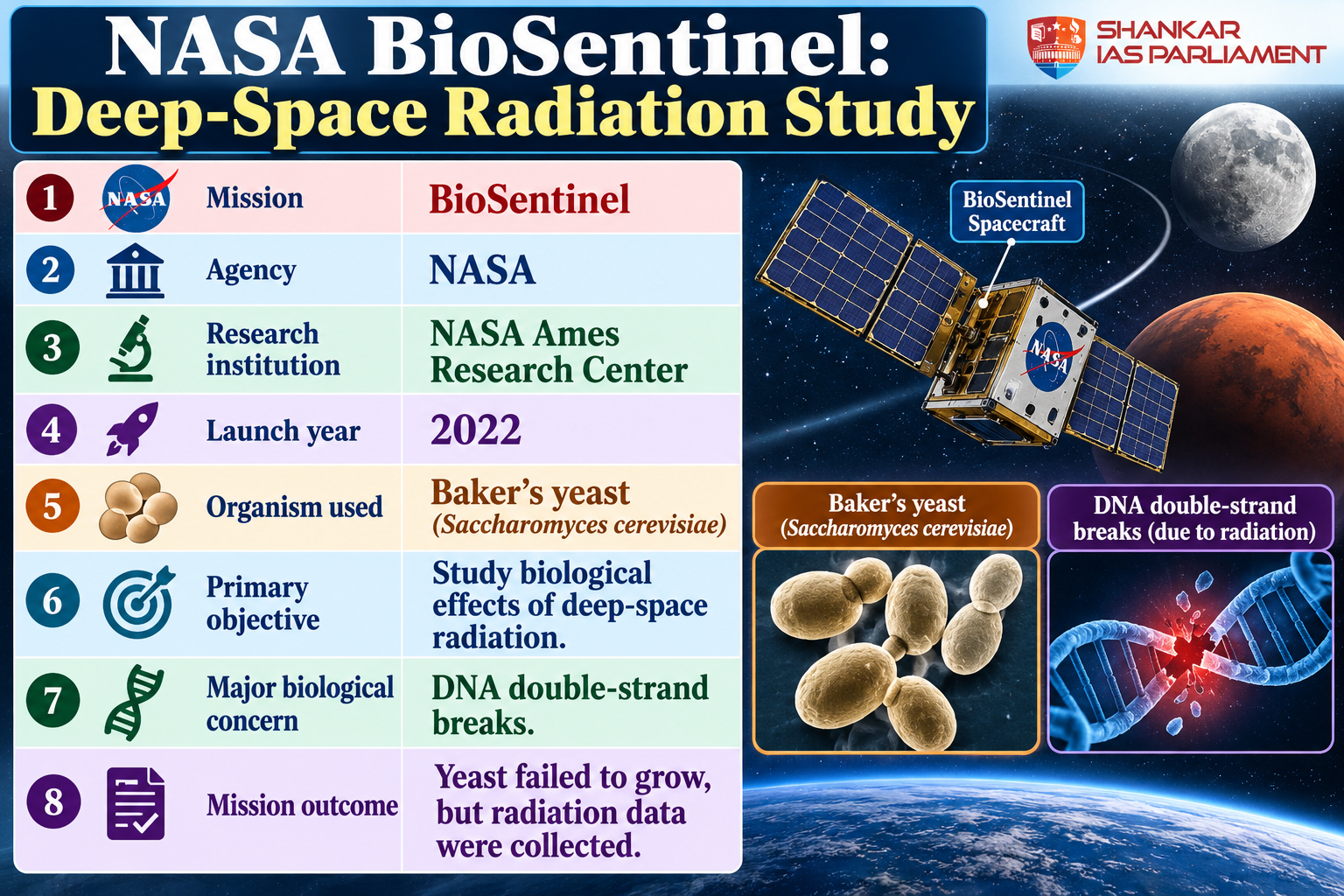
- The spacecraft transported yeast cells as biological samples to examine radiation-induced DNA damage.
- However, the yeast cells did not proliferate, likely due to expiration prior to launch.
- Despite the failure of the biological experiment, the spacecraft's radiation detector successfully collected deep-space radiation data.
NASA's BioSentinel Mission
- BioSentinel is a small, cereal-box-sized CubeSat developed by NASA.
- It was designed to study the biological effects of deep-space radiation on living organisms.
- It travelled beyond Earth's protective magnetic environment and flew past the Moon.
- Developed by – NASA Ames Research Center, California, USA.
- Launched in – 2022.
- Objectives
- To study the effects of deep-space radiation on living organisms.
- To understand radiation-induced DNA damage and cellular repair mechanisms.
- To generate scientific data to support the safety of future human deep-space missions.
Rationale for NASA's Selection of Yeast
- NASA selected Saccharomyces cerevisiae, commonly known as baker's yeast, as the model organism.
- Yeast is widely utilized in scientific research due to the significant similarities between its cellular and DNA repair mechanisms and those found in humans.
- Significance
- DNA Damage Studies – Deep-space radiation has the potential to induce double-strand breaks in DNA.
- DNA Repair Mechanisms – Yeast cells contain well-characterized mechanisms for repairing damaged DNA.
- Human Health Research – Investigations using yeast facilitate understanding of the biological effects of radiation exposure relevant to human health.
- Model Organism – Yeast is amenable to laboratory study and possesses well-characterised biological mechanisms.
The Importance of Studying Deep-Space Radiation
- Earth's Magnetic Protection – Earth's magnetic field establishes a protective environment surrounding the planet.
- This field deflects numerous charged particles that originate from the Sun and other cosmic sources.
- The Earth's magnetosphere significantly reduces radiation exposure for astronauts operating in low Earth orbit.
- Radiation Risks in Deep Space – Astronauts traveling beyond Earth's protective magnetic environment are exposed to significantly higher levels of radiation, including:
- Galactic Cosmic Rays (GCRs) – These are high-energy particles that originate outside the Solar System.
- Solar Energetic Particles (SEPs) – These are high-energy particles released during solar eruptions.
- Major Health Risks
- DNA damage and mutations.
- Increased cancer risk.
- Cellular and tissue damage.
- Potential long-term health complications.
Key Findings and Mission Outcomes
- The yeast cells aboard BioSentinel did not exhibit growth, which may be attributed to their expiration prior to launch.
- As a result, the planned biological experiment did not yield the anticipated outcomes.
- Nevertheless, the radiation detector onboard continued to collect data on the deep-space radiation environment.
Significance
- Astronaut Safety – Assesses deep-space radiation risks and supports development of effective shielding for Moon and Mars missions.
- Space Biology Research – Enhances understanding of DNA damage and cellular repair, improving safety for long-duration space missions.
Reference
HT | NASA BioSentinel: Deep-Space Radiation Study



