Prelims: Current events of national and international importance
Why in News?
Recently, Sample Registration System (SRS) Bulletin released by the Office of the Registrar General of India placed Telangana’s Infant Mortality Rate (IMR) at 17.
Infant Mortality Rate (IMR) – It is the number of deaths of infants under one year old per 1,000 live births in a given year.

- National average – 24.
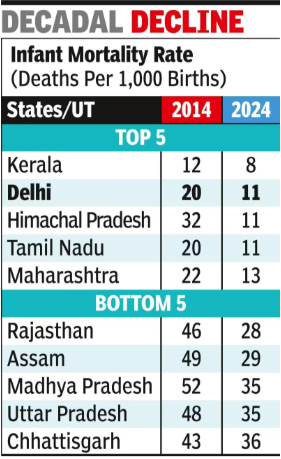
- IMR across states
- Importance if IMR – It is a critical public health indicator used to gauge the overall healthcare, socioeconomic, and environmental conditions of a region.
- Rural-urban divide - Nationally, the gap was wider, with rural India reporting 27 & Urban India 17
IMR is considered one of the most important indicators of a region's overall health status.
- IMR across States
The case of Telangana
- Improvement – Telangana's Infant Mortality Rate (IMR) Improves Further
- Long-Term Progress – Telangana has consistently outperformed the national average since its formation:
|
Year
|
Telangana IMR
|
India IMR
|
|
2014
|
35
|
39
|
|
2024
|
17
|
24
|
- Significance – Over the decade, Telangana reduced its IMR by 18 points, reflecting substantial improvements in maternal and child healthcare.
- Rural–Urban Gap
- Rural Telangana – IMR of 19
- Urban Telangana – IMR of 14
Odisha and Rajasthan recorded IMRs of 28 each, while Assam stood at 29.
Other Demographic Indicators
- Birth Rate – 15.7 per 1,000 population (India: 18.3)
- Death Rate – 6.5 (India: 6.4)
- Natural Growth Rate – 9.1 (India: 11.9)
References
1. The Hindu| IMR in India
2. The Times of India| IMR in India



