Prelims: Current events of national and international importance| Environment
Why in News?
India has initiated the rewilding of captive-bred Great Indian Bustards (GIBs) in Jaisalmer, Rajasthan. Two captive-bred birds are planned to be released from a soft-release facility into the Desert National Park.
Conservation Breeding Programme
- Implemented by – MoEFCC, Rajasthan Forest Department and Wildlife Institute of India (WII).
- Conservation-breeding centres are located at Ramdevra and Sam in Rajasthan. A soft-release facility has also been established at Naliya, Gujarat.
- The centres currently house 97 birds. 24 chicks were produced in 2025 and 29 in 2026.
- Rewilding Aviary – A new aviary at Ramdevra provides large, unobstructed flying space.
- It helps birds strengthen flight muscles and develop natural behaviours before release.
- ‘Jumpstart’ Approach – Captive-laid eggs are placed in wild GIB nests for incubation by wild females.
- This has produced 8 chicks — 6 in Rajasthan and 2 in Gujarat.
- Habitat Conservation – Around 200 sq. km of fenced grassland has been developed inside the Desert National Park.
- WII telemetry studies identified these areas as important breeding habitats.
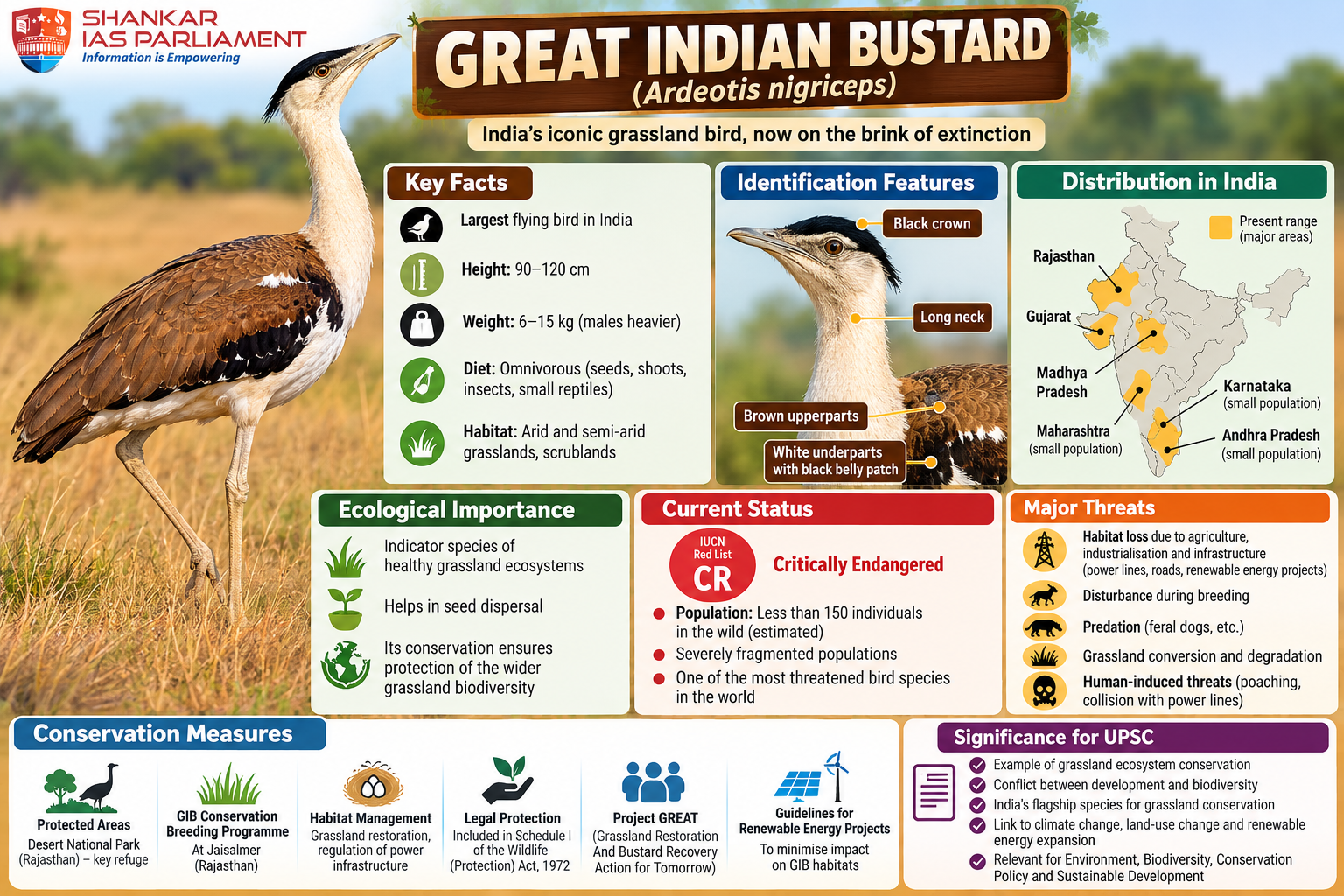
Key Facts about GIB
- Scientific name – Ardeotis nigriceps
- IUCN Status – Critically Endangered.
- State Bird – Rajasthan.
- Major habitats – grasslands and semi-arid regions of Rajasthan and Gujarat.
- It is an important umbrella species of the Thar ecosystem.
Reference
DD News| India begins process to rewild captive-bred Great Indian Bustards



