Prelims: Current events of national and international importance | Environment
Why in News?
Recently, the International Union for Conservation of Nature (IUCN) published the inaugural global assessment of coral reef ecosystems under the IUCN Red List of Ecosystems (RLE).
First Global Assessment of Coral Reef Ecosystems
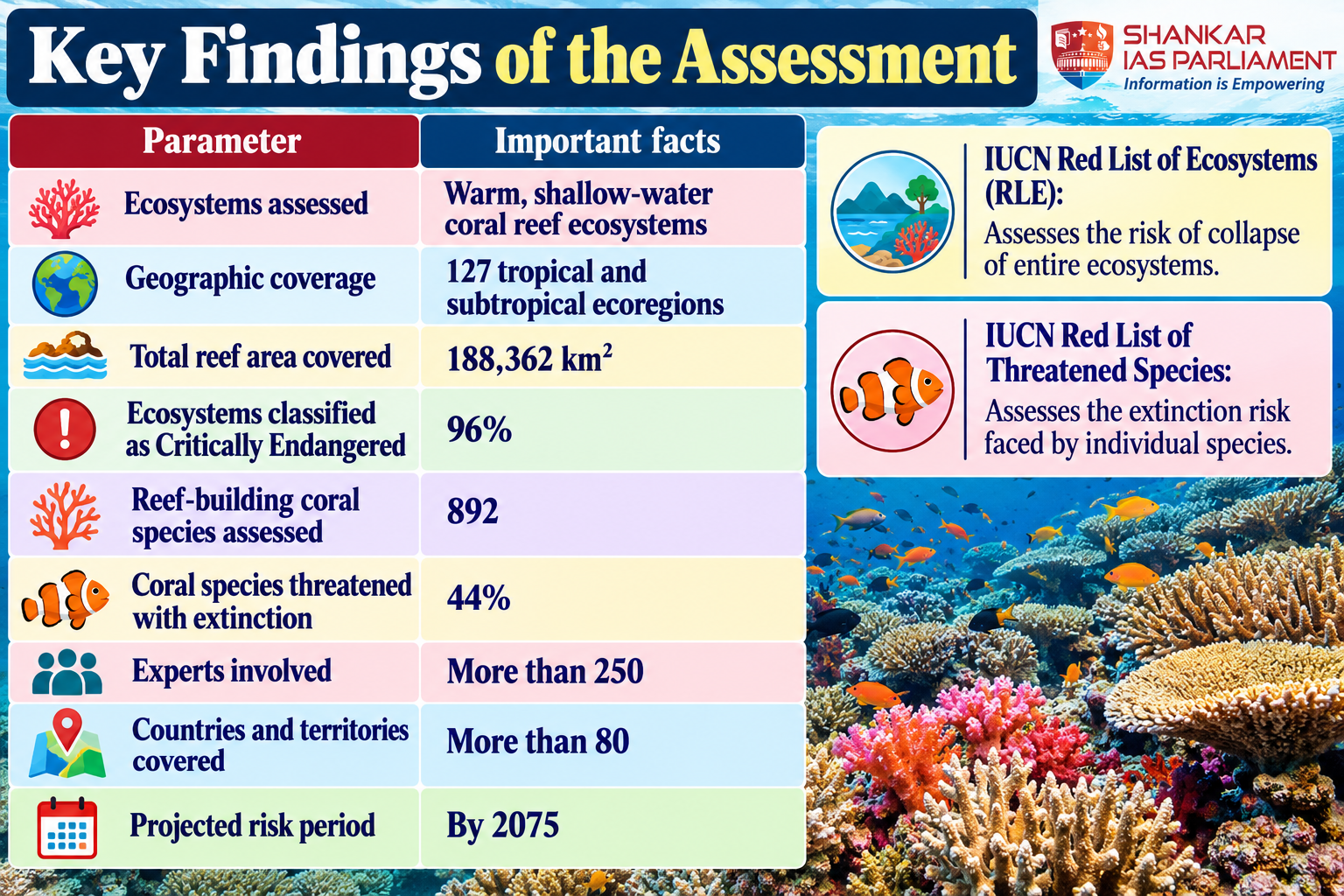
- 96% of assessed shallow-water coral reef ecosystems are classified as Critically Endangered, indicating an extremely high risk of ecosystem collapse by 2075.
- A separate assessment determined that 44% of reef-building coral species are threatened with extinction according to the IUCN Red List of Threatened Species.
|
Coral Reefs
|
- Coral reefs are complex marine ecosystems formed predominantly by colonies of small animals known as coral polyps.
- Reef-building corals secrete calcium carbonate skeletons, which collectively constitute the structural foundation of coral reefs.
- Most reef-building corals engage in a symbiotic relationship with microscopic algae known as zooxanthellae, which supply nutrients via photosynthesis.
- Coral reefs support approximately 25% of all marine species, although they cover only a small fraction of the ocean floor.
- Coral reefs provide essential habitat, breeding grounds, and food resources for a wide variety of marine organisms.
- Significance
- Biodiversity – It supports highly diverse marine food webs.
- Coastal Protection – It reduces wave energy and contribute to the protection of shorelines from erosion and storm impacts.
- Livelihoods – It supports fisheries, aquaculture, and tourism industries.
- Food Security – It sustains the livelihoods and food security of coastal fishing communities.
- Ecological Balance – It plays a critical role in maintaining marine habitats and regulating nutrient cycles.
|
Major Threats to Coral Reef Ecosystems
- Climate change represents the most persistent global threat
- Increasing ocean temperatures result in marine heatwaves and widespread coral bleaching.
- According to the IPCC's intermediate scenario, atmospheric warming is projected to reach 2.7°C by the end of the century.
- Ocean acidification, resulting from the absorption of atmospheric carbon dioxide, decreases the availability of carbonate ions necessary for coral skeleton formation.
- Increased storm intensity and altered rainfall patterns further contribute to reef degradation.
- Anthropogenic local pressures
- Overfishing leads to the depletion of key fish populations.
- Coastal development and industrial activities contribute to habitat loss and ecosystem disruption.
- Marine pollution, such as sewage, plastics, and agricultural runoff, introduces harmful substances into reef environments.
- Unsustainable tourism and physical disturbances from recreational activities cause direct harm to coral reefs.
- Pollution from aquaculture operations and freshwater flooding negatively affect coral reef health.
Overexploitation of key fish groups, such as parrotfish and groupers, threatens 63% of coral reef ecosystems.
The decline of herbivorous fish enables algal overgrowth on corals, whereas the reduction of predators destabilizes marine food webs.
Coral Bleaching vs Coral Reef Collapse
|
Coral bleaching
|
Coral reef ecosystem collapse
|
|
Corals lose their symbiotic algae or their pigments, often due to heat stress.
|
The ecosystem loses its defining characteristics and ecological functions.
|
|
Corals become pale or white.
|
Reef-building hard corals nearly disappear, while algae, rubble and sponges may dominate.
|
|
Bleached corals can recover if stress subsides.
|
Recovery may be difficult because the ecosystem structure and food webs have been severely altered.
|
|
Repeated or prolonged bleaching can cause mortality.
|
Represents a more severe ecosystem-level degradation.
|
Key Regional Findings – The assessment identifies several major reef systems as Critically Endangered.
-
- Great Barrier Reef in Australia.
- Coral Triangle in the Western Pacific and Southeast Asia.
- Mesoamerican Barrier Reef System in the Caribbean region.
- Red Sea coral reefs are important marine ecosystems that include some heat-tolerant coral populations.
- Western Galápagos Islands are classified as Collapsed following the 1982–83 El Niño event.
- Additional regional observations include the following:
- In East Asia, only 20% of assessed reef ecosystems would be classified as Critically Endangered based on observed changes over the preceding 50 years alone.
- In the Northern Red Sea, reefs with relatively high thermal tolerance would be classified as Vulnerable based solely on recent historical trends.
- When future climate projections are considered, the overall assessment indicates substantially higher risks.
Significance of the Assessment
- Early warning – Ecosystem-level assessments facilitate the identification of risks associated with the loss of ecological functions.
- Climate policy – Emphasises the urgency of implementing rapid greenhouse gas emission reductions.
- Marine conservation – Informs the expansion and effective management of marine protected areas.
- Sustainable fisheries – Contributes to the protection of herbivorous fish and predators essential for maintaining reef balance.
- Coastal livelihoods – Supports the safeguarding of economic and social benefits provided by reefs.
- Science-based policy – Integrates historical observations, ecological data, and satellite-derived sea-surface temperature measurements.
Reference
IUCN | First Global Assessment of Coral Reef Ecosystems



