Prelims: Current events of national and international importance | Environment
Why in News?
Recently, the Ministry of Statistics and Programme Implementation (MoSPI) released the Strategy for Environmental-Economic Accounts in India: 2026–2030.
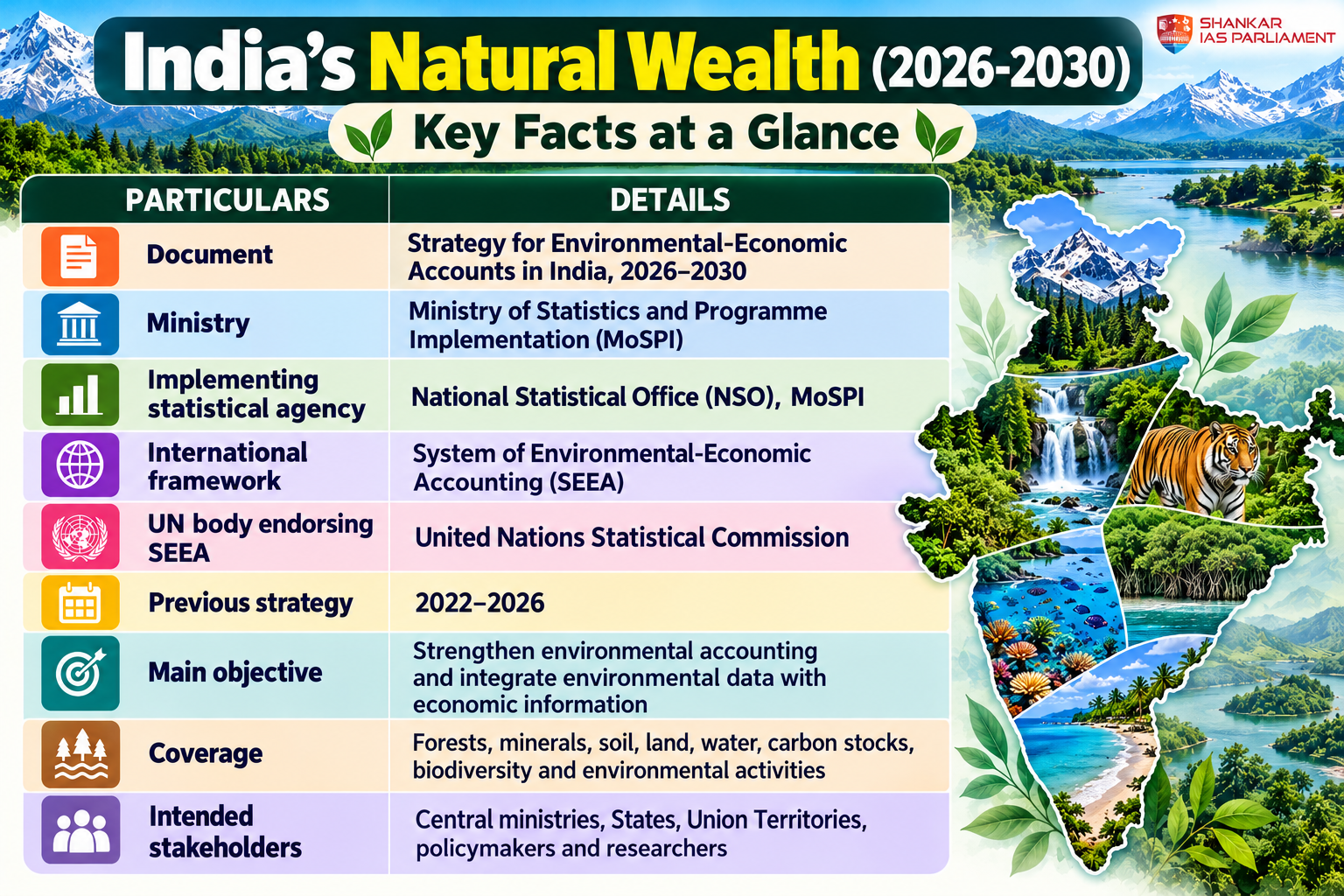
- Builds upon – The previous strategy for 2022–2026
- Aligns with – International environmental accounting frameworks.
- Objective – To provide a strategic roadmap to strengthen environmental accounting, address data gaps and expand the coverage of environmental-economic accounts in India.
- Major Areas Covered
- Natural resources – Forests, minerals, soils, and land.
- Water resources – Availability, usage, and related environmental data.
- Climate-related accounting – Carbon stocks and associated environmental activities.
- Biodiversity – Resources and ecosystem information.
- Environmental statistics – Enhanced data coverage, quality, and comparability.
- Emerging and expanded accounts – Continued development of areas from the previous strategy, such as ocean and energy accounts, material flows, and urban ecosystems.
System of Environmental-Economic Accounting (SEEA)
- The SEEA is an international statistical framework that has been endorsed by the United Nations Statistical Commission.
- It combines environmental and economic data using concepts, classifications, and accounting rules that align with the System of National Accounts.
- It enables evidence-based policymaking to advance sustainable development.
- Two important components:
- SEEA Central Framework (SEEA-CF) – Focus on physical and monetary accounts for environmental assets, natural resource flows and economic activities related to the environment
- SEEA Ecosystem Accounting (SEEA-EA) – Focus on ecosystem extent, condition, ecosystem services and changes in ecosystem assets.
|
Environmental-Economic Accounting
|
- Environmental-economic accounting systematically quantifies the interconnections among the environment, natural resources, and economic systems.
- It tracks natural resources, their use in economic activities, environmental changes, and associated expenditures.
- It complements conventional national accounts, which primarily measure economic activity and may not fully reflect changes in natural capital.
|
Background: India's Progress in Environmental Accounting
- MoSPI initiated the development of environmental accounts in 2018.
- The 2022–2026 strategy identified the following priority areas:
- Material Flow Accounts (MFAs)
- Ocean Accounts
- Energy Accounts
- Thematic Accounts for Biodiversity and Urban Areas
- Subsequent initiatives and publications addressed forests, biodiversity, wetlands, soil, water quality, croplands, energy, residuals, urban ecosystems, and pollination services.
- The 2026–2030 strategy seeks to build on these developments and broaden the scope of environmental accounting.
Reference
PIB | Environmental-Economic Accounts in India



