Prelims: Current events of national and international importance | Governance
Why in News?
- The SHANTI Act, 2025 replaces the Atomic Energy Act, 1962, and the Civil Liability for Nuclear Damage (CLND) Act, 2010.
- The Department of Atomic Energy released the new draft SHANTI Rules and Regulations for public feedback.
- Core Objective - Dramatically scale up India's nuclear energy capacity, aiming for 100 GW by 2047 and setting up at least 5 indigenous Small Modular Reactors (SMRs, up to 300 MW each) by 2033.
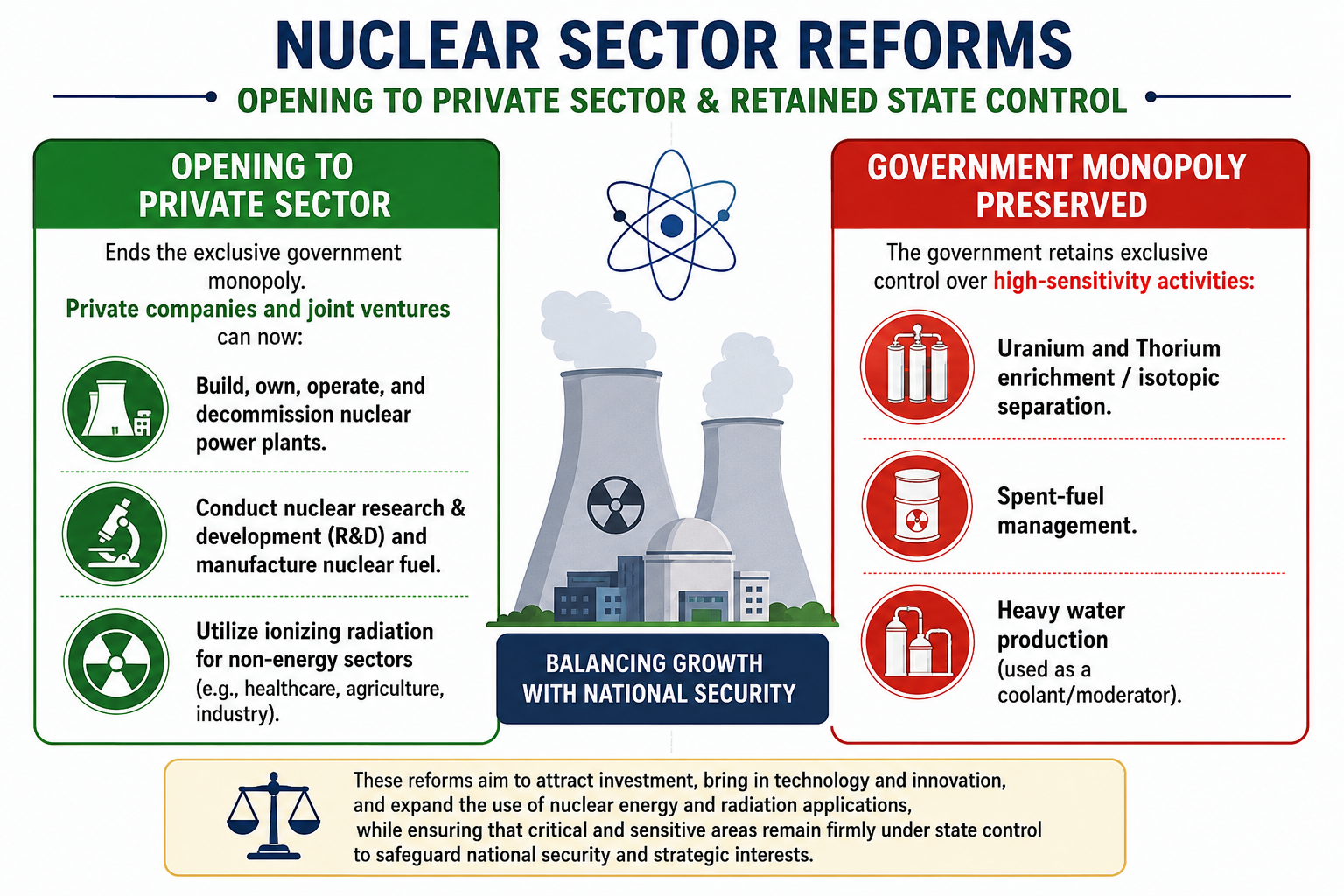
Opening to Private Sector & Retained State Control
- Private Role- Ends the exclusive government monopoly. Private companies and joint ventures can now:
- Build, own, operate, and decommission nuclear power plants.
- Conduct nuclear research & development (R&D) and manufacture nuclear fuel.
- Utilise ionising radiation for non-energy sectors (e.g., healthcare, agriculture, industry).
- Government Monopoly Preserved - The government retains exclusive control over high-sensitivity activities:
- Uranium and thorium enrichment / isotopic separation.
- Spent-fuel management.
- Heavy water production (used as a coolant/moderator).
Civil Liability & Insurance Structure
- Sliding Liability Scale- Replaces the previous flat Rs.1,500 crore liability limit with a capacity-linked structure:
- Large reactors (>3,600 MW thermal): Operator liability capped at Rs.3,000 crore.
- Small reactors (up to 150 MW thermal): Operator liability tapers down to Rs.100 crore.
- State Backstop & Liability Fund- If damages exceed the operator liability limit, the government will step in.
- A Nuclear Liability Fund funded through electricity tariffs will be set up and reviewed every 5 years to account for inflation, technology shifts, and market scale.
- Liability Scope- Covers risks through the entire lifecycle, including active operations, spent fuel, radioactive waste, and decommissioning.
Foreign Technology & Investment
- Certification Filters- Foreign technology and foreign investment are permitted, provided the reactor design is:
- Certified by the nuclear regulatory authority in its country of origin.
- Already operational in that country or elsewhere globally.
Streamlined Licensing & Regulatory Framework
- Single Composite License- Merges permissions for building, owning, operating, and decommissioning plants into a single process to prevent regulatory delays.
- In-Principle Approvals- Allows investors to secure early regulatory confirmation before finalizing all project details, providing investment certainty.
- Licensing Hold Points- Mandates regulatory check-ins at critical milestones (e.g., prior to construction start and prior to initial fuel loading).
- Regulatory Body- The Atomic Energy Regulatory Board (AERB) serves as the primary enforcement and regulatory agency.
Reference
The Print | SHANTI Act



