Prelims: Current events of national and international importance | Art & Culture
Why in News?
Recently, NCERT restored the original image of the Dancing Girl in the Class 9 Arts Education textbook, after controversy over a retouched version.
- The Dancing Girl figurine has long been a defining symbol of the Indus Valley Civilisation (Harappan Civilisation and is displayed in the National Museum, New Delhi.
Indus Valley Civilisation – 3300 BCE to 1300 BCE.
- Discovered in – 1926, by archaeologist Ernest McKay at Mohenjo‑daro (Sindh, Pakistan).
- Age – Over 4,500 years old, belonging to the Harappan period.
- Material – Bronze.
- Technique – Made using Lost‑wax casting technique, proving that ancient Harappans possessed intricate metal-blending and casting capabilities.
- Dimensions – Height 10.5 cm.
- Appearance – Nude female figure with hair tied in a bun, adorned with bangles, bracelet, and necklace.
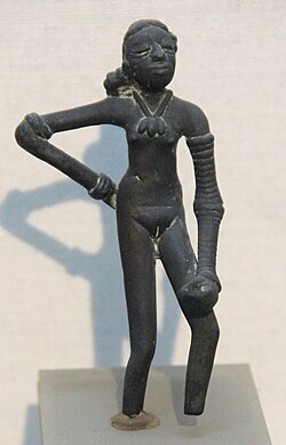
- Symbolic Value – Considered evidence of high art in Harappan society.
- Interpretations – Some historians view her as a dancer; others suggest she may represent a woman with an offering.
Mohenjo‑daro
- Timeline – 1st major Indus Valley urban centre, Built around 2500 BCE,
Mohenjo‑daro means Mound of the Dead.
- Discovery – Excavated in 1922, showing advanced civic and cultural life.
- River - Mohenjo-daro was built on the fertile right bank of the Indus River.
- City Features – Baked brick houses, public baths, granary, wells, soak pits, drainage system.
- Organization – Evidence of strong civic, economic, social, and cultural systems.
- Structure –
- Citadel (West) – Buddhist stupa built in 2nd century AD.
- Lower City (East) – Grid‑pattern streets with sanitation and drainage.
- UNESCO Status – World Heritage Site in Sindh, Pakistan.
- Significant Indus Valley artefacts – Pashupati seal, bearded priest, terracotta figurines.
References
- Indian Express | Dancing Girl
- UNESCO | Mohenjo-daro



