Prelims: Current events of national and international importance | Science & Technology
Why in News?
Recently, Researchers at International Advanced Research Centre for Powder Metallurgy and New Materials (ARCI), have developed a bi-layered single-piece dental implant.
A Bi-Layered, Single-Piece Dental Implant
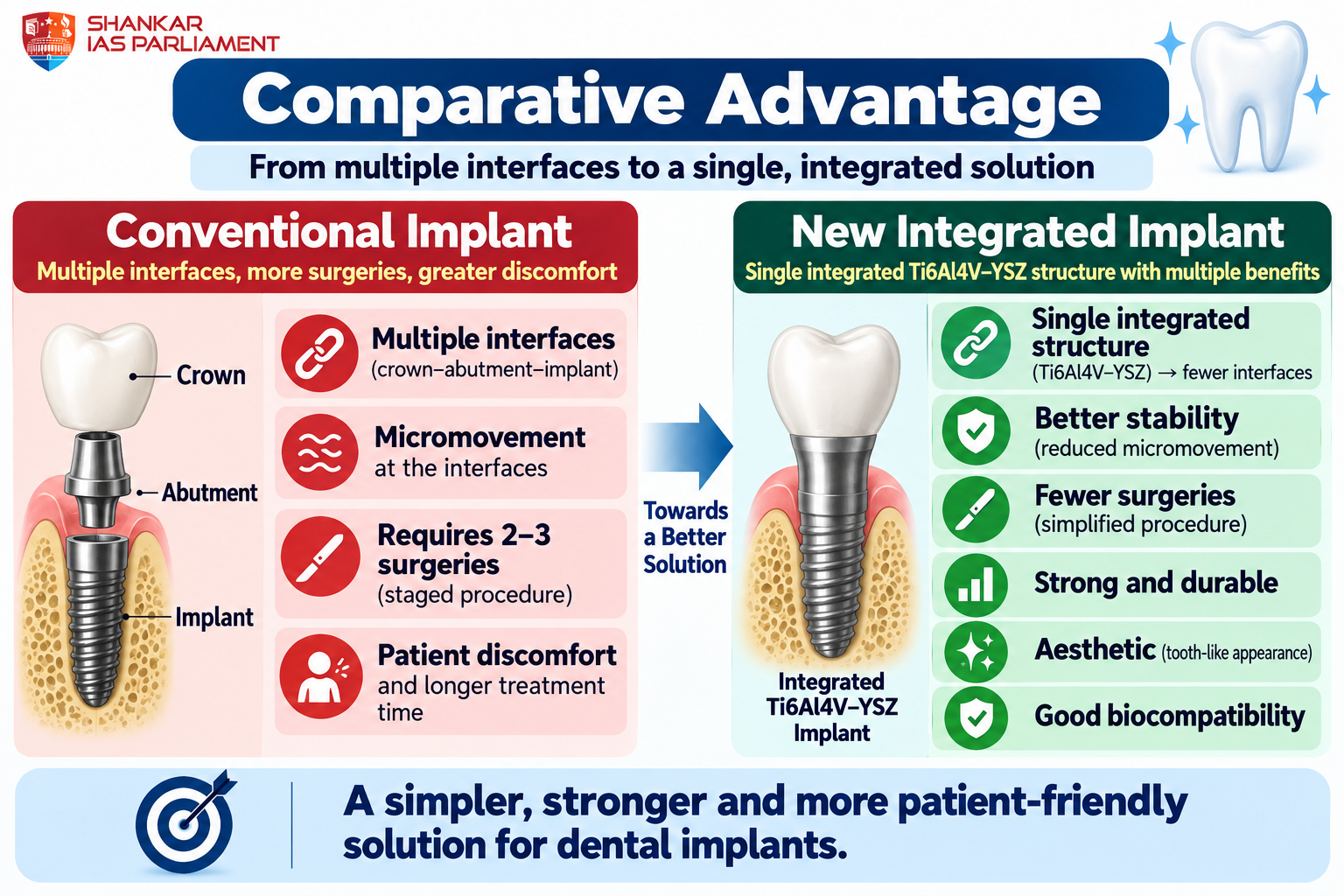
- Integration of – Ti6Al4V titanium alloy and yttria-stabilized zirconia (YSZ) within a single structure.
- Aim – To reduce the need for surgical interventions, improve implant stability, and enhance biocompatibility.
- Manufacturing Technology
- Spark Plasma Sintering (SPS) – It using a tapered graphite die facilitated single-step densification of Ti6Al4V and YSZ composites.
- A density of 99.5% was achieved, resulting in strong, defect-free, reproducible, and scalable materials.
- Key Scientific Findings – A stable ceramic–metal interface was observed, characterized by the absence of cracks, pores, or delamination, minimal diffusion, and a fine-grained transition zone.
- Mechanical Properties – It exhibited a density of 99.5%, hardness of 1350 HV, compressive strength of approximately 1550 MPa, and flexural strength of approximately 310 MPa, which are equal to or exceed those of commercial implants.
- Biocompatibility – The MTT assay demonstrated greater than 90% metabolic activity, indicating non-cytotoxicity.
- The hemolysis test showed negligible red blood cell damage, confirming biological safety.
|
Conventional Dental Implant
|
- A conventional dental implant typically consists of three primary components:
- Fixture - Embedded in jawbone
- Abutment - Connects fixture and crown
- Crown - Replaces visible tooth
- Challenges
- Micromovement may occur at the abutment to fixture interface.
- Such micromovement can disrupt osseointegration, potentially resulting in implant loosening.
- Placement of conventional implants typically requires two to three separate surgical procedures.
- It often leads to increased discomfort, higher costs, and greater clinical complexity.
|
- Significance
- Healthcare Impact – It reduces surgical complexity and enhances the stability of dental implants.
- Technological Advancement – It demonstrates the capability to develop indigenous biomaterials and apply powder metallurgy techniques.
- Industrial Relevance – It is reproducible and scalable, enabling the production of high-performance dental implants domestically.
- Atmanirbhar Bharat – It supports the development of indigenous biomedical devices and promotes affordable dental healthcare.
Reference
PIB | Bi-Layered Single-Piece Dental Implant



