Prelims: Current events of national and international importance | Space
Why in News?
Recently, astronomers have reported the potential detection of the first confirmed radio emission from an exoplanet, specifically Beta Pictoris b.
Beta Pictoris b
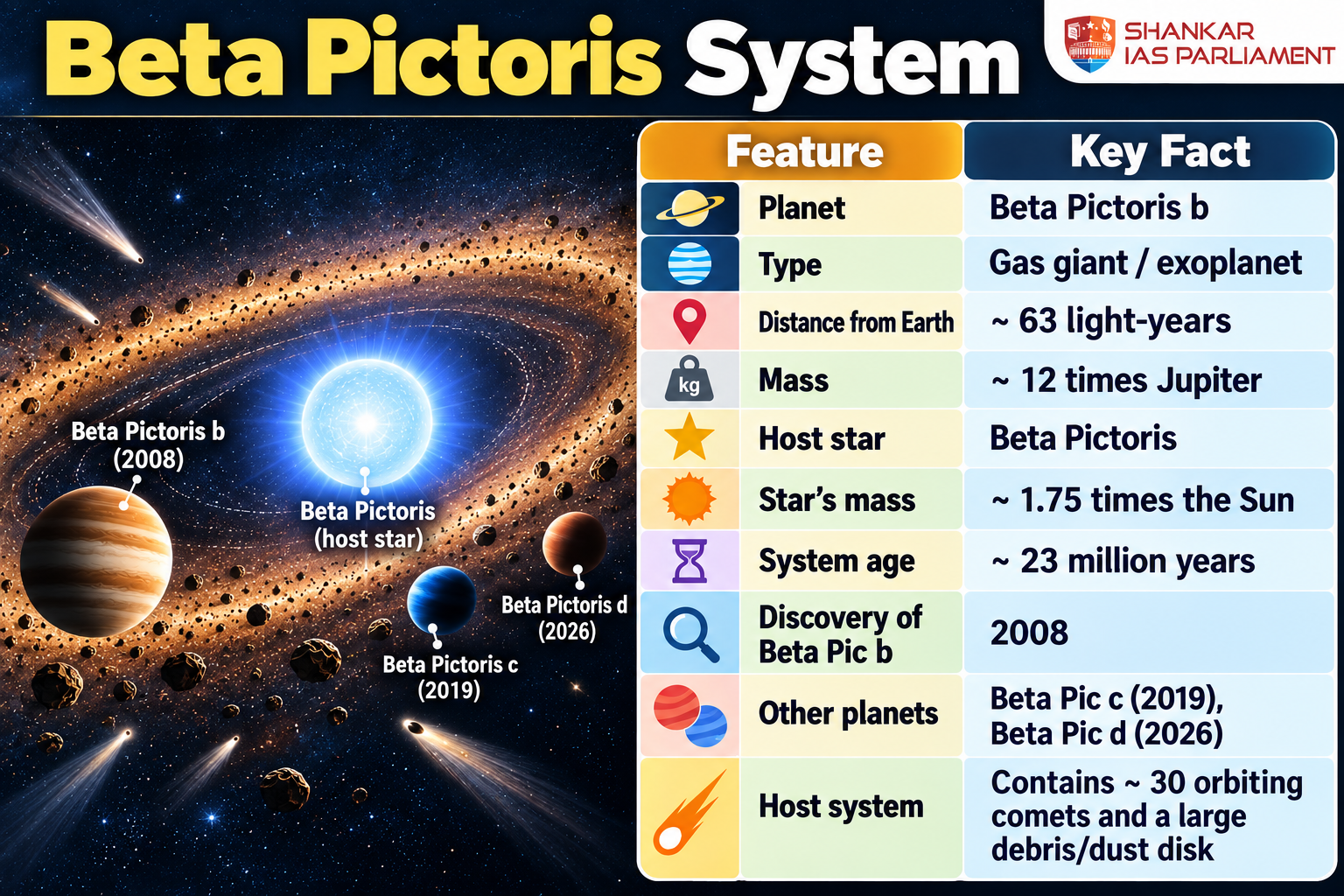
Exoplanet - A planet outside our Solar System that orbits a star other than the Sun.
Beta Pictoris b is therefore an exoplanet.
- Astronomers have detected repeating radio bursts that appear to originate from Beta Pictoris b, rather than from its host star.
- This finding is significant because previous suspected exoplanetary radio signals could not be clearly distinguished from emissions produced by the host star.
- The detected emission is classified as auroral radio emission.
- The radio emission is associated with auroras generated by a very strong magnetic field.
- This finding does not indicate evidence of extraterrestrial intelligence.
- It is important to note that the study is currently awaiting peer review.
Mechanism
- Charged particles interact with the magnetic field, spiral along magnetic field lines, and produce both auroras and radio waves.
- Similar processes occur on the following bodies:
- Earth
- Jupiter
- Saturn
- Sun
- Some stars and brown dwarfs
Extremely Strong Magnetic Field
- The magnetic field of Beta Pictoris b is estimated to be at least 200 times stronger than that of Jupiter.
- A magnetic field of this magnitude can generate radio waves at higher frequencies.
- A planet's magnetic field generates a magnetosphere, which is a region dominated by the planet's magnetic influence.
Auroral Radio Emission
- An aurora is light produced when energetic charged particles interact with a planet's atmosphere or magnetic environment.
- Auroral radio emission refers to radio waves generated by energetic charged particles moving or spiraling within a strong magnetic field.
- For example, Jupiter demonstrates this phenomenon.
- Jupiter possesses a powerful magnetic field.
- Its moon Io is volcanically active and releases charged particles.
- These particles become trapped within Jupiter's magnetic environment.
- Their interaction contributes to both auroras and radio emissions.
MeerKAT Radio Telescope
- The MeerKAT Radio Telescope was employed to detect the radio signal.
- Located in South Africa.
- The array consists of 64 individual radio telescope dishes.
- Therefore, MeerKAT exemplifies radio astronomy that utilizes multiple dishes operating in concert.
Significance
- Recent radio observations provide new insights into exoplanets, revealing properties that conventional methods cannot detect.
- These findings enhance scientific understanding by enabling the study of magnetic fields, auroras, atmospheric evolution, and interactions between planets and their host stars.
Reference
CNN | Beta Pictoris b – Radio Signals



