Prelims: Current Events of National and International Importance | Environment | Climate Change | International Initiatives
Why in News?
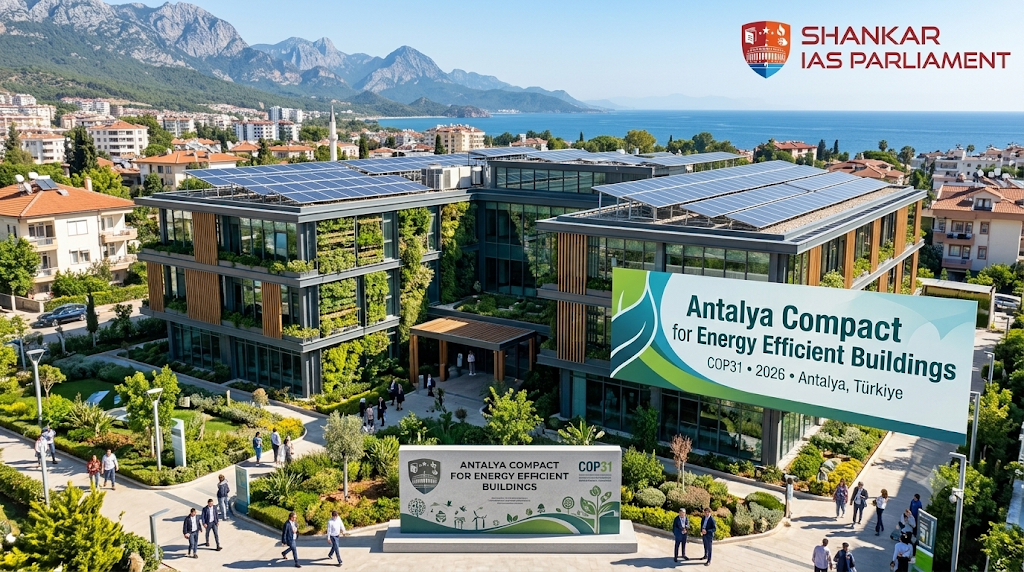
At COP31 in Antalya, Türkiye, countries expressed differing views on the Antalya Compact for Energy Efficient Buildings.
- About the Compact – A voluntary, non-binding framework seeks to reduce the operational energy intensity of the global building stock and accelerate electrification, while developing countries emphasised finance, technology transfer and affordability.
- Aim – To reduce global building energy intensity by 25% below 2020 levels by 2035 and support the“35 by 35” electrification target.
- Launched by – COP31 Presidency with support from the UNEP-hosted Global Alliance for Buildings and Construction (GlobalABC).
- Endorsement – It has already secured endorsements from 24 countries, the European Commission and 38 non-Party stakeholders.
- “35 by 35” – Supports the COP31 Presidency’s goal of increasing electricity’s share of global final energy consumption to 35% by 2035.
- Six action areas
- Mainstream efficiency and electrification in national strategies;
- Promote high-performance buildings;
- Renovate existing buildings;
- Electrify heating, cooling and cooking;
- Improve building performance and grid flexibility;
- Mobilise finance and implementation capacity.
- Developing-country concerns – High upfront costs, affordable and climate-resilient housing needs, grant-backed concessional finance, technology transfer and locally appropriate solutions.
- Developed-country emphasis – Stronger lifecycle building codes, deep retrofits of ageing buildings, low-carbon materials and electrification through heat pumps and efficient appliances.
- Stakeholder role – UN-Habitat highlighted affordable housing and informal settlements; UNECE supported passive cooling and regional cooperation; industry groups called for deeper energy-intensity cuts.
Reference
Down To Earth – COP31: Differing stances on the Antalya compact for energy-efficient buildings



