Prelims: Current events of national and international importance | Science & Technology
Why in News?
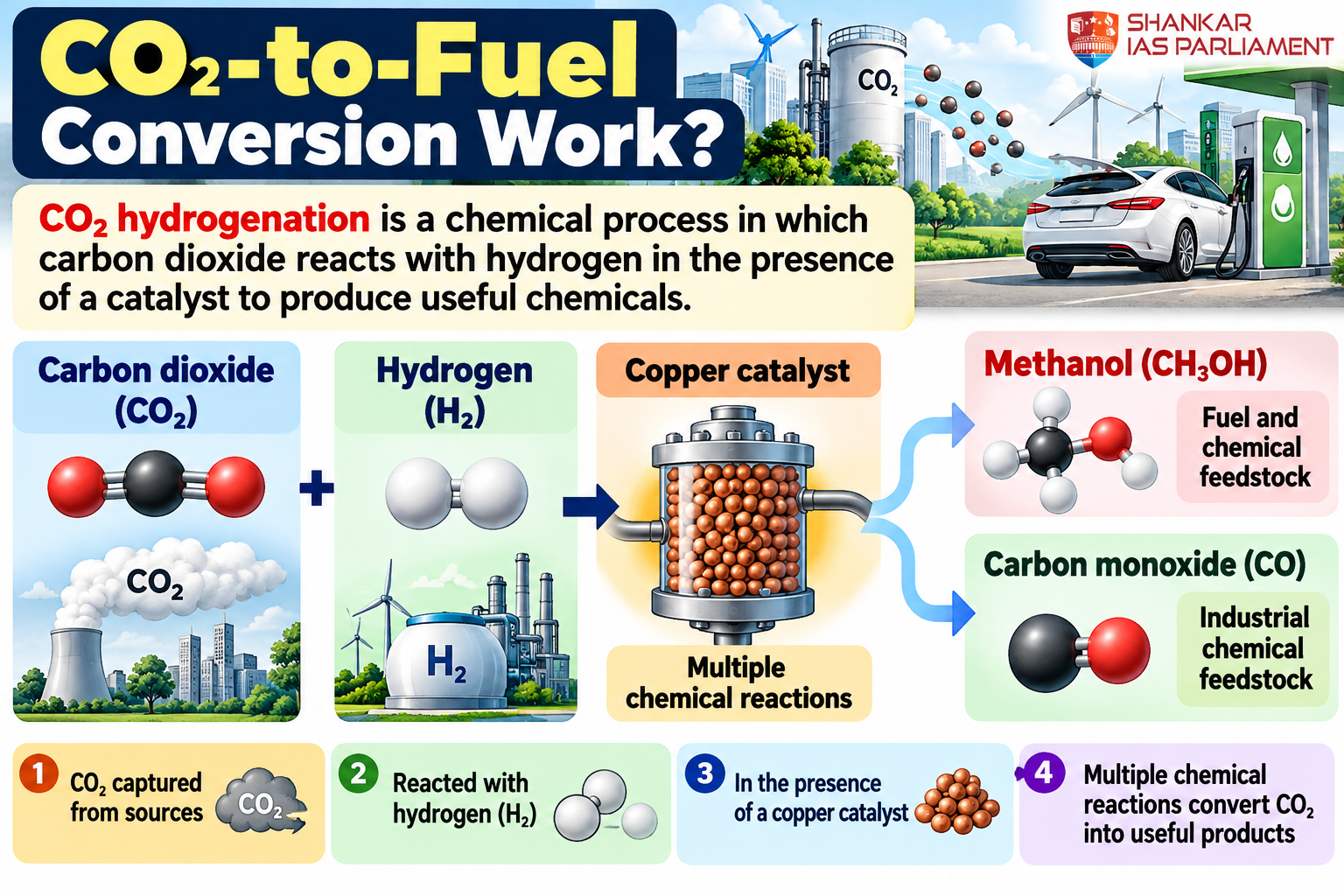
Researchers at the IISc, Bengaluru, developed a computational framework that maps 9,389 elementary chemical reactions for converting CO₂ into useful fuels and chemicals.
Key Findings
- The researchers expanded the initial database from 152 to 9,389 reactions.
- The network includes 105 chemical species present on the catalyst surface.
- A model limited to 152 reactions predicted formic acid as the main product and underestimated CO₂ conversion.
- The expanded model predicted a 40-fold increase in CO₂ conversion and identified methanol and carbon monoxide as major products, consistent with experimental results.
- The model also identified a less conventional pathway where molecular hydrogen (H₂) transfers hydrogen directly to intermediates without first splitting into individual atoms.
Technologies Used
- Quantum-mechanical simulations – Estimate reaction energies and barriers based on quantum mechanics.
- Machine learning (ML) – Predicts energy barriers for additional reactions to reduce computational effort.
- Automated reaction mapping – Identifies potential reactions among chemical species to build a comprehensive reaction network.
Significance
- Improved accuracy – This approach reduces errors by ensuring that potentially important reactions are not excluded.
- Catalyst design – It may assist in developing catalysts that favor pathways leading to methanol.
- Carbon utilisation – This framework supports research focused on converting captured CO₂ into valuable products.
- Wider applications – The framework can also be applied to CO₂ reduction with other catalysts, as well as to nitrogen reduction and water splitting.
Reference
TOI | CO₂ Hydrogenation



