0.2750
7667766266
x

Prahaar – India’s First Comprehensive Counter-Terror Doctrine

iasparliament Logo
February 27, 2026

Mains: GS III – Internal Security

Why in News?

Recently, India has unveiled its first-ever comprehensive counter-terrorism doctrine titled ‘Prahaar’, marking a significant evolution in the country’s security architecture.
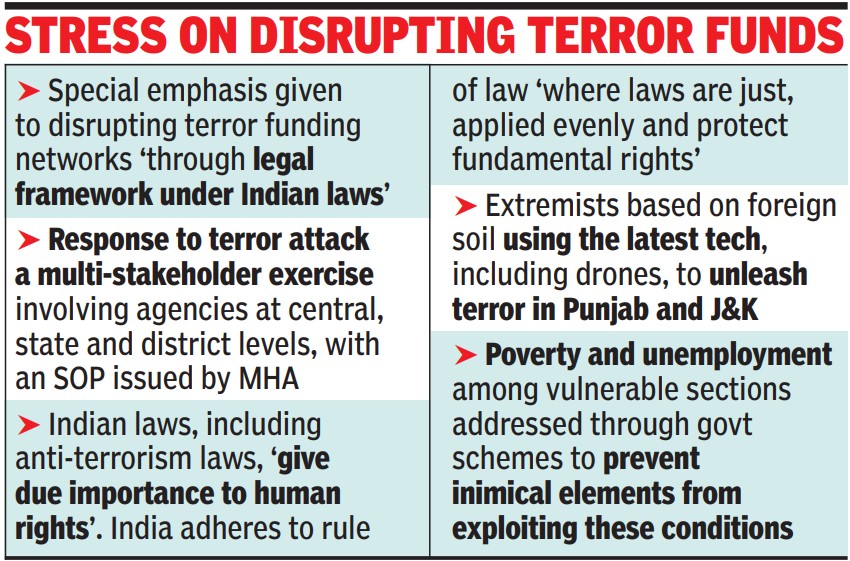
What is the rationale behind the policy?

  • Persistent Cross-Border Terrorism
    • Continued threats from hostile neighbours allegedly using terrorism as an instrument of state policy.
    • Presence of jihadi outfits and global terror networks such as ISIS and Al-Qaeda.
  • Evolving Nature of Terrorism
    • Use of modern technologies including drones, encrypted messaging apps, dark web, and cryptocurrency.
    • Increasing nexus between terrorist organisations and organised criminal networks.
  • Need for Institutional Coordination
    • Multiplicity of agencies dealing with terrorism necessitated a unified doctrine.
    • Requirement for synergy among central, state, and district-level authorities.

Prahaar

What are the key features of ‘prahaar’ doctrine?

‘Prahaar’ is an acronym representing seven pillars of India’s counter-terror strategy

  • Prevention
    • Focus on intelligence-based preventive action.
    • Early detection of radicalisation trends.
    • Strengthening surveillance and monitoring mechanisms.
  • Response
    • Swift and proportionate retaliation to terror attacks.
    • Graded police response depending on the level of radicalisation.
    • Uniform anti-terror structures and Standard Operating Procedures (SOPs) across jurisdictions.
  • Aggregation of Capacities
    • Whole-of-government approach integrating intelligence, law enforcement, and security agencies.
    • Modernisation of LEAs with advanced tools, technology, and weaponry.
    • Enhanced collaboration in intelligence collection and investigation.
  • Human Rights and Rule of Law
    • Legal processes ensuring safeguards and avenues of appeal for accused persons.
    • Emphasis on balancing national security with constitutional values.
  • Attenuation of Enabling Conditions
    • Addressing socio-economic vulnerabilities that lead to radicalisation.
    • Education, constructive engagement, and de-radicalisation programmes.
    • Disrupting overground worker networks and recruitment pipelines.
  • Alignment with International Efforts
    • Cooperation through extradition, deportation, and adherence to UN norms.
    • Global partnerships to counter misuse of ICT by terrorist groups.
    • Investments in technological cooperation and private-sector collaboration.
  • Recovery
    • Whole-of-society approach for post-attack rehabilitation and resilience building.
    • Strengthening community engagement to restore normalcy.

What are the emerging threat dimensions highlighted?

  • Cyber and Technological Threats
    • Use of encrypted platforms, dark web, and crypto for anonymity.
    • Proactive disruption of cyber activities of terror groups.
  • Drone and Hybrid Warfare
    • Deployment of drones for cross-border smuggling of arms and narcotics.
  • Criminal-Terror Nexus
    • Use of organised crime networks for logistics, financing, and recruitment.
  • Transnational Collaboration
    • Foreign-based terror groups leveraging local infrastructure and terrain knowledge.

What are the significance of the policy?

  • Doctrinal ClarityElevates counter-terrorism from an operational strategy to a formal doctrine.
  • Institutional UniformityStandardised structures and processes across levels of governance.
  • Holistic ApproachIntegrates security, socio-economic, legal, and international dimensions.
  • Balancing Security and RightsAcknowledges the importance of human rights in counter-terror operations.

What are the challenges?

  • Federal Coordination IssuesPolicing is a State subject and hence ensuring uniform adoption may be complex.
  • Technological UpgradationContinuous investment required to match evolving cyber threats.
  • Capacity BuildingNeed for trained manpower and specialised investigation skills at the state level.
  • Preventing MisuseSafeguards must prevent overreach and protect civil liberties.
  • International CooperationEffective enforcement of extradition and global cyber norms requires diplomatic agility.

What lies ahead?

  • The unveiling of ‘Prahaar’ marks a significant milestone in India’s internal security framework.
  • By institutionalising a proactive, intelligence-driven and coordinated approach, the policy seeks to address both conventional and emerging dimensions of terrorism.
  • Its success, however, will depend on effective federal cooperation, technological preparedness, safeguarding civil liberties, and sustained international collaboration.
  • If implemented robustly, Prahaar could strengthen India’s resilience against the evolving threat of terrorism while upholding democratic values.

Reference

The Times of India| Prahaar


Login or Register to Post Comments
There are no reviews yet. Be the first one to review.

ARCHIVES

MONTH/YEARWISE ARCHIVES

sidetext
Free UPSC Interview Guidance Programme
sidetext