0.1072
7667766266
x

Other Effective Area-based Conservation Measures (OECMs)

iasparliament Logo
August 05, 2026

Mains: GS III – Environmental Conservation

Why in News?

Recent discourse highlights India's emerging conservation challenge of transitioning from isolated protected areas (PAs) to a networked and inclusive conservation framework.

What is Other Effective Area-based Conservation Measures (OECMs)?

  • OECMsThese are geographically defined areas located outside formal national parks or reserves that achieve long-term and effective biodiversity conservation through ongoing human management or activities.

The term OECMs first appeared in 2010 within the Aichi Biodiversity Targets—global conservation goals established by the CBD as part of a strategic plan to conserve biodiversity.
  • Recognized by – Convention on Biological Diversity (CBD) in 2018.
  • Objectives – To deliver successful outcomes for the conservation of nature, alongside protected areas, and considering other area-based targets of the Global Biodiversity Framework.
  • Ecological Coverage – Increase coverage of ecologically representative areas of particular importance for biodiversity and ecosystem functions and services.
  • Stakeholder Engagement – Foster engagement with a diverse range of rights-holders and stakeholders who contribute to area-based conservation outside of protected areas.
  • Climate ActionAddress climate change by contributing to net-zero climate targets and building resilience to the physical impacts of climate change through nature-based solutions.
  • Identification and Mapping – The Ministry of Environment, Forest and Climate Change (MoEFCC), National Biodiversity Authority of India (NBA) and United Nations Development Programme (UNDP) are in the process of identifying, mapping and documenting OECMs in India.

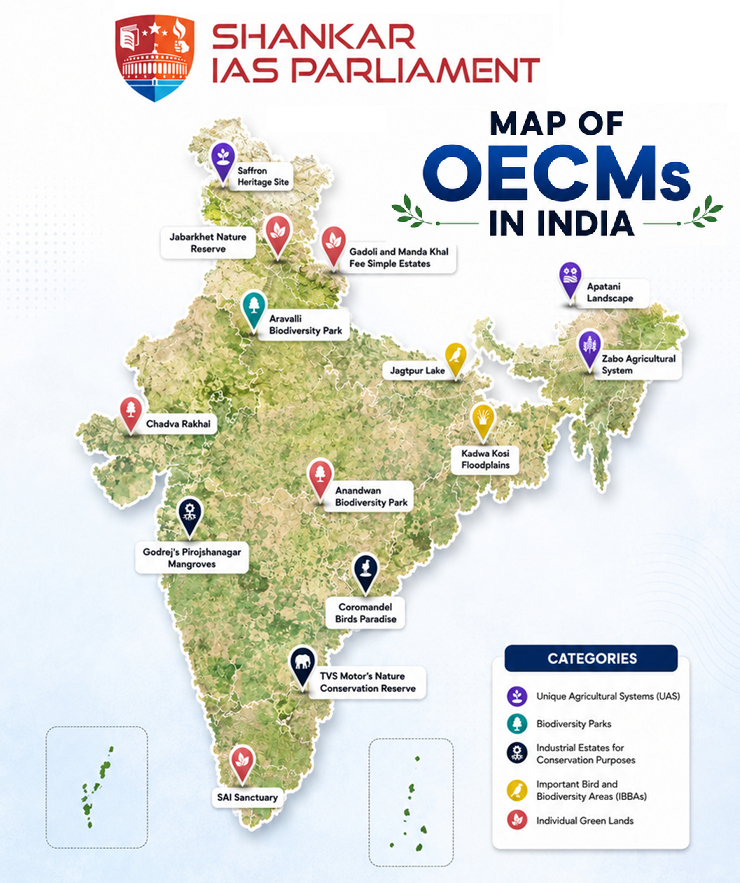
OECM in India

What the characteristics of OECMs?

  • Not Protected Areas – It lack formal designation as wildlife sanctuaries or national parks, which minimizes conflict with local economic interests.
  • Spatial segregation – It denotes the division of nature preservation zones from areas dominated by human activities, including agricultural regions and urban environments. 
  • Strict regulation – It entails restricting or prohibiting resource extraction, hunting, grazing, and permanent human settlement within defined boundaries.
  • Diverse governance structures – It involve management by local communities, private organizations, or government agencies through customary or legal frameworks.
  • Top-down control It relies on government oversight, ranger enforcement, and the imposition of legal penalties to prevent habitat degradation.
  • Sustained outcomes It include measurable biodiversity benefits and the provision of ecological corridors or carbon sinks

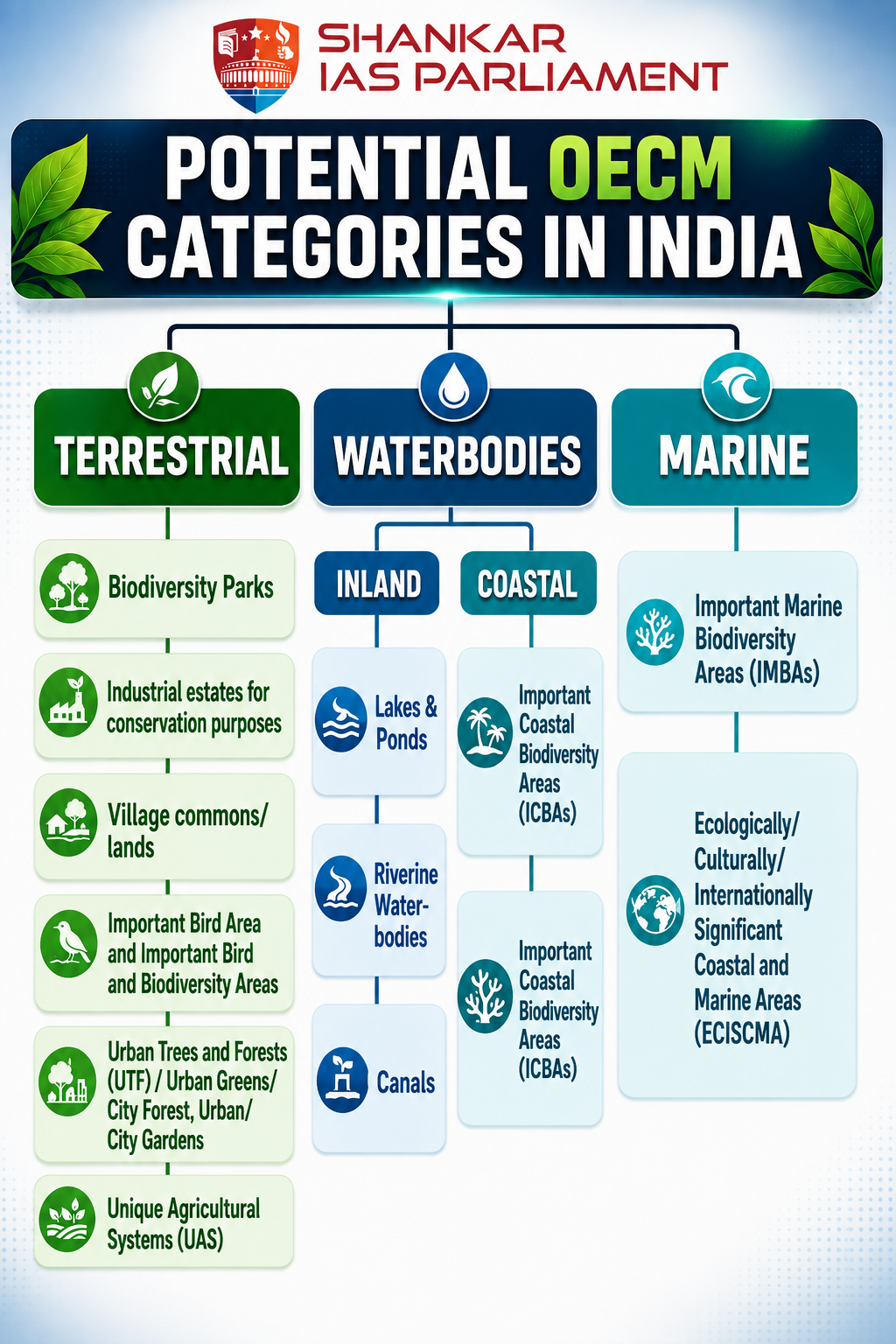
classification of OECM in india UPSc

What are the benefits of OECMs?

  • Community‑Led Governance – Supporting a range of governance and management mechanisms for conservation led by stakeholders other than the Government such as the
    • Communities, local healers, community-based organisations,
    • Corporates, women and youth and co-management models.
  • Traditional Knowledge Recognition – Providing recognition to traditional knowledge, social practices, and cultural and spiritual beliefs, that promote effective and equitable use of biological and genetic resources.
  • Corridor Conservation – Conserving important ecosystems, habitats and wildlife corridors.
  • Land Restoration – Restoration of degraded agricultural, forest and pasture lands.
  • Species Recovery – Supporting the recovery of threatened species.
  • Ecosystem Services – Maintaining ecosystem functions and securing ecosystem services such as:
    • Rejuvenation of springs and water bodies, aquifers, and improving ground water table
    • Conservation and promotion of agro biodiversity leading to food and nutritional security.
  • Enhancing resilience against threats.
  • Ecosystem Connectivity – Retaining and connecting remnants of fragmented ecosystems within developed landscapes.
  • Responsible Tourism – Promoting recreational benefits and responsible tourism.

What lies ahead?

  • Case‑by‑Case Approach – A flexible approach to recognizing diverse Other Effective Area-Based Conservation Measures (OECMs) is essential; however, clear guidelines are required to prevent ambiguity. 
  • Reporting to UNEP‑WCMC/WDPA – Reporting for OECMs parallels the protected area (PA) system, although key attributes differ as a result of legal and ownership distinctions.
  • Management & Monitoring – India’s Management Effectiveness Evaluation (MEE) and Protected Area Management Effectiveness (PAME) tools should be adapted for OECMs to ensure sustained biodiversity outcomes.
  • Stakeholder Consent – A two-step consent process is necessary to ensure that OECM recognition remains inclusive and equitable.
  • Global Commitments – Both OECMs and protected areas are critical for achieving India’s 30 by 30 conservation target under the Global Biodiversity Framework (GBF).

Reference
The Hindu | Next conservation challenge


Login or Register to Post Comments
There are no reviews yet. Be the first one to review.

ARCHIVES

sidetext


