Prelims: Current events of national and international importance | Conservation
Why in News?
A new herpetological study has reported the first confirmed record of the Sistan sand boa (Eryx sistanensis) in India.
It is a small, non-venomous, burrowing snake.
Habitat - Most verified records of the snake place it in farmlands, scrublands, and compact sandy soils located close to human habitations.
Distribution - Researchers documented 3 live individuals from the northern Thar Desert in Rajasthan.
Previously known to inhabit parts of Iran and Pakistan, this discovery officially adds a 4th sand boa species to India's native reptile database.
4 distinct sand boa species
Red sand boa (Eryx johnii)
Rough-scaled sand boa (Eryx conicus)
Whitaker’s boa (Eryx whitakeri)
Sistan sand boa (Eryx sistanensis) — New Addition
Key Characteristics
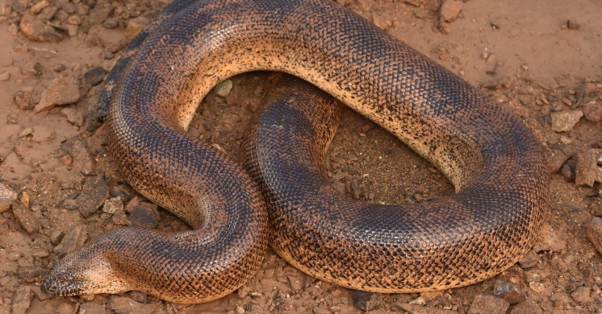
Persistent Banding - It can be clearly distinguished from the common red sand boa by its persistent dark, sooty body bands and a tail that gradually tapers toward the tip.
Unlike red sand boas, which lose their distinct body bands as they mature into adults, the Sistan sand boa retains these markings throughout its entire lifespan.
Coloration - Juveniles are typically buff-colored, while sub-adults and fully grown adults exhibit a tan to tan-brown coloration.
Behavioral Traits - The species is notoriously docile, exhibits a high tolerance to ambient temperature variations, and has low metabolic maintenance requirements.
Conservation Status
IUCN Red List - Not yet evaluated (NE).
Wildlife (Protection) Act, 1972 (India)- Listed under Schedule II, granting it high legal protection against hunting, poaching, and commercial trade.