Mains: GS-III – Energy Security
Why in news?
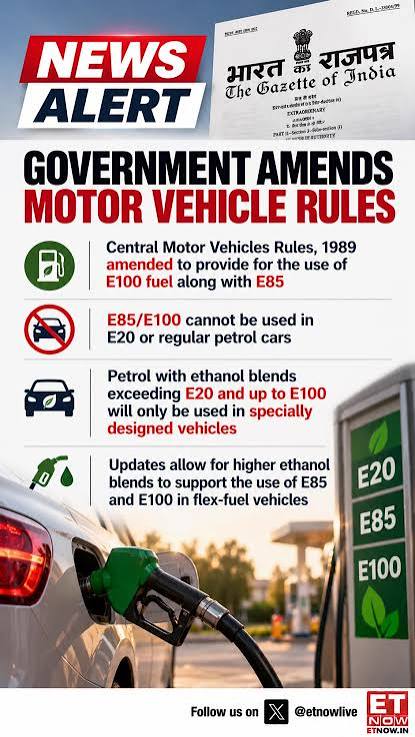
The Ministry of Road Transport and Highways has amended the Central Motor Vehicles Rules, 1989, to permit the use of ethanol-based fuel vehicles, paving the way for the use of flex-fuel vehicles.
What is E100?
- E100: Ethanol-based fuel – It contains up to 100% ethanol (E100) used as fuel in vehicles.
- It differs from
- E20 – 20% ethanol + 80% petrol
- E85 – 85% ethanol + 15% petrol
- E100 – Almost entirely ethanol.
- Flex-fuel vehicles – They can run on petrol, ethanol blends of varying proportions, or pure ethanol.
What has the government changed?
- Central Motor Vehicles Rules, 1989 – They came into force on July 1, 1989, under the authority of the Motor Vehicles Act, 1988.
- These rules govern the regulation, operation, safety standards, and licensing of motor vehicles across India.
- Rule 115 – The amendments modify Rule 115, which deals with emission standards and related requirements for motor vehicles.
- Rule 115E – It contains additional provisions relating to emission testing.
- Key changes – One of the key changes is the inclusion of E100, or fuel comprising 100% ethanol, alongside E85 in several tables under Rule 115.
- The amendments include an explanatory note stating that E85 or E100 may be used only in flex-fuel vehicles designed by original equipment manufacturers.
Should existing vehicles switch to E85 or E100?
- Affect to existing vehicles – No, the notification does not require owners of existing vehicles to switch to E85 or modify their vehicles, either now or in the future.
- Compatibility – The Ministry sought to allay concerns among motorists, clarifying that a vehicle’s compatibility with E10 or E20 does not establish its suitability for E85.
- Motorists should check the fuel-compatibility sticker on their vehicle and follow the manufacturer’s guidance in the owner’s manual when choosing fuel at a filling station.
How will the amendments support the rollout of E100 vehicles?
- Easier approval process – The amendments are expected to facilitate homologation, the official certification required before a vehicle can be sold or used on public roads.
Homologation – It is the process through which authorised testing agencies, such as the Automotive Research Association of India (ARAI), verify that vehicles and components comply with prescribed technical, safety, and environmental standards.
- This will help secure type approvals for E100-powered vehicles, supporting their rollout and wider consumer adoption.
- Updated fuel classification – Corrections have also been incorporated into fuel classifications, including a reference to gasoline blended with 20% ethanol, or E20, in place of an earlier notation referring to E10.
What is the status of the Ethanol Blended Petrol Programme now?
- Achieves E20 target ahead of schedule – India achieved its 20% ethanol-blending (E20) target in 2025, five years ahead of the original 2030 deadline set under the National Policy on Biofuels, 2018.
- E20 becomes the new standard – From April 2026, all Bharat Stage-VI (BS-VI) vehicles are required to fully meet E20 emission standards, and all petrol sold across India is mandated to contain 20% ethanol (E20).
- Expands beyond E20 – The policy focus is now widening beyond E20: the government has enabled the regulatory pathway for E85 and E100 vehicles, though these fuels will require compatible flex-fuel vehicles and dedicated dispensing infrastructure.
What are consumers’ concerns?
- Vehicle compatibility – Owners of older or non-E20-compliant vehicles question whether E20 could damage components, raise maintenance costs, or leave them without access to lower-ethanol petrol.
- Fuel efficiency – Consumers also question E20’s effect on fuel economy.
- Ethanol has a lower energy density than petrol; while the government estimates a 5% decline in mileage, some consumers say the loss is greater.
- Storage & Contamination risk – Dealers, meanwhile, warn that ethanol’s affinity for water could raise contamination risks during the monsoon, strengthening the case for separate storage and dispensing systems for higher blends.
- These concerns have prompted calls for a transparent assessment.
- No reduction in price – Users have also questioned why blending of ethanol has not reduced retail fuel prices, and the government has responded by saying that procurement of raw materials such as maize at Rs. 71.86 per litre is higher than $70 per barrel of crude oil (or Rs. 37 to Rs. 40 per litre).
What lies ahead?
- Experts argue that the focus on ethanol blending risks distracting from electrification, which they say offers a clearer long-term path to deep emissions cuts.
- The future is electric. Other technologies are interim solutions.
- Electrification is cleaner, avoids the lifecycle emissions associated with ethanol production, and offers public-health and climate benefits.
- As the grid decarbonises, electrification is the only viable long-term option. It is also where global innovation is concentrated, says the International Council on Clean Transportation (ICCT).
Reference
The Hindu | What the new E100 vehicle rules mean?



