Prelims: Current events of national and international importance | Science & Technology
Why in News?
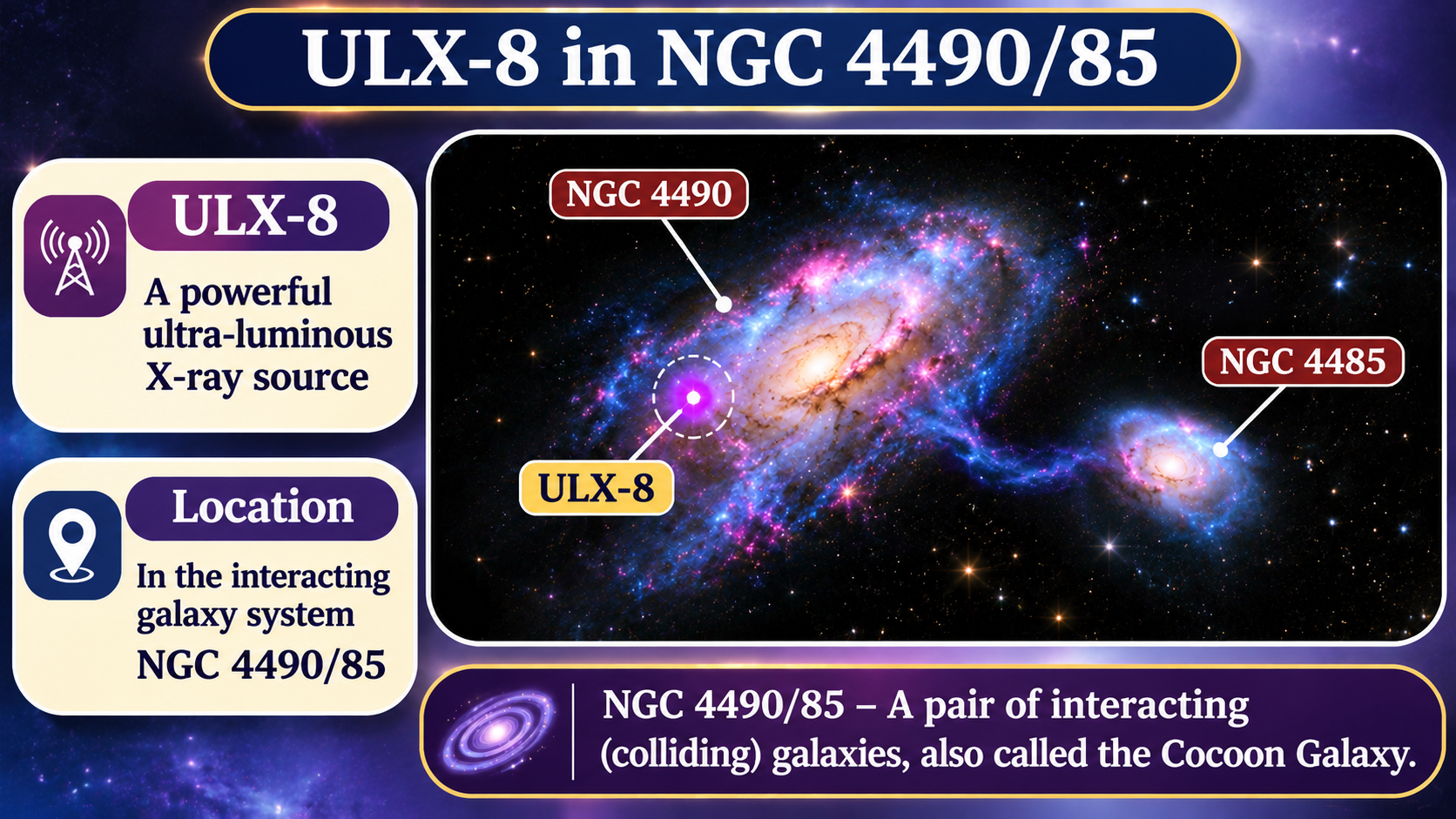
A team of astronomers analyzed 24 years of archival and recent X-ray data to unravel the complex behavior of an extreme cosmic source in a nearby galaxy.
Key Highlights
- The study focuses on an exceptional Ultraluminous X-ray Source (ULX) designated as ULX-8 located in the interacting galaxy system NGC 4490/85.
- Multi-Mission Long-Term Tracking - The researchers combined historical and current data spanning over two decades captured by 3 space-based X-ray observatories
- NASA’s Chandra X-ray Observatory,
- The European Space Agency's (ESA) XMM-Newton, and
- NASA’s Neil Gehrels Swift Observatory.
- Decoding Super-Eddington Accretion - ULXs emit radiation at rates that dramatically exceed the standard Eddington limit (the theoretical maximum luminosity for a body of a given mass, where gravity balances radiation pressure).
- The study sheds light on how compact objects such as black holes or neutron stars sustain such intense matter-accumulation (accretion) rates without blowing themselves apart.
- Uncovering Gas Outflows- The multi-decade temporal analysis helped trace the intricate relationship between intense accretion flows and the generation of powerful gas outflows/winds that sculpt the surrounding interstellar medium.
Ultraluminous X-ray Sources (ULXs)
- ULXs are non-stellar nuclear point sources that shine with X-ray luminosities greater than 10^39 erg/s, outshining typical X-ray binaries by orders of magnitude.
- They typically emit more energy than the theoretical Eddington limit for a standard stellar-mass black hole, making them prime laboratories for studying intermediate-mass black holes (IMBHs) or extreme super-Eddington accretion physics.
Reference
PIB | Brightest X-ray emitters in nearby galaxies



