Why in news?
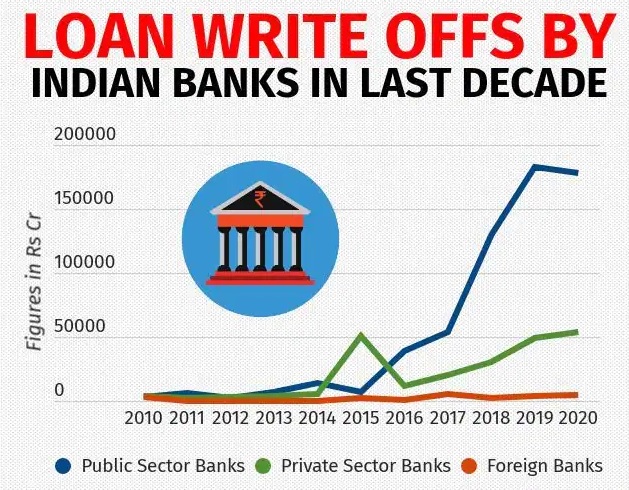
As per the government, during the last five years (2017-18 to 2021-22), scheduled commercial banks wrote off non-performing assets (NPAs) worth Rs 9,91,640 lakh crore.
What is the RBI data on loan write-offs?
- According to RBI data, banks have written off Rs 10,09,510 crore over the last five years.
- Public Sector Banks (PSBs) accounted for most of these write-offs.
- Banks were able to recover only 13 % of this amount subsequently despite lending funds against assets or collaterals.
What are the causes for losses in banking / financial sector (BFSI)?
- Major causes for losses in banking / financial sector (BFSI) include
- Economic downturn
- Technological disruption
- Change in government policies
- Regulatory hurdles
- Increased competition
- Fraud or malfeasance
- Banker’s error of judgement in advancing funds
What does loan write-offs mean?
- Loan write-offs - Writing off a loan essentially means it will no longer be counted as an asset.
- Significance - By writing off loans, a bank can reduce the level of non-performing assets (NPAs) on its books.
- The amount so written off reduces the bank’s tax liability.
- Reason - The bank writes off a loan after the borrower has defaulted on the loan repayment and there is a very low chance of recovery.
- It may be important to realise that all loan write-offs are not lost money.
- Many write-off cases continue to be on birth register of banks/financial institutions.
- Write-off is resorted to even in cases where the bank has not exhausted all avenues for recovery of dues.
- Such write-offs do not affect the right of the bank to proceed against the borrowers to collect the dues.
- Any recovery made against the borrower is considered as a profit for the bank in that financial year.
Why loan classification is so significant?
- Loan classification reflects what the true value of the loan might be.
- It is accompanied by provisioning, which ensures the bank sets aside a buffer to absorb likely losses.
- If the losses do not materialize, the bank can write back provisioning to profits.
- If the losses do materialize, the bank does not have to suddenly declare a big loss, it can set the losses against the prudential provisions it has made.
- The bank balance sheet then represents a true and fair picture of the bank’s health.
Quick Facts
Non-performing assets (NPAs)
- NPA is a loan or advance for which the principal or interest payment remained overdue for a period of 90 days.
- Banks are required to classify NPAs further into Substandard, Doubtful and Loss assets.
- Substandard assets - Assets which has remained NPA for a period less than or equal to 12 months.
- Doubtful assets - An asset would be classified as doubtful if it has remained in the substandard category for a period of 12 months.
- Loss assets - Loss asset is considered uncollectible and of such little value that its continuance as a bankable asset is not warranted, although there may be some salvage or recovery value.
References
- The Hindu Businessline│ Loan write-offs are above board
- Indian Express│ What is a loan write-off and why do banks do it?



