Mains: GS III – Environment, Energy
Why in News?
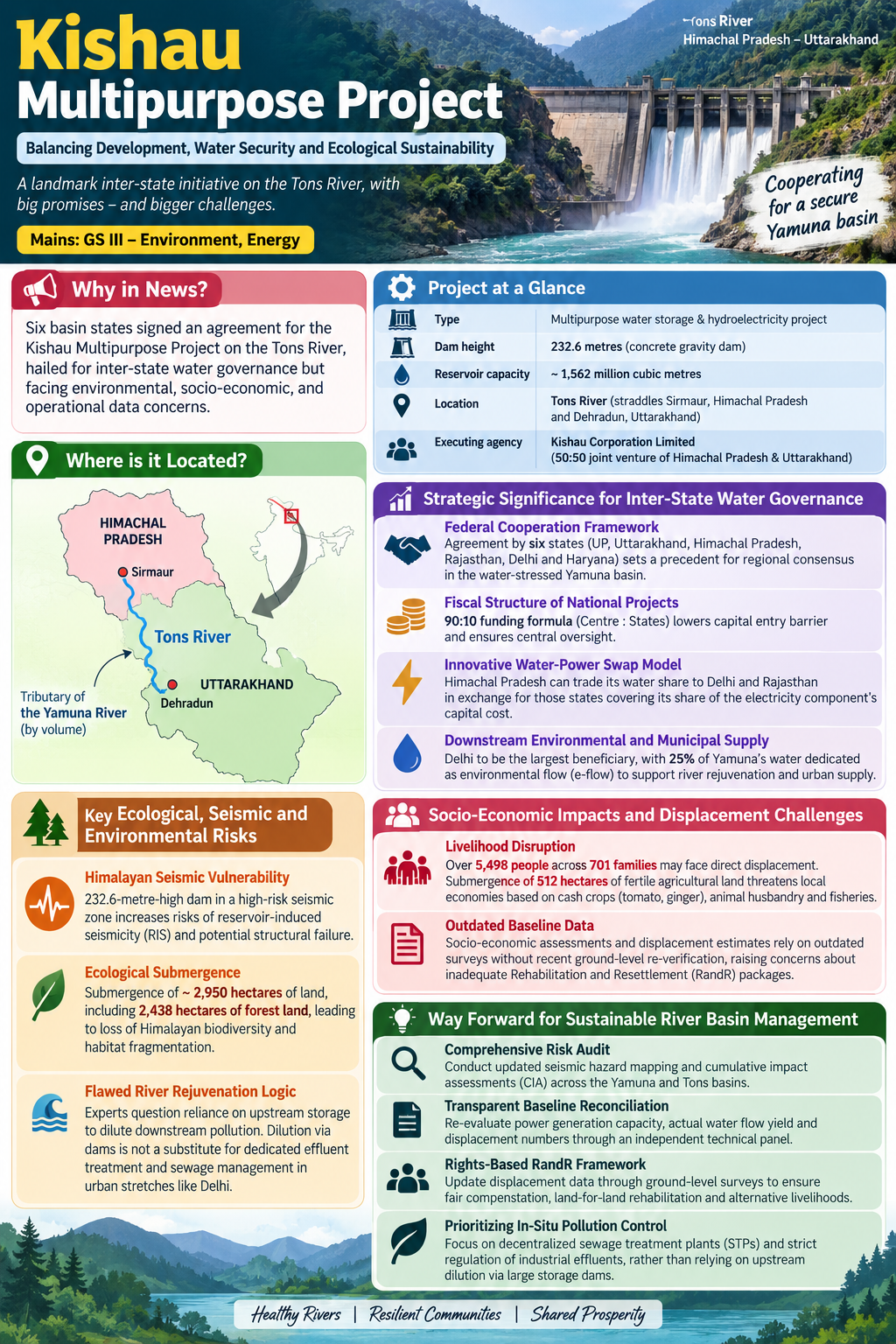
Six basin states signed agreement for Kishau Multipurpose Project on Tons River, hailed for inter‑state water governance but facing environmental, socio‑economic, and operational data concerns.
What is the Kishau Multipurpose Project and where is it located?
- Project Profile – The Kishau Multipurpose Project is a major planned water storage and hydroelectricity venture featuring a 232.6-meter-high concrete gravity dam.
- It creates a massive reservoir with a storage capacity of roughly 1,562 million cubic meters.
- Geographical Location – It is situated on the Tons River (the primary tributary of the Yamuna River by volume), directly straddling the inter-state border between Sirmaur district in Himachal Pradesh and Dehradun district in Uttarakhand.
- Executing Agency – The project is executed by Kishau Corporation Limited, a 50 –50 joint venture between the state governments of Himachal Pradesh and Uttarakhand.
Why is the Kishau Multipurpose Project strategically significant for inter-state water governance?
-
Federal Cooperation Framework – The signing of the agreement by six states (Uttar Pradesh, Uttarakhand, Himachal Pradesh, Rajasthan, Delhi, and Haryana) sets a precedent for regional water-sharing consensus in the water-stressed Yamuna basin.
-
Fiscal Structure of National Projects – With a 90:10 funding formula between the Central Government and participating states, the project lowers the capital entry barrier for state governments while securing central oversight for national-scale infrastructure.
- Innovative Water-Power Swap Model – The arrangement allows Himachal Pradesh to trade its allocated water share to Delhi and Rajasthan in exchange for those states covering Himachal Pradesh's share of the electricity component's capital cost.
- Downstream Environmental and Municipal Supply – Delhi is slated to be the largest beneficiary, with 25% of Yamuna’s water dedicated as environmental flow (e-flow) to assist in downstream river rejuvenation and urban supply.
What key ecological, seismic, and environmental risks surround the project?
- Himalayan Seismic Vulnerability – The construction of a 232.6-metre-high concrete gravity dam in a high-risk seismic zone in the Himalayas increases risks related to reservoir-induced seismicity (RIS) and potential structural failure.
- Ecological Submergence – The project requires the submergence of roughly 2,950 hectares of land, including 2,438 hectares of forest land, causing loss of Himalayan biodiversity and habitat fragmentation.
- Flawed River Rejuvenation Logic – Environmental experts question the approach of relying on upstream water storage to dilute downstream pollution. Dilution via storage dams is considered an ineffective substitute for dedicated effluent treatment and sewage management in urban stretches like Delhi.
What are the socio-economic impacts and displacement challenges associated with the dam?
- Livelihood Disruption – Field studies indicate that over 5,498 people across 701 families face direct displacement.
- The submergence of 512 hectares of fertile agricultural land threatens local agrarian economies built around cash crops (tomato, ginger), animal husbandry, and local fisheries.
- Outdated Baseline Data – The socio-economic impact assessments and displacement estimates rely on outdated baseline surveys without recent ground-level re-verification, raising concerns about inadequate Rehabilitation and Resettlement (RandR) packages.
What is the way forward for sustainable river basin management?
- Comprehensive Risk Audit – Conduct updated seismic hazard mapping and cumulative impact assessments (CIA) across the Yamuna and Tons river basins before full-scale construction.
- Transparent Baseline Reconciliation – Re-evaluate power generation capacity, actual water flow yield, and displacement numbers through an independent technical panel to harmonize official records.
- Rights-Based RandR Framework – Update displacement data through ground-level surveys to ensure fair compensation, land-for-land rehabilitation, and alternative livelihood restoration for affected mountain communities.
- Prioritizing In-Situ Pollution Control – Reframe river cleaning strategies by prioritizing decentralized sewage treatment plants (STPs) and industrial effluent regulation rather than relying on upstream dilution via large storage dams
Reference
Down to Earth | Kishau Water Agreement



