Prelims: Current events of national and international importance | Agriculture
Why in News?
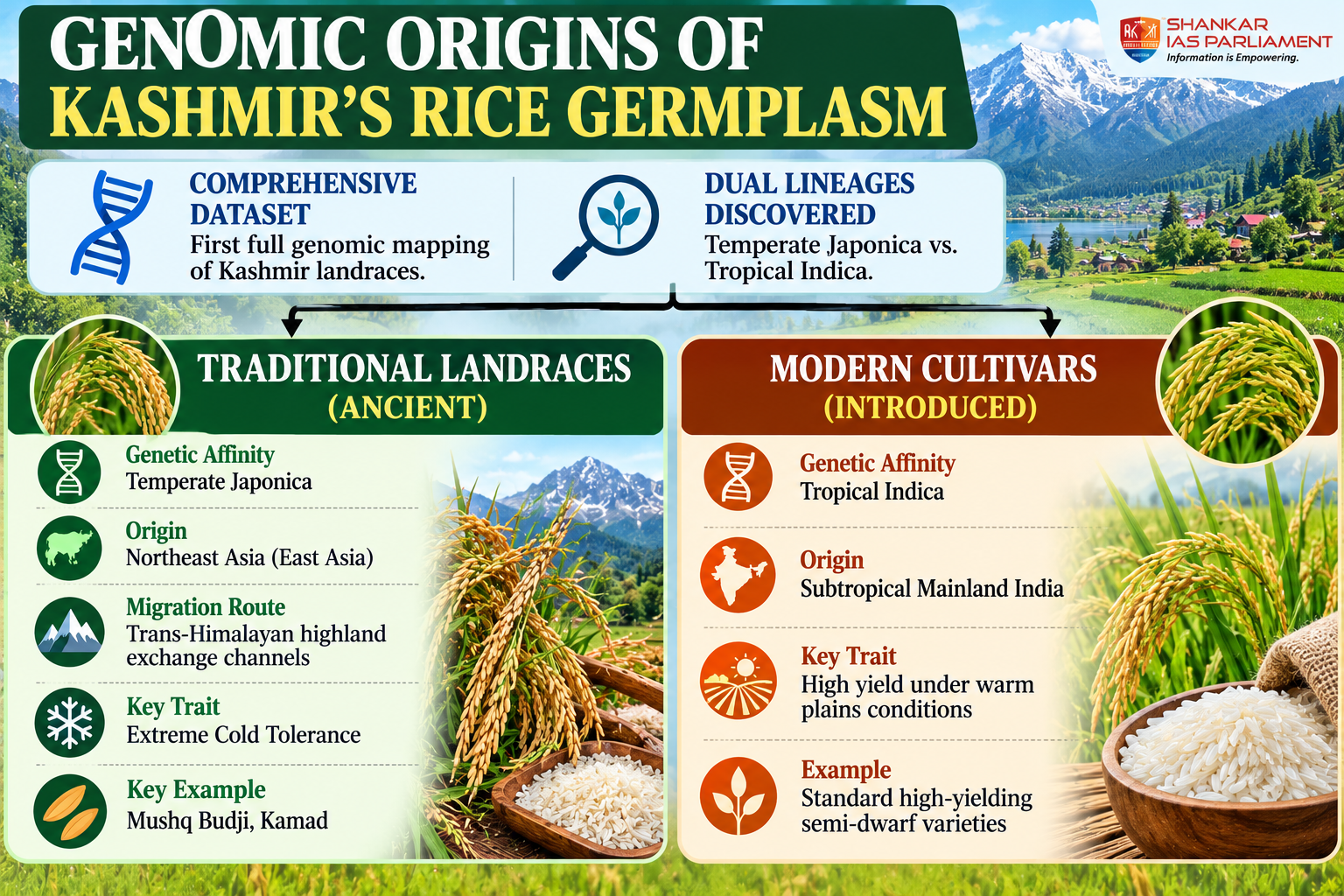
Recently, a study conducted by researchers at SKUAST-Kashmir revealed that traditional rice landraces of the Kashmir Valley trace their primary genetic roots to temperate japonica rice from Northeast Asia.
Key Genomic Findings
|
Parameter |
Traditional Kashmir Landraces |
Modern Introduced Varieties |
|
Primary Lineage |
Temperate Japonica |
Subtropical Indica |
|
Geographic Origin |
Northeast Asia (East Asia/Trans-Himalayan routes) |
Indo-Gangetic & Peninsular India |
|
Adaptive Phenotype |
High cold tolerance during early germination and reproductive stages in alpine high-altitude climates (>1,500 m |
Thermal adaptation to warm, low-altitude plains. |
|
Notable Cultivars |
Mushq Budji (aromatic landrace), Kamad, Zag (red rice). |
Modern high-yielding varieties (HYVs). |
Archaeobotanical Significance
Reference