What is the issue?
As MSMEs are expected to become the backbone of India there is a strong need to make them more efficient and competitive by adopting Industry 4.0 technologies.
What is Industry 4.0?
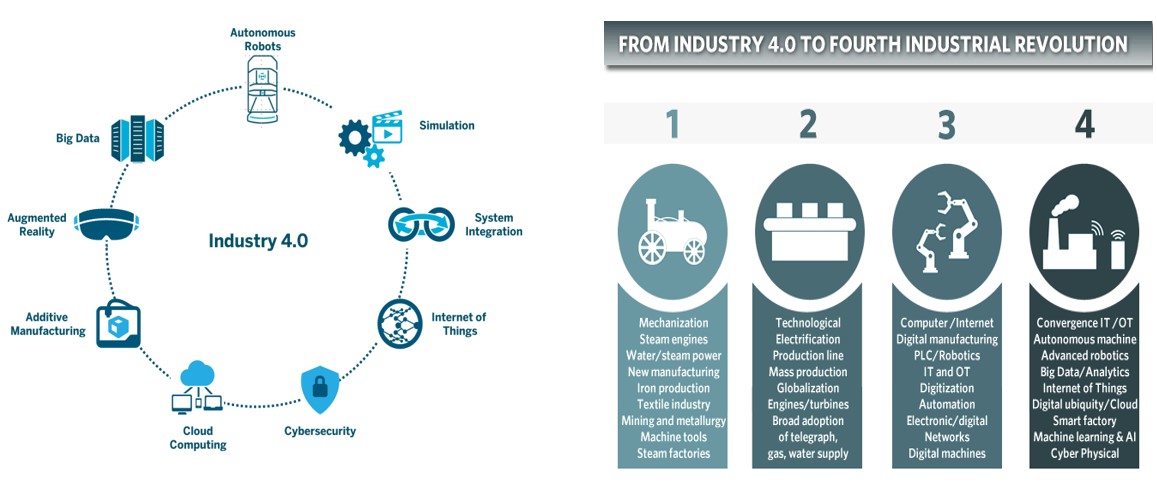
- Industry 4.0/ 4th Industrial Revolution is the digital transformation of manufacturing/production, related industries, and value creation processes.
- Refers to the intelligent networking of industrial machines and processes with the help of information and communication technology (ICT).
- The technologies involved include -
- Additive manufacturing
- Internet of Things
- Cyber Physical Systems
- Augmented Reality/Virtual Reality
- Data analytics
The term ‘Industry 4.0’ was coined by German government in 2011. Other countries have specific terms for their own industrial initiatives. E.g., U.S. - Smart Manufacturing, China - Made in China 2025, and India - Make in India or Digital India.
What is the significance of MSMEs?
- Form more than 95% of the industries in India
- Produce more than 45% of the total manufacturing output
- Employ more than 40% of the workforce
- Contribute roughly 30% to the GDP and half of the country’s export
- Support larger enterprises, leading to a seamless supply chain integration
How do Industry 4.0 technologies benefit MSMEs?
- Make MSMEs more competitive by offering world-class quality products to customers.
- Increase the level of efficiency and productivity.
- Improve the delivery timings and the flexibility in meeting the different needs.
- Promote innovation and revolutionise the production processes.
What are the challenges involved?
- Lack of awareness regarding Industry 4.0 and its benefits
- Less scope for major financial investments to adopt Industry 4.0.
- Lack of experts and consultants.
- Absence of a positive organisational culture and the support of people.
- Absence of frameworks and steps that assist MSMEs in adopting Industry 4.0 technologies like understanding of data.
What are the measures needed?
- Promotion of investments in digital infrastructure and data.
- Changes to curriculums (under National education systems) to meet the changing skill sets.
- Identifying the relevant tools and practices in adopting new technology.
- Promoting R&D in both public and private sectors to facilitate innovation.
- Regulatory frameworks that encourage innovation, digitalisation and the adoption of new technologies while ensuring data protection
- In all, government intervention in funding, infrastructure and human capital development is the need of the hour.
Source: The Hindu, Business Line



