Why in News?
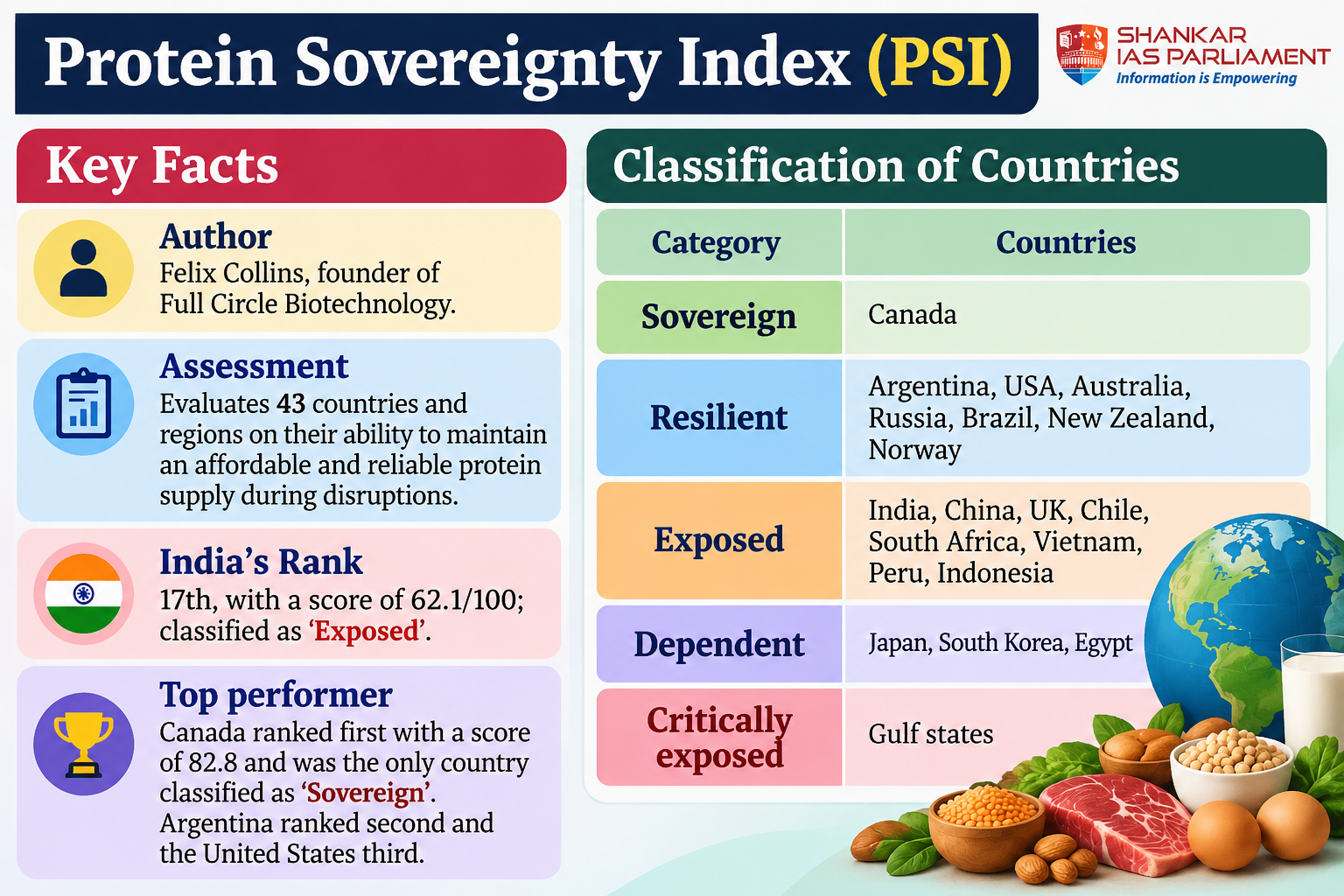
The recently released Protein Sovereignty Index, developed by Full Circle Biotechnology, highlights vulnerabilities in countries’ protein supply chains.
What is Protein Sovereignty?
- Protein sovereignty – A country’s ability to ensure reliable, affordable and sustainable protein supplies despite trade, production and input disruptions.
- Importance of protein – Protein supports growth, tissue repair, and muscle maintenance and hormone production; deficiency can cause malnutrition, especially in children.
What are the Major Vulnerabilities in India’s Protein Supply?
- Dependence on Imported Fertilisers –
- Import dependence – 68.6% of fertiliser supply by value comes from foreign sources.
- India imports over 90% of its rock phosphate and depends on imported natural gas for urea production.
- External shocks – Strait of Hormuz disruptions, global price volatility and rising fishmeal costs threaten agricultural and aquaculture production.
- Rising Pulse Import Dependence –
- India imported a record 7.34 million tonnes of pulses in 2024–25, accounting for about one-fifth of domestic supply.
- Pulse cultivation declined from 30.6 million hectares (2021–22) to 26.9 million hectares (2024–25), increasing import dependence.
- Water Stress and Unsustainable Agriculture –
- Groundwater supports nearly 60% of irrigation, increasing vulnerability to groundwater depletion.
- Renewable freshwater availability is 1,014 cubic metres per person, below the water-stress threshold of 1,700 cubic metres.
- Affordability and Nutritional Inequality
- 520.1 million Indians (35.5%) could not afford a healthy diet in 2025, according to SOFI 2026.
- The richest 10% consumed 1.5 times more protein than the poorest 10%, whose egg, fish and meat intake reached only 38% of recommendations.
What are the Implications for India?
- Food security – Import disruptions and price shocks can affect the availability and affordability of protein-rich foods.
- Agricultural resilience – Dependence on imported fertilisers and energy exposes domestic production to geopolitical and global market uncertainties.
- Environmental sustainability – Groundwater depletion threatens long-term agricultural productivity and the stability of food supplies.
- Public health – Inadequate access to diverse protein sources can worsen malnutrition and nutritional deficiencies.
- Economic inequality – Rising food prices disproportionately affect low-income households, widening nutritional disparities.
What measures can be taken?
- Diversify fertiliser supplies – Strengthen domestic fertiliser production, improve supply-chain resilience and diversify import sources.
- Promote pulses – Expand pulse cultivation through improved seeds, assured procurement, better storage and remunerative prices.
- Adopt sustainable agriculture – Promote micro-irrigation, rainwater harvesting, groundwater management and climate-resilient farming.
- Diversify protein sources – Encourage pulses, dairy, eggs, fish and other locally available nutritious foods according to regional dietary preferences.
- Improve affordability – Strengthen nutrition programmes, food distribution systems and access to affordable protein-rich foods for vulnerable households.
- Invest in research – Develop climate-resilient crops, improve agricultural input efficiency and support sustainable fisheries and aquaculture.
What lies ahead?
- India’s protein challenge extends beyond domestic food production to the resilience of agricultural inputs, sustainable resource management and equitable access to nutrition.
- Strengthening protein sovereignty requires an integrated approach that combines import diversification, pulse self-sufficiency, and affordable nutritious diets.
Reference
Down To Earth| India’s protein supply exposed to import dependence



