Mains: GS III – Energy | Infrastructure
The acceleration of India's transition from fossil fuels to clean energy raises important questions regarding economic equity and social impact.
Progress in renewable energy
Capacity Milestone – Non‑fossil sources now contribute over half of India’s installed electricity capacity, advancing toward the 500 GW target by 2030.
Deployment Success – Projects like Rewa Solar Park and storage initiatives in Madhya Pradesh showcase cost reduction and investment mobilisation.
Solar Role – Solar power increasingly meets daytime electricity demand, strengthening India’s renewable energy mix.
Continued dependence on coal
Dominant Role – Despite lower installed capacity share, coal still generates 70%+ of electricity.
Scale – India produces 1+ billion tonnes annually with ~230 GW coal‑based thermal capacity.
Critical Importance – Coal underpins baseload power, grid stability, industry, state revenues, and employment.
Intermittency of Renewable Energy
Variable Output – Solar and wind generation fluctuate with weather and time of day.
Storage Gap – Limited storage capacity makes it hard to meet evening and peak‑hour demand.
Continued Coal Dependence
Reliability – Coal remains vital for stable electricity supply.
Risk of Rapid Exit – A fast phase‑down without alternatives could endanger energy security and industrial growth.
Livelihood Dependence on Coal
Mass Employment – Coal sustains millions of jobs across mining, transport, power generation, equipment manufacturing, and allied sectors.
Vulnerability – Large numbers of informal workers lack social protection and have few alternative employment options.
Regional Inequality
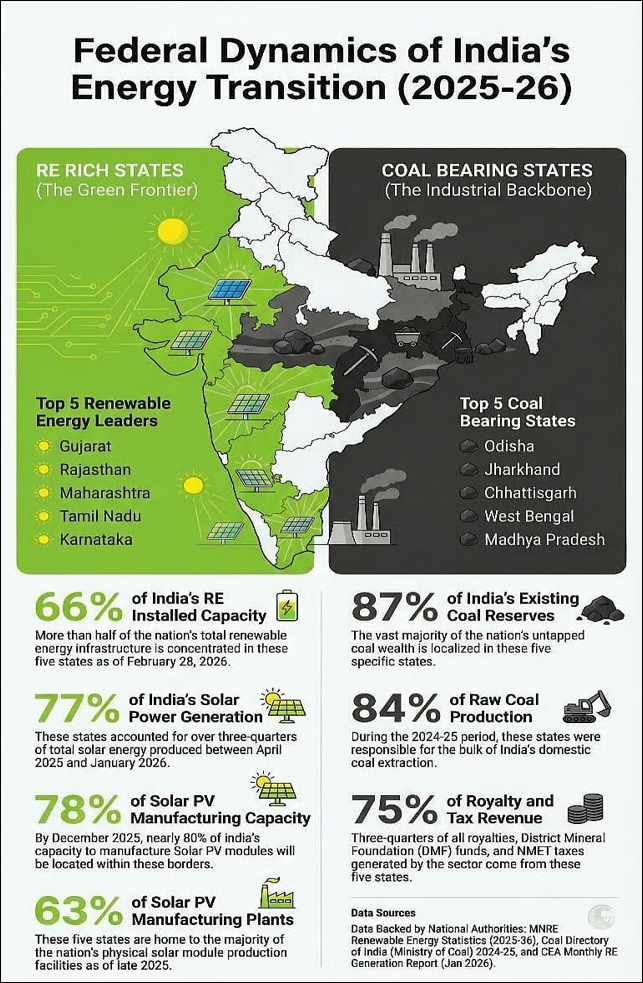
Coal States Burdened – Jharkhand, Chhattisgarh, Odisha, Madhya Pradesh, and West Bengal bear the social & economic costs of decarbonisation.
Persistent Vulnerability – Many coal‑rich districts remain economically fragile despite fuelling national industrialisation.
Federal Challenge
Union vs State Roles – Energy & mining policy is Union‑driven, but transition impacts fall on states/districts.
Revenue Decline – States risk losing coal royalties, revenues, jobs, and local economic activity during decarbonisation.
Limited Diversification
Absorption Gap – Renewable projects alone cannot re‑employ the coal workforce.
Regional Disparity – Several coal‑producing states have lower renewable potential compared to western & southern India.
Institutional Fragmentation
Multi‑Sector Involvement – Transition spans power, coal, renewables, labour, finance, industry, environment, tribal affairs, rural development.
Coordination Gap – Weak integration raises social & fiscal costs of energy transition.
Inadequate Early Planning
Delayed Action Risk – Waiting until mines/power plants turn unviable risks sudden disruption.
Worker Impact – It could leave workers & communities without alternatives or social safety nets.
Adopt a Just Transition Framework
Dual Focus – Align decarbonisation with livelihood protection.
Inclusive Benefits – Ensure coal‑dependent workers & communities share gains of the clean‑energy economy.
Diversify Coal Dependent Economies
Sectoral Expansion – Promote manufacturing, logistics, agro processing, circular economy, services, and clean energy industries.
Employment Security – Build alternative jobs before coal activities decline, ensuring smoother transition.
Repurpose Post Mining Land
Economic Use – Convert retired mines into industrial clusters, manufacturing zones, logistics parks, renewable energy facilities.
Social & Ecological Renewal – Promote ecological restoration and community enterprises for sustainable local development.
Special Employment Zones
Targeted Zones – Establish employment focused zones in former mining regions.
Priority Shift – Emphasise job creation & economic diversification, not just eco parks or reservoirs.
Strengthen Storage & Grid Flexibility
Expand Systems – Scale up Battery Energy Storage and pumped storage hydropower.
Grid Upgrades – Invest in transmission infrastructure, flexible generation, and demand side management.
Coal Reduction – Enhances ability to meet evening/peak demand while reducing reliance on coal.
Centre–State Transition Compact
Revenue Security – Mechanisms to offset declining state revenues from coal.
Worker Protection – Ensure compensation & reskilling for affected workers.
Local Diversification – Drive district level economic diversification & investment in coal dependent regions.
Reskill & Protect Workers
Training – Provide vocational reskilling for coal dependent workers.
Social Security – Extend social security support to cushion transition shocks.
Pathways – Enable entry into renewables, manufacturing, construction, logistics, and emerging sectors.
Whole of Government Approach
Multi-Level Coordination – Align Union ministries, state governments, industries, labour institutions, local bodies.
Institutional Mechanisms – Establish dedicated structures for just transition planning to ensure coherence and accountability.
Start Planning Early
Advance Preparation – Draft transition plans before mines turn uneconomic and thermal plants retire.
Cost Reduction – Early planning lowers future social & fiscal burdens of transition.
India’s energy transition extends beyond a technological shift from coal to renewables.
It represents a comprehensive economic, social, and federal restructuring process.
The success of this transition will be evaluated not only by increases in installed renewable capacity or reductions in emissions, but also by its ability to enhance energy security, generate new livelihoods, and promote equitable regional development.
Down to Earth | India’s Energy Transition



