Why in news?
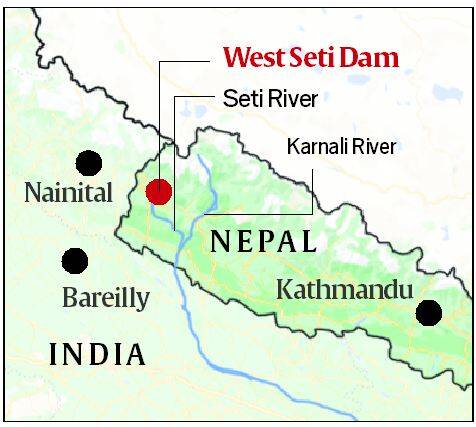
Recently, Nepal has signed a Memorandum of Understanding (MoU) with India to develop the West Seti and Seti River (SR6) projects to enhance the cross-border power exchanges.
How did the project evolve?
- The 750MW West Seti Hydroelectric Project was thought of in the early 1980s as a 37 MW run-of-the-river scheme.
- The project which was handed over to France followed by Australia could not take off.
- Nepal handed over the project to China but it withdrew in 2018, citing issues of resettlement and rehabilitation.
- Nepal tried to develop the project by mobilising internal resources but increased costs resulted in further delays.
- Later, the project was remodelled as the West Seti and Seti River (SR6) joint storage project (1,200 MW).
What is the project about?
- The project is to be located in the Sudurpaschim province of Nepal.
- Estimated to cost Rs 6,500 crore, the project is envisaged to provide Nepal 21.9% electricity free.
- Besides, locals affected by the project are being given a share of Nepali Rs 10 million and 30 units of electricity per month free.
- The project will be developed under Public Private Partnership.
To know more about India-Nepal relations, click here
What potential does the project hold?
- India is already involved in the projects of Nepal including
- The Mahakali Treaty (6,480 MW)
- The Upper Karnali Project (900 MW)
- The Arun Three projects (900 MW)
The Mahakali Treaty, signed in 1996 covers the Sarada and Tanakpur barrages as well as the Pancheshwar Multipurpose project.
Scope for India
- Supports hydropower cooperation- On completion of the project, it is expected to provide India the much-needed leverage in future hydropower cooperation.
- China factor- It will help India minimise the geopolitical influence of China, since the West Seti Hydroelectric Project was a major Chinese venture under the Belt and Road Initiative.
- As an alternative- The West Seti Hydroelectric Project can provide an added alternative and viable way to address India’s power deficits.
- Cross-border power exchanges- The project has the potential to enhance cross-border power exchanges between the two countries.
Scope for Nepal
- Power shortage - The project has the potential to address the power shortage of Nepal.
- Foreign exchange- Nepal’s electricity exports to India is expected to increase foreign exchange.
What are the concerns in this project?
- The revised cost around the construction process has increased to $2.04 billion.
- Nepal is concerned that the electricity rates and supply from India is inadequate to meet the rising demands.
What steps are needed for the successful project completion?
- Address investment-related constraints- There needs to be a careful study of investment scenarios such as conducive investment environment, distribution and transmission network and cost of resettlement and rehabilitation, at the preliminary stage.
- Project expansion- The project can also be extended to other regional partners under the Bangladesh-Bhutan-India-Nepal (BBIN) framework for cross-border energy cooperation.
References
- https://www.thehindu.com/opinion/op-ed/energising-india-nepal-ties-the-hydropower-way/article65943114.ece
- https://nepalindata.com/media/resources/items/13/bWest-Seti-and-SR6-Joint-Storage-Hydroelectric-Project.pdf
- https://nepaltourismhub.com/destination/seti-gandaki-river/
Quick facts
Seti River
- The Seti Gandaki River, also known as the Seti River or the Seti Khola, is a river of western Nepal.
- It is a left tributary of the Trishuli River.
- It is one of the holiest rivers of Nepal, worshipped in Hinduism as a form of Vishnu.
- Seti River cuts through the Mahabharat range and, therefore, seems to disappear in caves and tunnels in many places along its route through Pokhara city.



