0.1450
7667766266
x

India-Australia Civil Nuclear Cooperation

iasparliament Logo
July 15, 2026

Mains: GS II – International Relations

Why in News?

Recently, India–Australia Civil Nuclear Cooperation Agreement was finalised during the Third India–Australia Annual Summit.
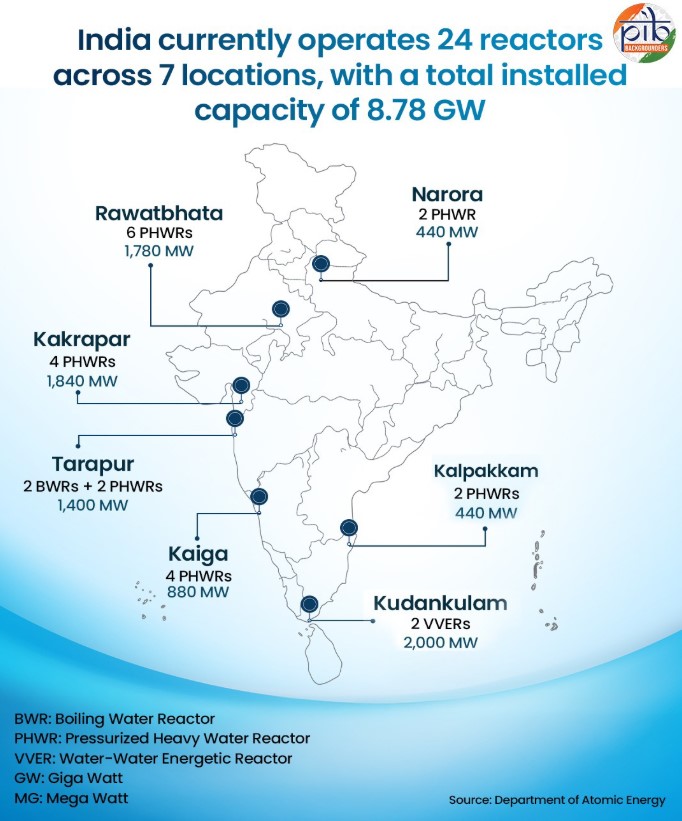
What is India’s nuclear energy landscape?

  • Total number of reactors & capacity– India currently operates 24 nuclear power reactors across seven sites with a total installed capacity of 8.78 Gigawatt (GW).
  • Current projects – Ten more reactor units with a combined capacity of 8000 Megawatt (MW) are under construction.
  • Pre-project activities for 10 additional reactors are also underway.
  • Reactor types – The reactors are Pressurised Heavy Water Reactors (PHWRs), Boiling Water Reactors (BWRs) and Light Water Reactors (LWRs).
  • India mainly uses natural uranium fuel to run the Pressurised Heavy Water Reactors (PHWRs) to produce nuclear energy and Plutonium is produced as a bye product.

Nuclear Reactor

  • Thorium reserves – India's long-term strategy is centred on utilising its abundant thorium reserves for future nuclear fuel, found mainly in the coastal sands of Kerala, Tamil Nadu, Andhra Pradesh, and Odisha.
  • But naturally occurring Thorium has to be first made fissile by neutron absorption inside a nuclear reactor.
  • FBRs – India is advancing Fast Breeder Reactors (FBRs) to utilise plutonium and support the transition to thorium-based reactors.
  • SMRs – The Government has allocated ₹20,000 crore in the Union Budget 2025–26, for the research, design, development, and deployment of indigenous Small Modular Reactors (SMRs).
  • SMRs typically generate up to 300 MWe of electricity. Their compact, modular design enables factory-based manufacturing, faster construction, improved quality and phased deployment.
  • The Government aims to operationalise at least five indigenous SMRs by 2033.
  • With continued investments in advanced reactor technologies and domestic innovation, nuclear energy is emerging as a reliable pillar of India's future energy mix.

Prototype Fast Breeder Reactor (PFBR)

  • India's indigenously built 500 MWe Prototype Fast Breeder Reactor (PFBR) at Kalpakkam attained first criticality on 6 April 2026, marking the start of India’s second stage of its three-stage nuclear power programme.
  • Unlike conventional reactors, the PFBR uses plutonium recovered from spent fuel of Pressurised Heavy Water Reactors (PHWRs) and is designed to produce more nuclear fuel than it consumes.
  • It will eventually breed Uranium-233 from thorium, unlocking India's vast thorium reserves for future-ready clean energy generation.
  • Developed indigenously by the Department of Atomic Energy, the reactor is a major milestone, strengthening India's reliable fuel supply, reducing dependence on imported uranium, and advancing the country's net-zero ambition by 2070.

Why this is crucial for India?

  • Energy SecurityThe Arrangement assures a long-term supply of fuel for an expanding fleet of reactors.

Australia possesses the largest uranium resources globally, accounting for more than one-third of the global total.

  • Nuclear power provides dependable baseload generation, available at all hours, which lends stability to the grid and complements the variable output of solar and wind power.
  • Clean Energy Nuclear power is a low-carbon source that adds firm capacity to India's non-fossil energy mix.
  • It can progressively meet demand currently served by coal while supporting the growing energy needs of industry, data centres and the digital economy.
  • Nationally Determined Contributions (NDCs) and net-zero India has committed to achieving net-zero emissions by 2070 and has progressively raised its climate targets, including a greater share of non-fossil capacity.
  • A secure supply of nuclear fuel supports this transition by enabling the expansion of clean and reliable generation.
  • India as a responsible nuclear power Australia's decision to supply uranium reflects confidence in India's strong non-proliferation record and responsible use of nuclear technology.
  • The Arrangement further reinforce the India–Australia Comprehensive Strategic Partnership by adding a robust energy pillar to cooperation spanning trade, defence, critical minerals, technology and the Indo-Pacific.

India has signed Inter Governmental Agreement (IGA) with 18 countries on Civil Nuclear Co-operation for peaceful purposes.

  • Supports India's nuclear ambitions – It complements the Nuclear Energy Mission, which targets 100 GW of nuclear power capacity by 2047.
  • It also reinforces the Sustainable Harnessing and Advancement of Nuclear Energy for Transforming India (SHANTI) Act, enacted in December 2025.
  • The Act enables participation by Indian private companies and joint ventures in building, owning and operating nuclear power plants.
  • Assured long-term uranium supplies provide greater confidence to developers, investors and industry, supporting timely project implementation.

What lies ahead?

  • The Administrative Arrangement is a practical measure with far-reaching benefits.
  • For the economy, it helps to secure clean and firm power for growth, manufacturing and digital infrastructure.
  • For energy security, it diversifies India’s fuel supply and strengthens the foundation of the power system.
  • This momentum is already evident, with milestones such as the PFBR at Kalpakkam attaining first criticality.
  • For the bilateral partnership, energy now joins a broad and deepening relationship.
  • Anchored in shared interests and mutual trust, India and Australia are well placed to widen their cooperation in the years ahead, with a dependable supply of uranium lending India’s clean energy endeavor a firmer foundation.

Reference

PIB| India – Australia Nuclear Arrangments

Login or Register to Post Comments
There are no reviews yet. Be the first one to review.

ARCHIVES

MONTH/YEARWISE ARCHIVES

sidetext
Free UPSC Interview Guidance Programme
sidetext