0.3024
7667766266
x

Importance of Devdar forests

iasparliament Logo
January 24, 2026

Prelims: Current events of national and international importance | Environment

Why in News?

In 2025, nearly year-long climate disasters caused over 4,000 deaths in Himachal Pradesh and Uttarakhand, even as a road project went ahead, cutting down about 7,000 sacred Devdar trees and many other native species.

  • Scientific name – Cedrus deodara (Deodar)
  • Devdar – They are majestic, high-altitude evergreen coniferous ecosystems, known as the "wood of the gods”.
  • Etymology – It is derived from the Sanskrit term devadaru (deva means god, daru means wood), signifying its sacred status in India.
  • Habitat – They thrive in temperate climates, often found in dense, pure stands or mixed with oak and fir.
  • Distribution – It is native to the Western Himalayas, spanning Afghanistan, Pakistan, India (Himachal Pradesh, Uttarakhand), and Nepal.
  • Key Locations in India – It is commonly found in Kashmir, Himachal Pradesh, and the Kumaon region, especially located in the Bhagirathi Eco-Sensitive Zone (4,000 sq. km, notified in 2012).

Key Characteristics

  • Features – It is a large conifer with needle-like leaves and drooping branchlets. Unlike many conifers, its fat, stout, upright cones disintegrate upon maturity, leaving only an upright spike on the branch.
  • Altitude – It grows at elevations of 1,500–3,200 m, featuring trees 40–60 m tall with conical crowns and aromatic wood.
  • Significance
    • Spiritual – Ancient Hindu texts & Shaivite traditions refer to these as Darukavana (forest of deodars), often associated with places where sages performed penance.
    • Economic – The wood is highly valued for its durability and scent, and it is also used in traditional medicine.
    • Ecological – It stabilises slopes, prevents landslides, maintains the water quality of the Ganga (antimicrobial properties) and also regulates microclimates and sustains aquatic ecosystems.
  • Threats – It faces existential threats from deforestation, flawed infrastructure, climate change, and governance failures.
  • Recent proposals Translocating ancient Devdar trees is ecologically unsound, as their unique, site-specific functions cannot be recreated elsewhere—making their preservation an environmental necessity rather than a matter of convenience.

Quick Fact

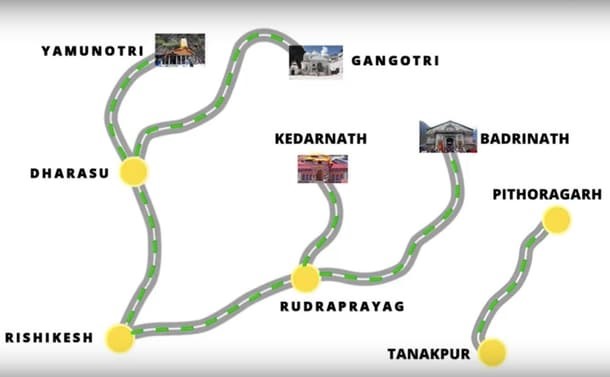
Controversy in Char Dham Project

  • Launched in – 2016.
  • Purpose – To provide all-weather road connectivity to four major pilgrimage sites - Badrinath, Kedarnath, Gangotri, and Yamunotri in Uttarakhand.

Char Dham

  • Status – As of January 2026, the project is in its final phases, with approximately 75% of the total work completed and expected to be complete by the end of 2026.
  • About controversy – The approval of the project led to the felling of nearly 7,000 Devdar (Deodar) trees and the diversion of 43 hectares of forest land.
  • Adopting flawed DLPS road standards already triggered more than 800 landslide zones, exposing the vulnerability of the Himalayan ecosystem.
  • Reasons – Systemic governance lapses and flawed engineering choices include -
    • Fragmented EIAs
    • Incorrect road-width standards
    • Vertical hill-cutting destabilised fragile Himalayan slopes.
    • Indiscriminate muck dumping.
    • No carrying capacity assessments for tourism and traffic.
    • Short-term economic gains are prioritised over long-term disaster resilience.

References

  1. The Hindu | A dangerous march towards a Himalayan ecocide
  2. Great Himalayan National Park | Devdar Forest
  3. DU | Deodar Forest


Login or Register to Post Comments
There are no reviews yet. Be the first one to review.

ARCHIVES

MONTH/YEARWISE ARCHIVES

sidetext
Free UPSC Interview Guidance Programme
sidetext