0.2631
7667766266
x

Horn-eyed ghost crab

iasparliament Logo
December 06, 2025

Prelims: Current events of national and international importance | Government policies and interventions

Why in News?

Visakhapatnam researchers recently documented the first confirmed instance of a horn-eyed ghost crab preying on a Mottled Lightfoot crab along the Rushi Konda shoreline suggests a temporary merging of habitats where sand and stone occur in close succession.

Mottled Lightfoot crab is a species that occupies rocky crevices and does not ordinarily cross paths with its sand-dwelling counterpart.
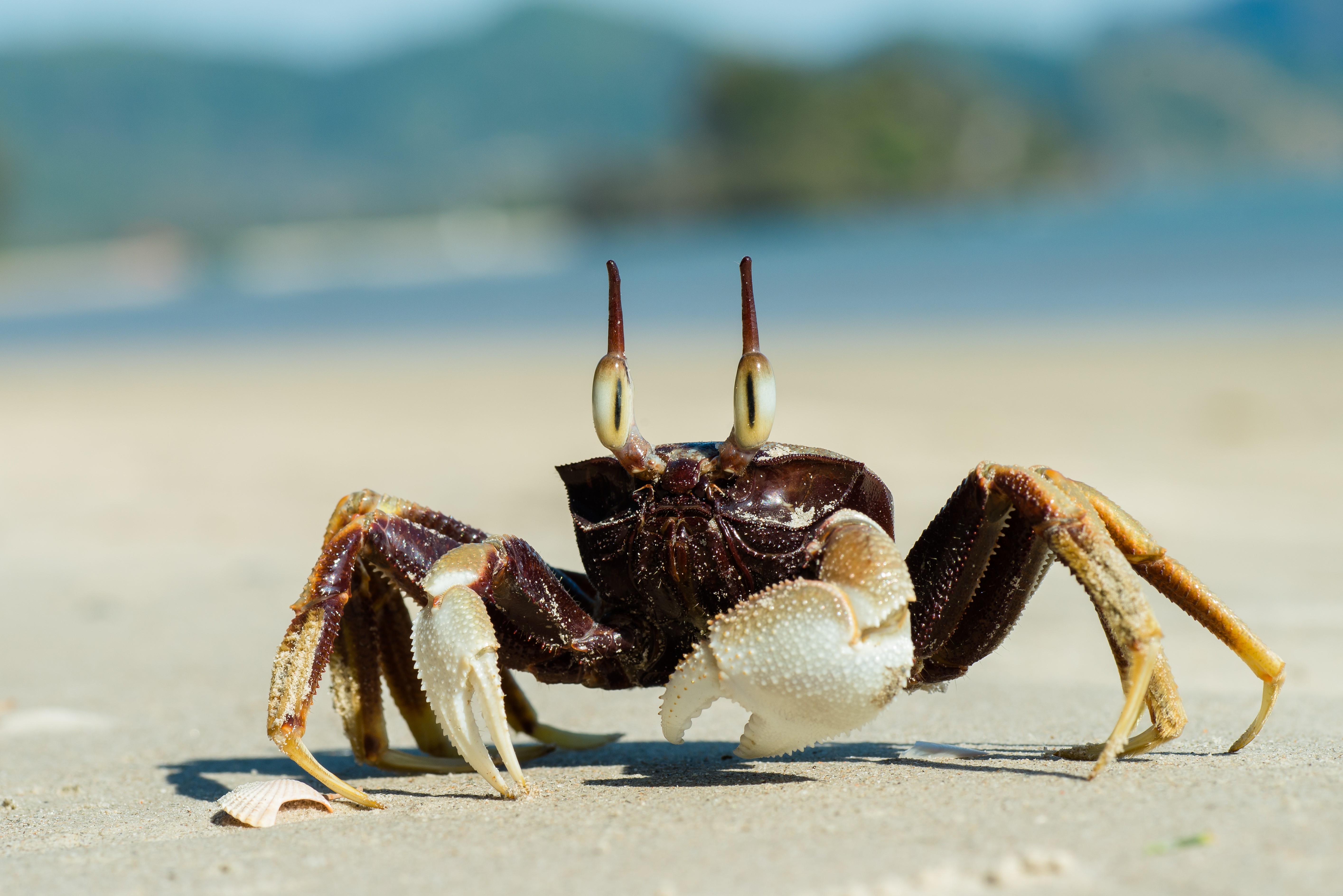
  • Scientific Name - Ocypode ceratophthalmus.
  • Genus - Ocypode.
  • It is a fast-running, sand-colored crab commonly found on tropical and subtropical beaches of the Indian Ocean and western Pacific — including India’s coastline.
  • Key identification features
    • “Horns” on eyes - Each eye has a pointed extension (a style) on top — the crab’s trademark.
    • Color- Pale sandy to grey; blends well with beach sand (excellent camouflage).
    • Size - Carapace up to ~5–6 cm wide.
    • Build - Long legs; built for speed on open sand.

Horn-eyed Ghost Crab

  • Habitat - It is generally restricted to sandy zones, above the high-tide line.
  • Digs deep, slanting burrows for shelter and moisture.
  • Behavior - Their pale bodies blend easily with sand, a feature that, along with their swift movement at dusk and dawn, has given rise to their common name.
  • Mostly nocturnal; active at dusk and night.
  • Breathes using modified gills and can stay out of water for long periods.
  • Diet - They have been recorded hunting clams, snails, worms, isopods, shrimps and a variety of insects.
  • In some regions, they feed on the eggs and hatchlings of birds and turtles. They also prey on other crabs, including smaller hermit crabs.
  • Ecological importance - Cleans beaches by scavenging dead matter.
  • Indicator species - Healthy ghost-crab populations often reflect low beach disturbance.
  • Aerates sand through burrowing, aiding nutrient cycling.

Six species of ghost crabs have been reported along the Indian coastline, and at least 3 of these have been observed at Rushikonda Beach, including O. brevicornis, O. macrocera and O. cordimanus.

Reference

The Hindu | Horn-eyed ghost crab

Login or Register to Post Comments
There are no reviews yet. Be the first one to review.

ARCHIVES

MONTH/YEARWISE ARCHIVES

sidetext
Free UPSC Interview Guidance Programme
sidetext