Why in news?
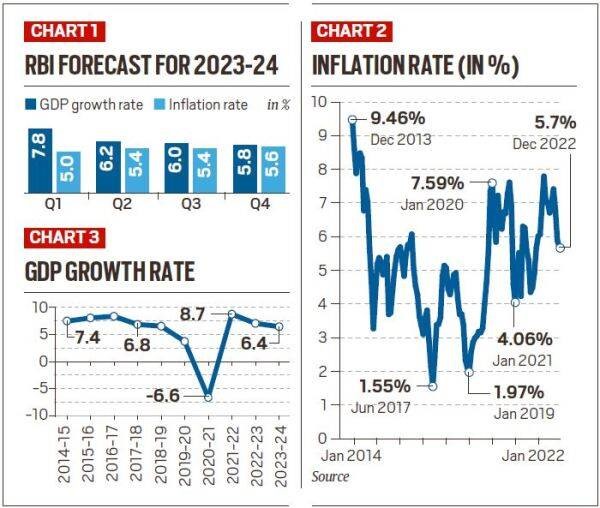
Reserve Bank of India (RBI) hikes repo rate by 25 basis points (bps) to 6.5% and has also projected a GDP growth for the next fiscal at 6.4%.
What are the current changes done by the RBI?
- Repo Rate – It is the rate at which the central bank of a country (RBI, in case of India) lends money to commercial banks in the event of any shortfall of funds.
- Repo rate is used by monetary authorities to control inflation.
- The Monetary Policy Committee (MPC) announced that the repo rate has been increased by 25 basis points and the rate is now 6.5%.
- Reverse repo rate – It is the rate at which the central bank of a country (RBI, in case of India) borrows money from commercial banks within the country.
- It is a monetary policy instrument which can be used to control the money supply in the country.
- During its meeting MPC has decided to keep the reverse repo rate unchanged at 3.35%.
- Growth projection - The RBI has projected GDP growth for at 6.4% for the next fiscal as earlier projected 7% GDP growth is not achieved.
- The projections are not achieved because of geopolitical tensions, global slowdown and tightening of global financial conditions.
Why RBI’s Monetary Policy Committee hiked the repo rate?
- Inflation forecast - The central bank has lowered the inflation target from 6.7% to 6.5%, which is still above the RBI’s comfort level of 4%.
- Inflation is expected to be 5.3% in FY24.
- The hike will help in moderating inflation in the country.
What happens when Repo Rate and CRR is increased?
- Cash reserve ratio (CRR) is the percentage of a bank's total deposits that it needs to maintain as liquid cash.
- This is an RBI requirement, and the cash reserve is kept with the RBI.
- A bank does not earn interest on this liquid cash maintained with the RBI and neither can it use this for investing and lending purposes.
- If the Repo rate is hiked,
- The banks will now have to pay a higher amount of interest to the RBI which in turn shall be collected from the retail/ corporate borrowers of the banks.
- This would result in higher interest outflow on loans taken from the banks, thus the loans in general will become costlier by 1-2%.
- When CRR is increased, it
- Decreases money supply
- Increases interest rates on home loans, car loans, etc.
- Increases demand for money in inter-bank market
- Decreases inflation
How this move will impact overall economy?
- Lending rates of banks is expected to go up as the cost of funds is expected to rise further.
- EMIs on vehicles, home and personal loans will also rise.
- The external benchmark linked lending rate (EBLR) of banks will rise as such loans are linked to the Repo rate.
- Some analysts say that consumption and demand can be impacted by the repo rate hike.
- Marginal cost of funds-based lending rates (MCLR) which accounts for 49.2% of the loans portfolio of banks is also expected to move up.
What does accommodative stance mean with respect to monetary policy?
- Accommodative monetary policy is a strategy used by central banks to keep interest rates low in order to infuse more cash into the economy to boost growth and maintain or reduce unemployment.
- This policy tactic helps maintain economic stability in a time of crisis by keeping people working and helping businesses expand.
- An accommodative monetary policy is often implemented during and after a crisis to provide support for the economy.
- The goal is to keep employment and prices as stable as possible while the situation gets resolved.
- While it has the major benefit of saving jobs, the low interest rates that result can hurt savers.
- If the policy steps are successful, the resulting strong economy could become inflationary.
Quick facts
- Marginal cost of funds-based lending rates (MCLR) – It is the minimum lending rate below which a bank is not permitted to lend.
- Inflation – It is the rate of increase in prices over a given period of time.
References
- The Indian Express | RBI hikes Repo rate by 25 bps to 6.5%
- The Indian Express | Reading RBI’s policy review



