Prelims: Current events of national and international importance | International Relations
Why in News?
Recently, the U.S. Department of Energy (DOE) has classified helium as a critical material in accordance with the Energy Act of 2020.
- Aim – To enhance domestic manufacturing, decrease reliance on foreign sources, and increase supply-chain security.
- Helium plays a vital role in semiconductor manufacturing and is indispensable for various advanced technologies.
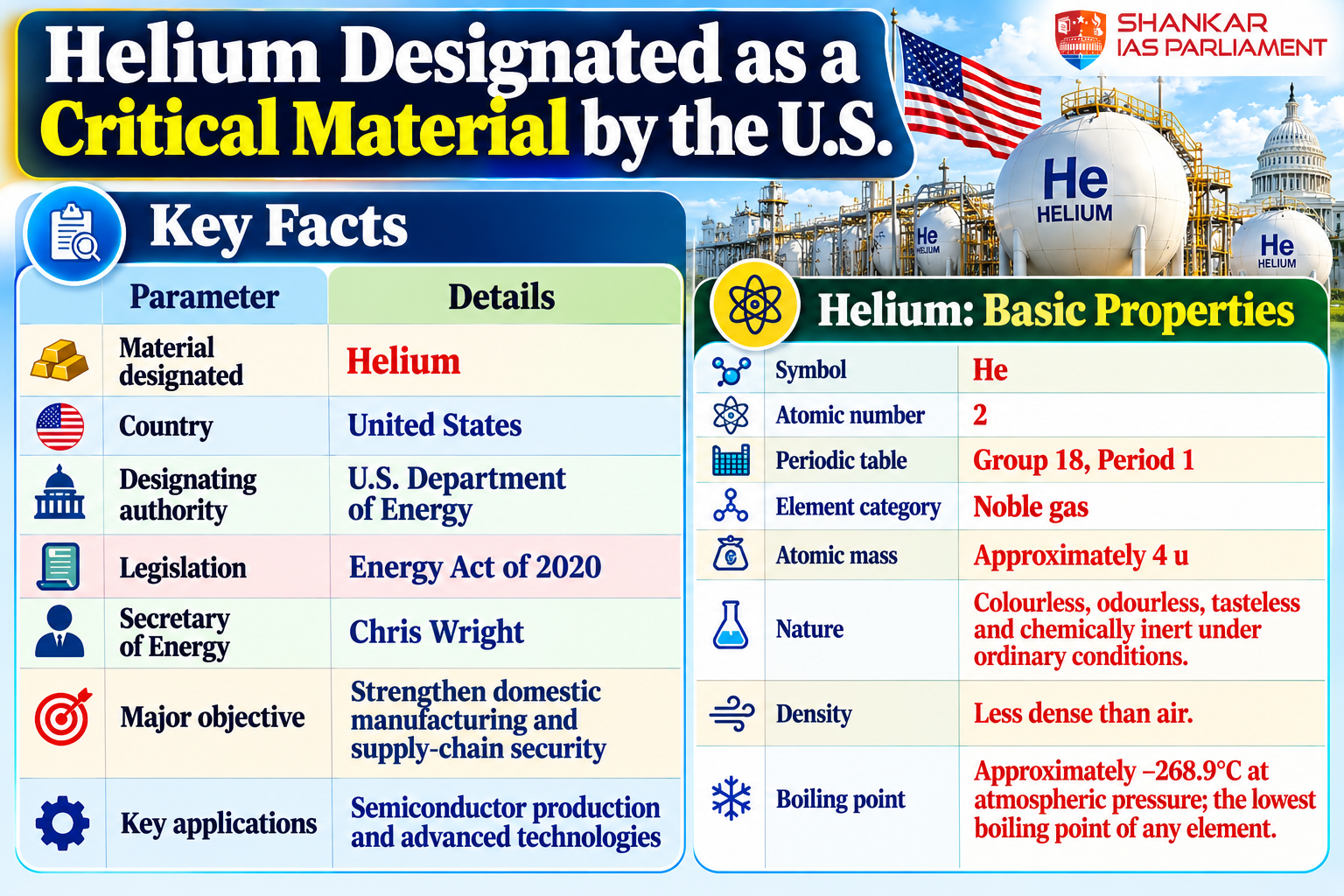
Physical Properties
- Chemically inert – The filled electron shell of helium renders it highly unreactive.
- Low boiling point – This property makes liquid helium valuable for cryogenic cooling applications.
- Non-flammable – In contrast to hydrogen, helium does not combust.
- Lightweight – Helium is utilised in balloons and other lighter-than-air technologies.
- Cryogenic properties – Liquid helium facilitates cooling to temperatures necessary for achieving superconductivity.
Major Uses
|
Sector
|
Application
|
|
Semiconductors
|
Manufacturing processes and controlled production environments
|
|
Medical technology
|
Cooling superconducting magnets in MRI scanners
|
|
Scientific research
|
Cryogenics and low-temperature experiments
|
|
Nuclear and advanced energy technologies
|
Cooling and specialised industrial applications
|
|
Aerospace
|
Pressurising and purging rocket fuel systems
|
|
Leak detection
|
Detecting leaks in vacuum systems and industrial equipment
|
|
Electronics
|
Specialised manufacturing and fabrication processes
|
Justification for the U.S. Classification of Helium as a Critical Material
- Strategic importance – Helium is indispensable for semiconductor manufacturing and the development of advanced technologies.
- Supply-chain vulnerability – Global demand for helium is increasing at a rate that exceeds current production capacity.
- Limited substitutes – Many critical applications lack viable alternatives to helium.
- Domestic production constraints – Although the United States possesses significant helium-rich natural gas resources, domestic refining capacity remains limited.
- Regulatory delays – Prolonged permitting processes hinder the expansion of domestic helium production.
- National security – Ensuring reliable access to critical materials such as helium is essential for maintaining industrial capacity and technological leadership.
|
Helium: Sources and Production
|
- Helium is primarily produced commercially by processing helium-rich natural gas deposits.
- Helium forms naturally from the radioactive decay of heavier elements in Earth's crust and accumulates in underground gas reservoirs.
- Due to its low chemical reactivity, helium does not readily form chemical compounds.
- Because helium is very light, it gradually escapes from the atmosphere into space. This makes recoverable terrestrial deposits especially valuable.
Note – Helium is not typically extracted directly from the atmosphere on a commercial scale. Natural gas processing remains the primary source.
|
Reference
The Hindu | Helium Designated as a Critical Material by the U.S.



