Prelims: Current events of national and international importance| Geography
Why in News?
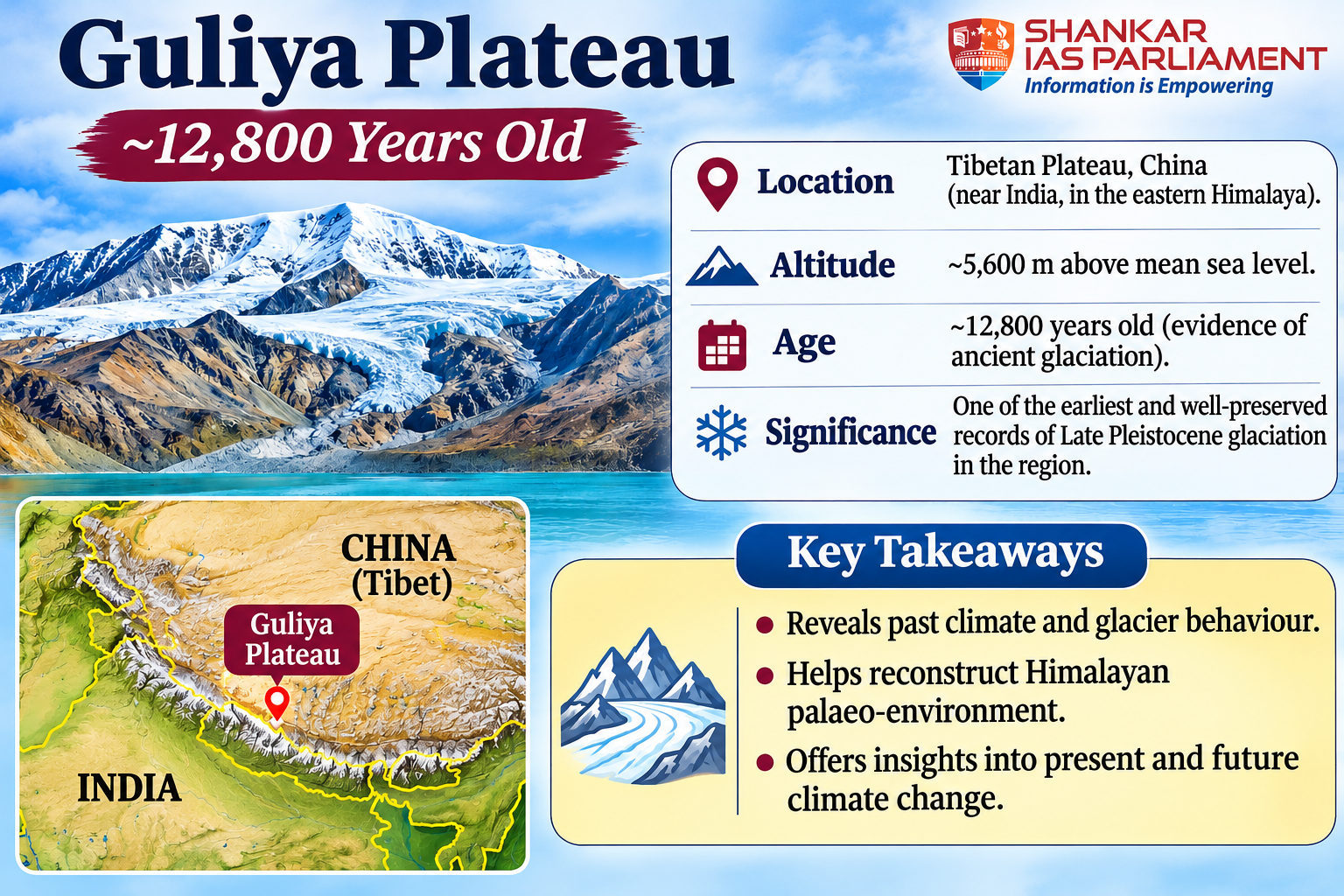
Scientists discovered evidence of ice dating back more than 128,000 years in the Guliya ice cap, northwestern Tibet. The findings, published in Science Advances, provide new insights into Earth's ancient climate and glacial history.
Key Findings
- Study location – Guliya Plateau, northwestern Tibet.
- Ice samples – Ice cores collected in 1992 and 2015 showed similar oxygen isotope patterns, confirming reproducibility.
- Dating techniques – Researchers used radioactive isotopes of beryllium and chlorine to establish the ice's age.
- Les Échamp Geomagnetic Excursion – Its chemical signatures helped identify a geological event occurring over 41,000 years ago.
- Significance – Extends the known glacial record of the region by over 100,000 years and indicates that mountain glaciers survived major climatic changes.
About Ice Cores
- Ice cores are cylindrical samples drilled from glaciers and ice sheets to reconstruct past climate conditions.
- Accumulated snow gets compressed into ice, preserving atmospheric gases, dust and chemical signatures.
- Oxygen isotope analysis helps reconstruct past temperatures and environmental conditions.
- Significance – Improves understanding of Earth's glacial cycles and long-term climate variability.
- Provides evidence of ancient ice surviving beyond the last glacial period.
- Helps reconstruct glacier formation, expansion and retreat through geological history.
Reference
Science daily| Guliya Plateau Ice - More Than 128,000 Years Old



