Mains: GS III – Science and Tech
Why in News?
Recently, OpenAI unveiled ChatGPT for Teens aimed at users between 13 and 17 years of age.
What is the background?
- Rapid growth of AI – Artificial Intelligence (AI) is rapidly becoming part of the everyday lives of children and adolescents.
- From solving mathematical problems to assisting with homework, creative activities and information seeking, AI chatbots are increasingly being used as learning companions.
- Concerns with AI – However, their growing use has also raised serious concerns regarding children's mental health, privacy, emotional dependence, critical-thinking abilities and exposure to harmful content.
- Recent Initiative – Against this backdrop, OpenAI unveiled ChatGPT for Teens on August 18, 2026, aimed at users between 13 and 17 years of age.
- The initiative seeks to create stronger safeguards for adolescents while retaining the educational and creative benefits of generative AI.
- It represents an important attempt to address the emerging challenge of making AI systems age-appropriate, without completely denying young people access to technological innovation.
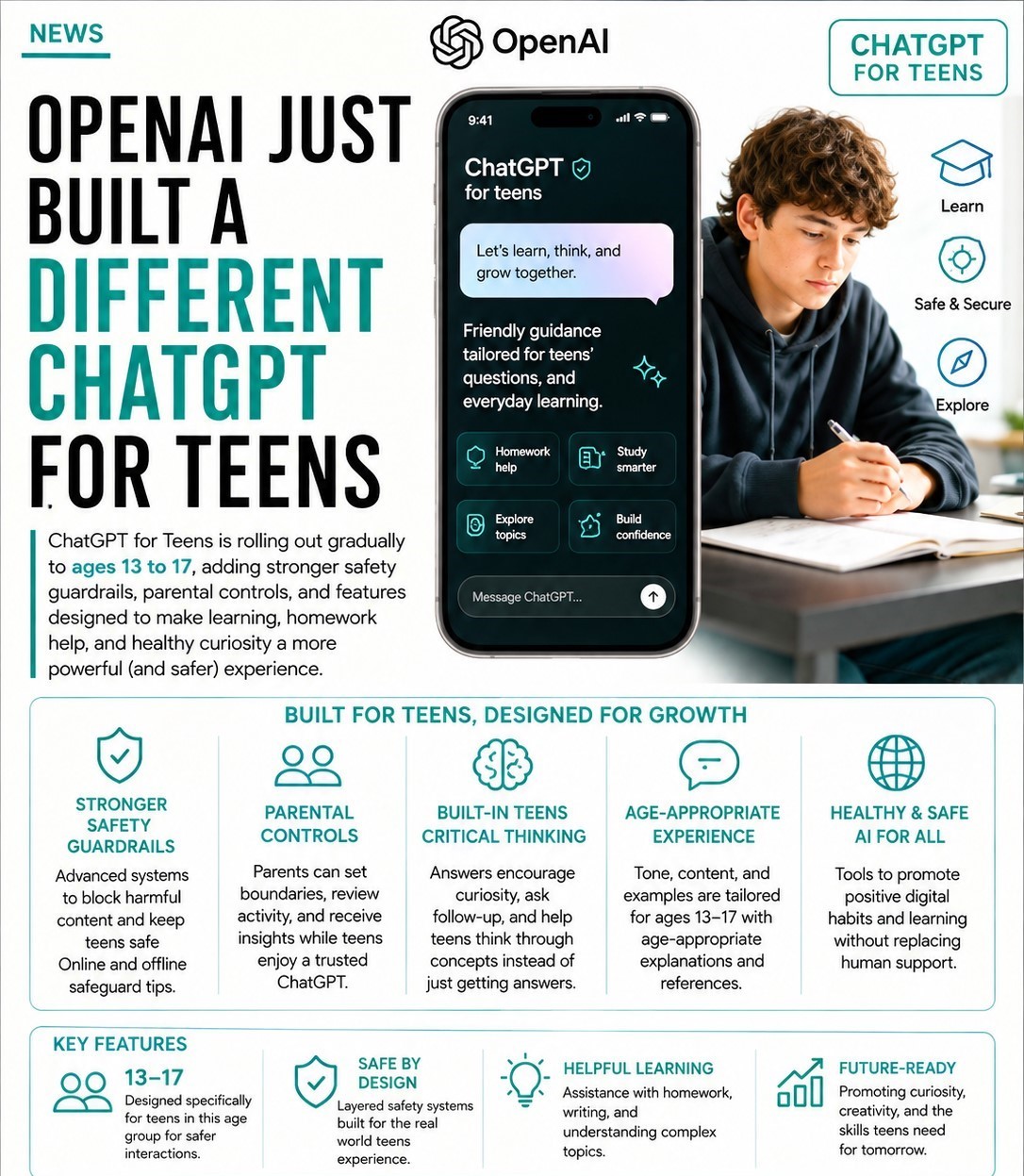
- ChatGPT for Teens – It is a version of ChatGPT specifically designed for adolescents aged 13–17.
- OpenAI has stated that it will adopt a stronger safety framework based on the principle of “treat teens as teens”, recognising that adolescents have different vulnerabilities and developmental needs from adults.
- Users who identify themselves as minors can be placed under these safeguards.
- In addition, OpenAI has indicated that its age-estimation systems may automatically place users whom it determines to be below 17 into the teen experience.
- The central objective is not simply to restrict access, but to encourage safe, responsible and educational use of AI, while strengthening the connection between technology and real-world human support.
What are the major safety features?
- Parental controls – Parents and teenagers can link their accounts.
- This enables parents to configure certain settings and receive notifications in specified high-risk situations.
- Such alerts are intended to help parents recognise circumstances where real-world intervention may be necessary.
- However, parental oversight must balance child safety with adolescent privacy and autonomy.
- Excessive surveillance could undermine trust, while inadequate monitoring could leave vulnerable children without timely assistance.
- Quiet hours – The “quiet hours” feature allows parents and teens to establish periods during which ChatGPT cannot be used.
- This can potentially reduce excessive screen time and discourage late-night dependence on AI systems.
- The feature is particularly relevant because healthy childhood development requires adequate sleep, physical activity, family interaction and offline social relationships.
- Restrictions on harmful content – The teen version is designed to reduce exposure to content relating to self-harm, suicide, violence, eating disorders, dangerous activities and explicit sexual or graphic material.
- The chatbot is also expected to avoid behaviour that could promote emotional dependency.
- OpenAI has stated that ChatGPT should not use romantic language, encourage emotional dependence, or suggest that it possesses human-like feelings or consciousness.
- Human intervention in high-risk situations – In certain situations, notifications may be reviewed by human moderators.
- This acknowledges an important limitation of AI: not every problem can or should be solved by an algorithm.
- Serious mental-health or safety concerns require parents, teachers, counsellors, medical professionals or emergency services in the real world.
- Privacy and reduced personalization – Teens can turn off memory, preventing the system from retaining information from previous conversations for future responses.
- Voice mode can also be disabled to reduce the possibility of the chatbot developing an overly human-like presence.
- The system also cautions teenagers against uploading sensitive images, highlighting the growing importance of digital privacy among minors.
- ChatGPT as an Educational Tool – One of the most significant features is the emphasis on learning rather than merely providing answers.
- Traditional use of generative AI can encourage students to outsource their homework.
- This may produce short-term convenience but can weaken independent reasoning and problem-solving skills.
- The teen-oriented approach seeks to counter this problem through Study Mode.
- Developed with input from teachers, scientists and other experts, it encourages students to work through problems step-by-step.
- Instead of simply providing the solution to a mathematical equation, for instance, ChatGPT may ask questions, offer hints and explain the underlying reasoning.
- This approach is important because education is not merely about obtaining correct answers. It is about developing critical thinking, curiosity, analytical ability and intellectual independence.
Why are stronger safeguards necessary?
- Vulnerability with AI – There are growing allegations that some vulnerable users have developed unhealthy relationships with AI systems.
- Chatbots are designed to communicate in natural, conversational language and can therefore appear empathetic or human-like.
- This creates the possibility of emotional over-reliance, particularly among adolescents who are still developing emotionally and socially.
- Concerns regarding self-harm and suicide – OpenAI has faced lawsuits from families alleging that interactions with ChatGPT contributed to harmful outcomes, including the death of 16-year-old Adam Raine. Such allegations are subject to legal scrutiny, but they underline the seriousness of the debate surrounding AI safety.
- Excessive dependence on AI – More dependence on AI for schoolwork could weaken learning outcomes.
- If students routinely ask AI to write essays, solve equations or conduct research without understanding the process, technology could become a substitute for thinking rather than a tool that enhances it.
- Wider Regulatory Challenges – The emergence of ChatGPT for Teens also highlights the difficulties governments face in regulating rapidly evolving AI technologies.
- The United States has examined concerns relating to AI companions and their potential impact on children.
- The United Kingdom has also debated stronger restrictions and safeguards for minors using AI systems.
- India, meanwhile, does not have standalone legislation specifically regulating AI chatbots used by children.
- However, India's broader digital, data-protection and child-safety framework provides a starting point for addressing some of these concerns.
- The challenge for policymakers is to develop regulations that protect children without unnecessarily restricting innovation, education and access to useful technology.
What are the concerns and limitations?
- Despite its safeguards, ChatGPT for Teens cannot be viewed as a complete solution.
- AI systems can make mistakes, misunderstand context or fail to recognise subtle signs of distress.
- Automated age detection may also incorrectly classify users.
- Parental controls can be bypassed, while excessive restrictions could push teenagers towards less regulated platforms.
- Moreover, technological safeguards cannot replace digital literacy, parenting, school counselling and mental-health support.
- A child facing loneliness, bullying, abuse or psychological distress needs human relationships and professional assistance, not merely a safer chatbot.
- Therefore, the effectiveness of these safeguards must be evaluated through independent audits, transparency, child-safety research and continuous monitoring.
What India should do?
- Establishing clear age-appropriate safety standards for AI platforms.
- Strengthening privacy protections for children's data.
- Mandating transparent risk assessments for AI systems likely to be used by minors.
- Developing independent audits of AI safety mechanisms.
- Promoting AI and digital literacy among students, parents and teachers.
- Ensuring easy access to school counsellors and professional mental-health services.
- Encouraging AI companies to adopt safety-by-design principles.
- Creating mechanisms for reporting harmful AI interactions and seeking timely intervention.
- The objective should not be to isolate children from AI, but to ensure that AI remains a tool under human supervision rather than becoming a substitute for human relationships and judgement.
India should adopt a rights-based and child-centric approach to AI governance.
What lies ahead?
- ChatGPT for Teens represents an important step towards making generative AI more age-sensitive and responsible.
- Its parental controls, quiet hours, study mode, content safeguards, privacy options and human intervention mechanisms acknowledge that children require a different technological environment from adults.
- Nevertheless, technology alone cannot solve the social and psychological challenges associated with AI.
- The long-term solution lies in a combination of responsible AI design, effective regulation, parental involvement, digital literacy and strong human support systems.
- For India, the emergence of AI tools designed specifically for adolescents should serve as an opportunity to move towards a comprehensive child-centric AI governance framework.
- The guiding principle should be clear: innovation must empower the child, not exploit the child's vulnerability; AI must supplement human development, not replace it.
Reference
The Hindu| ChatGPT For Teens



