Mains: GS-III – Cyber Security
Why in news?
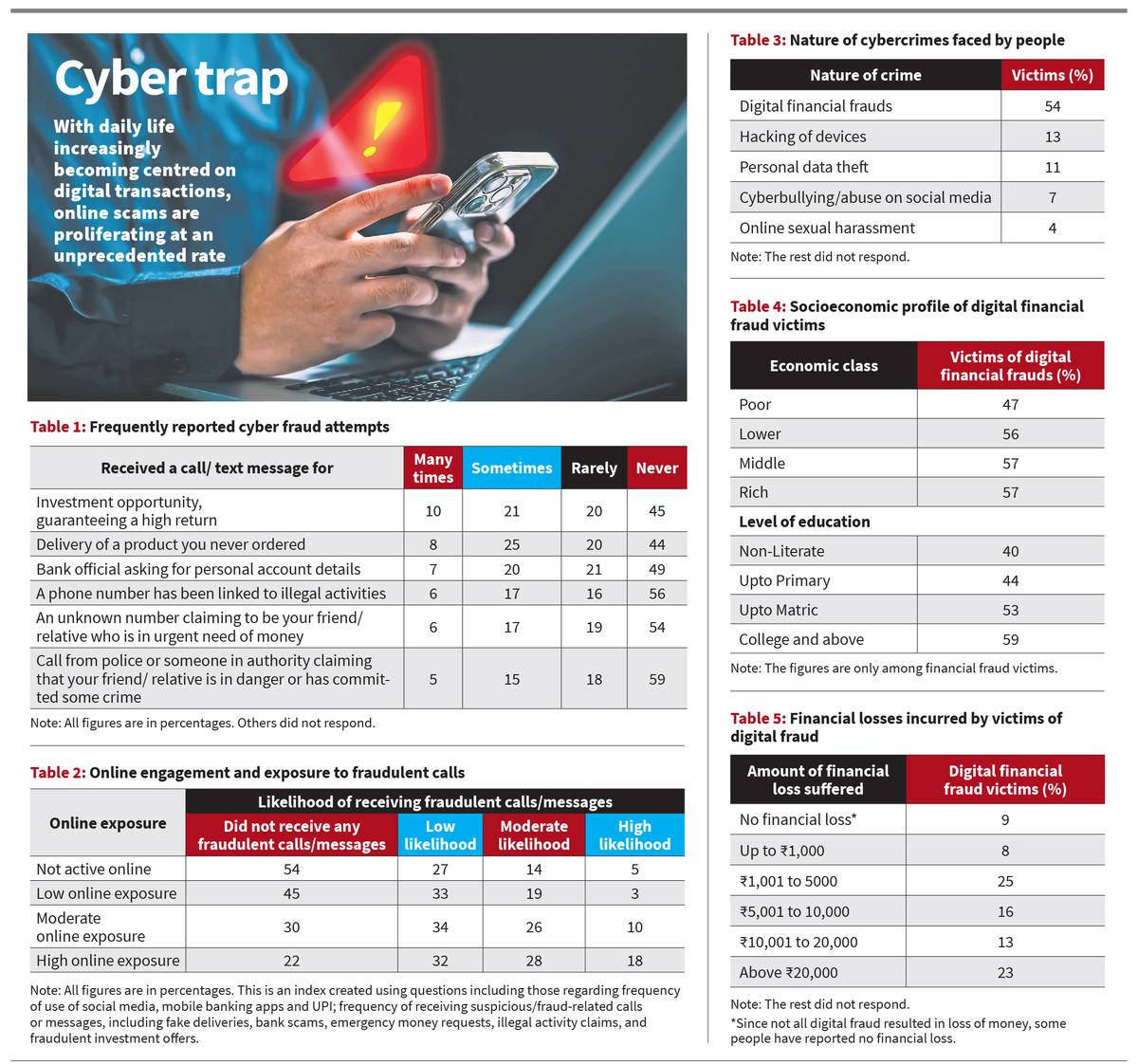
A recent study by Lokniti-Centre for the Study of Developing Societies (CSDS) and Common Cause surveyed 8,306 citizens across 16 States, examining how frequently citizens encounter fraud calls/messages, who is targeted, and the social profile of those most exposed.
What is cyber fraud and its types?
- Cyber fraud – It is any illegal activity using the internet and digital tools to steal your sensitive information, personal data or money through deception.
- Common Types
- Digital Arrest – Scammers pose as police or customs officials, claiming you are in a fake crime video and demanding money to avoid arrest.
- Investment & Trading Scams – Fake apps or social media groups promise huge profits on stock or crypto trading.
- Phishing & Vishing – Fraudulent texts, emails, or phone calls trick you into revealing passwords or One-Time Passwords (OTPs).
- Task-Based Scams – Offers for easy money in exchange for rating videos, liking posts, or doing small online tasks.
- Customer Care Fraud – Fake helplines offering cashbacks or refunds.
- Malware/APK Scams – Harmful apps that give criminals remote access to your phone.
- National Crime Records Bureau (NCRB) Data – Cybercrime cases rose 17.9% nationally, from 86,420 in 2023 to 1,01,928 in 2024, even as overall registered crime declined by 6% in the same period.
- Cybercrime as a crime category is moving sharply against the national trend.
What is the scale of cyber frauds and scams in India?
- Widespread exposure to fraud calls – Nearly 33% of the citizens reported frequently (‘many times’ and ‘sometimes’) receiving calls about deliveries they never ordered.
- Regularly encountered high-return investment scam calls (31%).
- More than 27% frequently received calls from bank officials asking for personal account details
- About 23% received calls about their phones being linked to illegal activities
- An unknown number claiming to be their friend urgently in need of money is 23%.
- 20% of the respondents frequently received calls from police or someone in authority claiming that their friend or relative is in danger or has committed some type of crime.
- However, it is important to note that a majority, roughly 50-60% of respondents, have never received these calls.
- Internet usage and scam exposure – Moreover, respondents who spend more time online were more likely to be targeted by fraudsters.
- Heavy Internet Users – 18% fall in the high scam-exposure category and 28% in the moderate category; together, over 46% report scam exposure.
- Non-Internet Users – In contrast, among those who do not use the internet, only 5% report high exposure and 14% report moderate exposure.
How do fraudsters exploit the digital footprint?
- Growing digital footprint – The common thread is deeper integration into the digital ecosystem, creating a larger footprint for fraudsters to exploit.
- Exploiting digital participation – Instead of relying solely on technical expertise, fraudsters target social relationships and institutional credibility.
- Investment scams appeal to the aspiration of getting rich quickly, delivery scams draw on trust in e-commerce, bank impersonation uses institutional credibility, and fake police calls exploit fear of authority.
- By manipulating familiar relationships and situations, fraudsters are able to effectively make deception appear legitimate.
- From scam attempts to actual victims – Not every scam attempt succeeds, but a significant number of people suffer real harm.
- Data shows that 13% of people were direct victims of cybercrime in the last two to three years.
- Among them, more than half (54%) of the people have experienced financial fraud, 13% said their devices were hacked, 11% reported personal data theft, 7% reported cyberbullying or abuse on social media, and four per cent reported online sexual harassment.
Who are the targets of financial fraud?
- Financial fraud and social status – Financial frauds are more layered around social and economic position.
- The wealthiest people (57%) are most vulnerable to financial fraud, though nearly half of economically disadvantaged respondents (47%) are victims of digital fraud too.
- Higher education, higher risk – Similarly, the more educated a respondent is, the more likely they are to be a victim of cybercrime.
- 40% of those without any formal education are victims of financial fraud, as compared to nearly three in five (59%) college graduates.
- Significant financial loss – The losses incurred due to cyber fraud are substantial. Over eight in ten victims of cybercrime reported some financial loss.
- Target people with resources – In essence, fraudsters in India, all the while exploiting ignorance and vulnerability, are also systematically tracking digital participation, aiming to catch those with resources.
- Fraud in this sense has become less a tax on carelessness than a tax on connectivity itself.
How are cyber frauds administered and reported in India?
- Legal framework – When an FIR is filed by law enforcement, the offences are booked under a combination of two major legal codes -
- Information Technology (IT) Act, 2000 –
- Section 66D – Cheating by personation using a computer resource (e.g., fake profiles, impersonating officials).
- Section 66C – Identity theft (stealing passwords, OTPs, digital signatures, or biometrics).
- Section 66 – Fraudulent or dishonest damage to a computer or network.
- Bharatiya Nyaya Sanhita (BNS), 2023 (Formerly the Indian Penal Code) – Sections covering Cheating & Forgery – Traditional criminal aspects of the fraud, such as financial cheating, extortion, and forging electronic documents.
- Designated Reporting Systems
- National Cybercrime Reporting Portal (NCRP) – All online frauds can be registered digitally at cybercrime.gov.in.
- Citizen Financial Cyber Fraud Reporting and Management System (CFCFRMS) – Financial online frauds (like UPI, banking, or credit card scams) reported through the 1930 National Helpline are processed under this dedicated system to freeze stolen funds in real-time.
Reference
The Hindu | Who is the most vulnerable to cyber frauds?



