Why in news?
Recently, Supreme Court asked the Punjab government why it could not fund the costs of crop residue management machines for marginal farmers.
Why stubble burning is practised?
- Also called as parali burning, stubble burning is a method of removing paddy crop residues from the field to sow wheat.
- It is usually done in the last week of September to November.
- It is usually required in areas that use the combined harvesting method which leaves crop residue behind.
- It is practised by the farmers to prepare the land for the next cultivation.
- It is practised mainly in the Indo-Gangetic plains of Punjab, Haryana, and UP to clear the fields for rabi crop sowing.
|
Stubble burning
|
High prevalence
|
|
Rice
|
Punjab and Haryana
|
|
Wheat
|
Uttar Pradesh
|
Why stubble burning is practised?
- Limited duration- Multiple cropping and shortened intervals between crops give a very short window of about 10–15 days during which the field needs to be prepared for the next crop.
- There is only short time available between rice harvesting and sowing of wheat as delay in sowing wheat affects the wheat crop.
- Cheap- It is considered one of the cheapest methods to clean the field after the harvesting season.
- Labour shortage- Use of expensive labour for stubble extraction is not feasible, especially in Punjab and Haryana where farm sizes are large.
- Clears all stubble- The use of mechanized harvesters leaves stubble of 10– 30 cm in the field, depending on the type of crop, which was not the case earlier with manual harvesting.
- Low crop residue- The low commercial and economic value of crop residue, coupled with the high costs of processing, reduces its value for farmers.
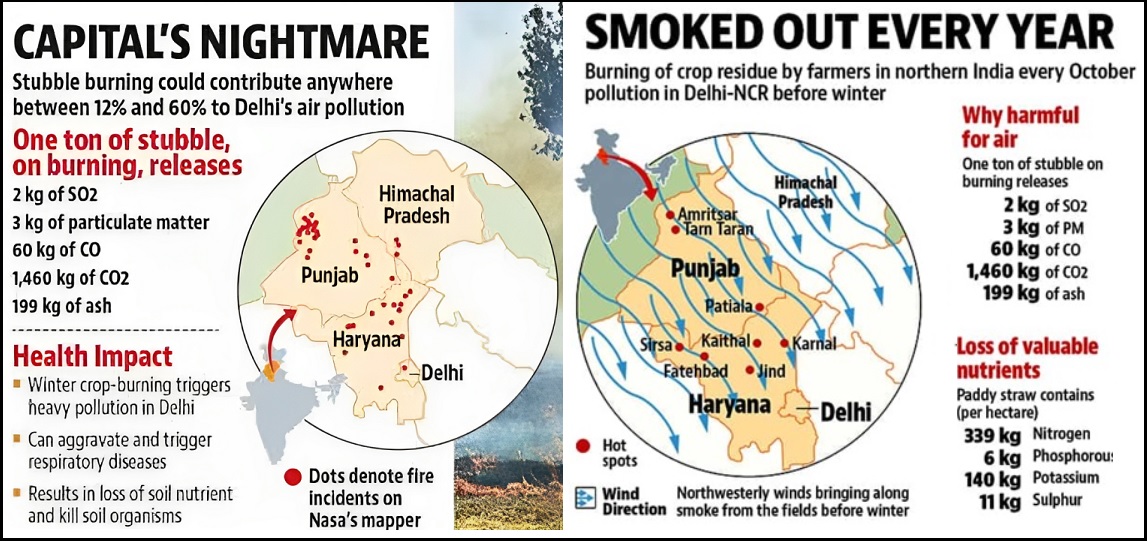
What are the impacts of stubble burning?
- Air pollution- It emits toxic pollutants in the atmosphere containing harmful gases like carbon monoxide (CO), methane (CH4), carcinogenic polycyclic aromatic hydrocarbons, volatile organic compounds (VOC).
- The combustion of agricultural residue is a prominent contributor to air pollution in certain regions of northern India.
- Soil fertility- Soil becomes less fertile and its nutrients are destroyed when the husk is burnt on the ground.
- Heat penetration- Stubble burning generates heat that penetrates into the soil, causing an increase in erosion, loss of useful microbes and moisture.

- Climate change- The release of toxic gases from stubble burning will increase global warming, further aggravating the climate change.
- Uncontrolled firing- Risk of fires spreading out of control, could turn into huge pit of flames.
|
Supreme Court’s Remarks on Stubble Burning
|
- The court asked the Punjab government why it could not fund the costs of crop residue management machines for marginal farmers.
- Punjab responded that the issue of manpower and fuel for the machines was a challenge.
- The court warned that paddy cultivation would deplete the water table in Punjab and suggested switching to crops other than paddy to save water and reduce pollution.
|
What are the strategies to reduce stubble burning?
- Promote agri-implements- Punjab has rolled out schemes for providing subsidy for mechanical implements that can mix the crop residue with soil to improve fertility.
- Promote co-ownership models for the agri-implements which can make such implements accessible to farmers.
- Foster awareness- Farmers should understand the value of crop residues and use of agri implements in extraction and packaging.
- Power generation- State governments need to incentivise establishment of biomass-based power plants through fiscal interventions and prioritization. Example- Biomass co-firing
- Promote R&D- Punjab Agricultural University is developing a variant of paddy straw that has lower silica content, thereby making it suitable for utilisation in biomass-based power plants.
- Biofuel production- The State governments, along with appropriate policy interventions from the Central government need to incentivise utilisation of biofuels.
- Industrial application- Biomass pellets can be sold commercially as the main fuel for industrial boilers and replace coal. Micro-pelletization should be incentivised and its local usage promoted.
- Crop residue collection mechanism- Create a uniform decentralised mechanism for the collection, storage and commercial sale of crop residue.
Chhattisgarh model
- A gauthan is a dedicated 5-acre plot, held in common by each village.
- Here, all the unused parali (paira in Chhattisgarhi) is collected through parali daan (people’s donations) and converted into organic fertiliser by rural youth.
References
- Indian Express- Tackling stubble burning
- Down To Earth- Strategies to reduce crop residue burning



