Why in news?
The Intergovernmental Panel on Climate Change (IPCC) recently released the 1st part of its Sixth Assessment Report (AR6) titled ‘Climate Change 2021: The Physical Science Basis’.
What is the IPCC?
- It is established by the UNEP and the World Meteorological Organization in 1988.
- It is a body of world’s leading climate experts.
- It provides reports on the current state of knowledge in climate change and its potential environmental and socio-economic impacts.
- Its first report in 1990 on consequences of rising greenhouse gas (GHG) emissions led to the forming of UNFCCC in 1992.
- Since then, reports have been produced roughly every 7 years.
What are the key factors of climate change as per the report?
Human Activities
- The combined contribution to global warming by natural factors, such as the sun and volcanoes, is now estimated to be close to zero (negligible).
- 1.07℃ out of the 1.09℃ warming is due to GHG associated with human activities.
- Thus, almost 100% of global warming has been caused by humans.
Emissions
- CO2 levels were greater in 2019 than they had been in “at least 2 million years."
- Methane and nitrous oxide (2nd and 3rd major contributors of warming respectively) levels are their highest in at least 800,000 years.
- CH4 stays in the atmosphere only for a fraction of time compared to CO2, but is far more efficient at trapping heat.
- Human-induced sources of methane
- consuming fossil fuels
- leaks from natural gas production, coal mining and landfills
- livestock and manure handling

- Aerosols contribute to reducing the impact of warming therefore drastic reduction of aerosols actually leads to an increase in warming.
Weakened Natural allies
- The CO2 emissions notably increased by half since 1960.
- In the same period, forests, soil and oceans have absorbed 56% of all the CO2 humanity has released into the atmosphere.
- But these carbon sinks which are natural allies in the fight against global heating are showing signs of saturation.
- The percentage of human-induced carbon they soak up is likely to decline as the century unfolds.
“It’s suicidal and economically irrational to keep procrastinating”
Temperature Rise
- 2011-20 was hotter than any period of time in the past 1.25 lakh years.
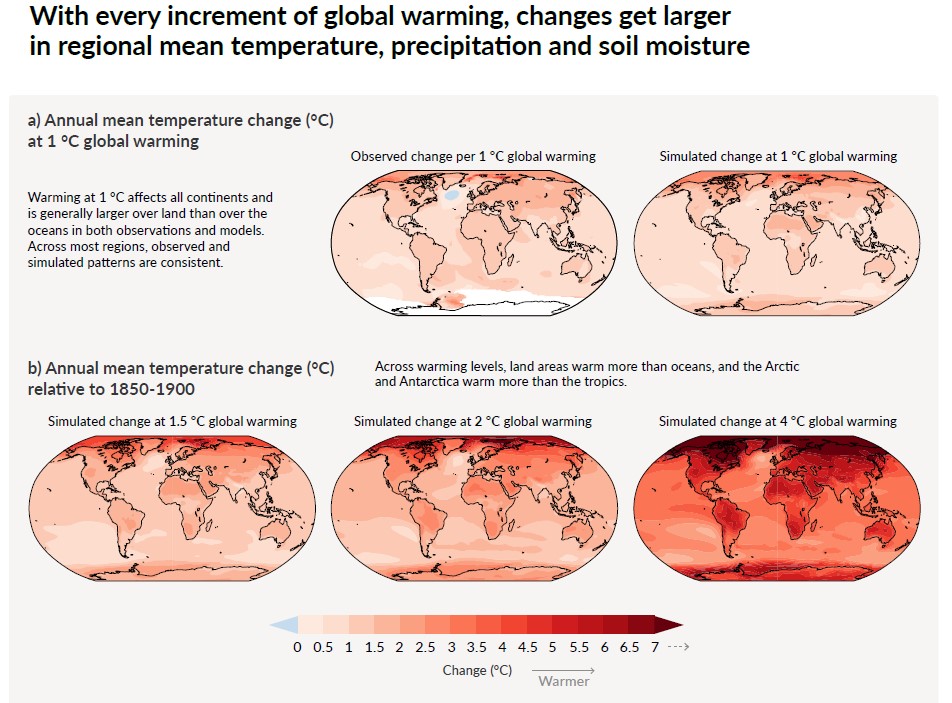
- Global surface temperature was 1.09°C higher in 2011-20 than between 1850-1900.
What are the impending threats?
Global Warming
- Within the next two decades, temperatures are likely to rise by more than 1.5 °C above pre-industrial levels.
- Additional warming will weaken the Earth’s carbon sinks present in plants, soils, and the ocean.
- Air pollution reduction and steep climate change mitigation are not complementary goals but require independent efforts over the short and medium-term.
- Human-induced global warming has been more rapid in Africa than the rest of the world.
Sea level rise
- Sea-level rise has tripled compared with 1901-1971 in the last decade.
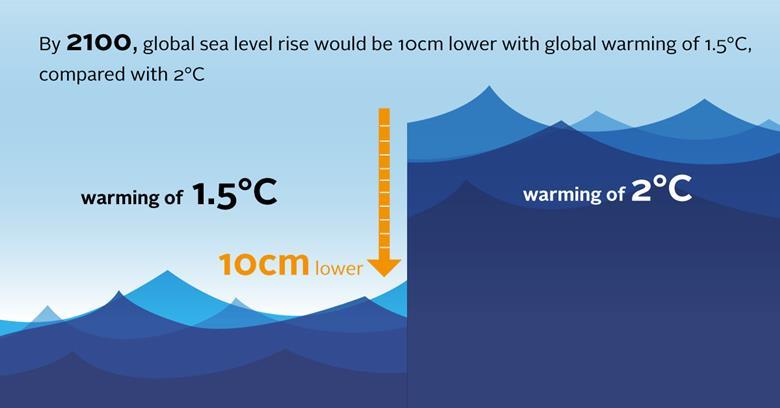
- Global oceans have risen about 20 cm since 1900.
- The Arctic Sea ice is the lowest it has been in 1,000 years.
- Crumbling and melting ice sheets atop Antarctica have replaced glacier melt as the main drivers of sea level rise.
- If global warming is capped at 2°C, the ocean watermark will go up about half a metre over the 21st century.
Impact on Cities
- Floods and sea-level rise in coastal areas & Ice sheet collapse or rapid changes in ocean circulations
- Least developed countries will increasingly bear the brunt of global warming
- Other common threats - increased heatwaves, more intense storms, and more serious droughts and floods etc
- With every 1°C rise in temperature, there will be a 7% increase in the intensification of extreme rain events.
New IPCC report is "a code red for humanity" - UN Secretary-General António Guterres
Impact on India
- With a 7,517 km coastline, India will face significant threats from rising seas
- Also, Indian Ocean is warming faster than the global average.
- Across 6 Indian port cities - Chennai, Kochi, Kolkata, Mumbai, Surat and Visakhapatnam - 28.6 million people will be exposed to coastal flooding.
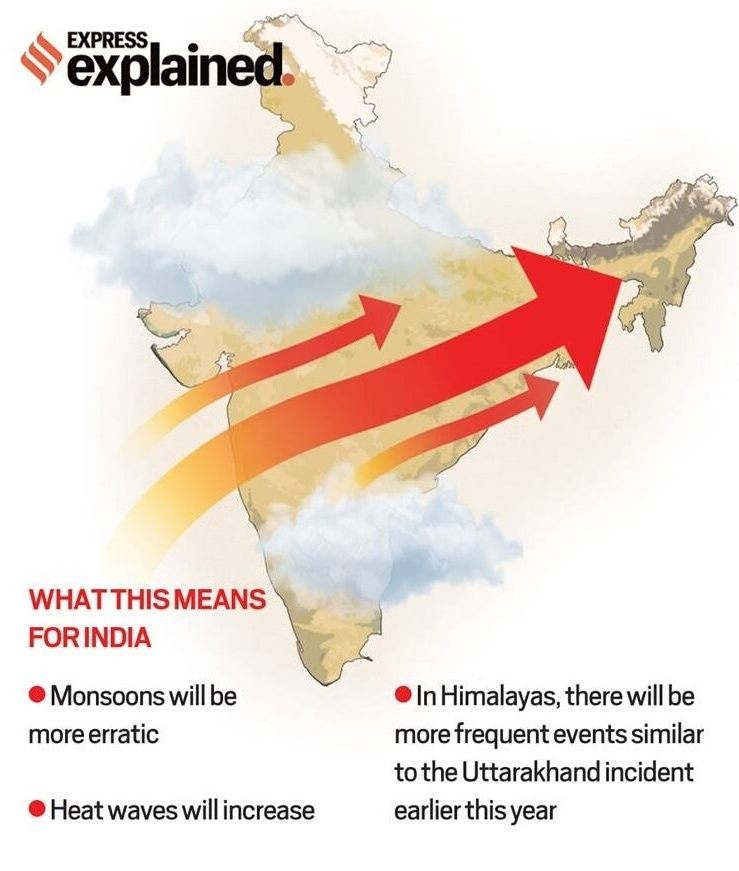
- The snowlines are retreating, and this can cause a change in the water cycle, the precipitation patterns, increased floods as well as an increased scarcity of water in the future in the states across the Himalayas.
- Changes in monsoon precipitation are also expected, with both annual and summer monsoon precipitation projected to increase.
What is the 1.5°C mark that IPCC advocates?
The 2015 Paris Agreement set the goal to limit global warming to well below 2°C, compared to pre-industrial levels, in this century.
It also sets 1.5°C as an aspirational target to channelize countries’ efforts.
- Temperatures have now risen by about 1.1°C since the period 1850 to 1900.
- Even if we start reducing emissions now, we will still overshoot the 1.5°C mark by 2030. But we will see a drop in temperatures to around 1.4°C by 2100.
Will 1.5°C level address all climate risks?
- It will take a lot of time for nature to heal; 20-30 years to see global temperatures stabilise.
- So, some long-term impacts of warming that are already in line are likely to be witnessed - Sea level rises, Melting of Arctic ice, Warming and acidification of the oceans.
- Nevertheless, the 1.5°C level will represent a much smaller risk than 2°C.
- And notably, this report is likely to be the last from the IPCC while there is still time to stay below 1.5°C.
What does IPCC call for?
Emission Control
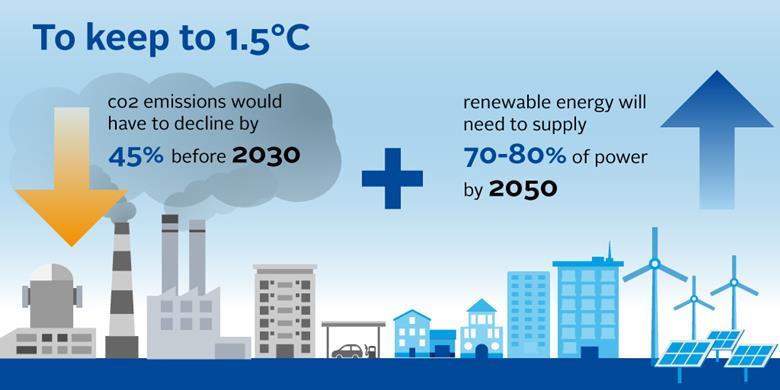
- IPCC has recommended that countries strive to achieve net zero emissions i.e no additional greenhouse gases were emitted by 2050.
- Drastic cuts in GHG emissions are needed this very decade (2021-2030).
- End to new coal plants and new fossil fuel exploration and development.
- Efforts of governments, investors and businesses towards a low-carbon future.
Cumulative Emissions
- Reaching net zero alone is not enough to reach the 1.50C target.
- Historical cumulative emission i.e total emission by each country throughout the industrial phase is the cause of the climate crisis that the world faces today.
- They cannot be mitigated by promises of net zero 30 years from now.
- Therefore cumulative emissions should be factored in while calculating net zero.
Negative emissions
- Warming could be brought back down via “negative emissions” i.e., to cool down the planet by -
- sucking out or sequestering the carbon from the atmosphere
- stopping the use of fossil fuels and stopping deforestation
- But the technology at this end is not yet evolved and perfect, and needs attention.
Peak by 2025
- Earth could exceed 1.5°C of global warming as soon as the early 2030s.
- So, staying below 2°C this century will happen only if emissions reach net zero by 2050.
- For this to happen, global emissions must peak sometime in the middle of this decade itself (by 2025).
- Indigenous and Traditional knowledge had played an increasing role in historical climatology.
- Peruvian fishermen had first thought of the name ‘El Niño’ for the now well-known climate phenomenon in the tropical eastern Pacific Ocean, that scientists link with the Southern Oscillation.
- Inuit communities had contributed to community-based monitoring across the Arctic.
- Indigenous Australian knowledge of climatic patterns has been offered as a complement to observational records, such as those of sea-level rise.
- Such traditional knowledge must be assessed and integrated with scientific literature.
To test your knowledge on IPCC Report, Click here
Source: The Hindu, The Indian Express, The Guardian, Down to Earth
Related article: IPCC Report on Global Warming 2018



