Why in news?
Hydrogen fuel cell technology is emerging globally as a valuable multisector alternative for fossil fuels.
What is the need for the push towards alternative energy sources?
- Combating climate change
- Preventing the ecological degradation
- Reaching the net-zero emissions goal in the next few decades
- Reducing the carbon footprint
What is the fuel cell technology?
- A fuel cell uses the chemical energy of hydrogen or other fuels to cleanly and efficiently produce electricity.
- If hydrogen is the fuel, the only products are electricity, water, and heat.
- Working- Fuel cells work like batteries, but they do not run down or need recharging.
- They produce electricity and heat as long as fuel is supplied.
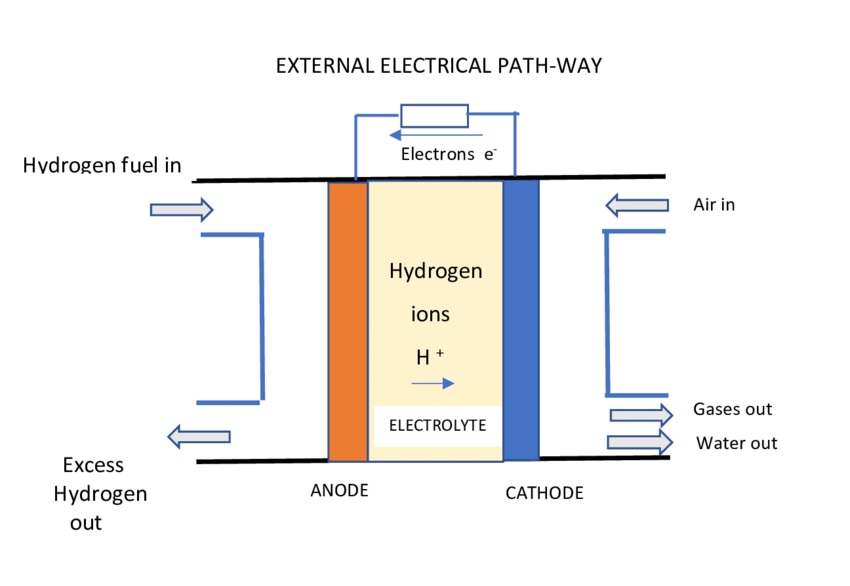
- A fuel cell consists of two electrodes—anode and cathode sandwiched around an electrolyte.
- A fuel, such as hydrogen, is fed to the anode, and air is fed to the cathode.
- The electrons go through an external circuit, creating a flow of electricity.
- The protons migrate through the electrolyte to the cathode, where they unite with oxygen and the electrons to produce water and heat.
What are fuel cell electric vehicles (FCEVs)?
- Fuel cell electric vehicles (FCEVs) are powered by hydrogen.
- FCEVs use electricity to power an electric motor but instead of using electricity through batteries, FCEVs generate electricity using a fuel cell stack powered by hydrogen, which is stored on-board.
- FCEVs are among the cleanest modes of transportations as they release no harmful emissions, and only emit water vapour and warm air.
- With future technical enhancements, there will be a forecasted improvement in overall WTW (well-to-wheel) efficiency for FCEVs which is pegged at around 30–35 % today.
- Benefits
- Achieve energy security
- Fulfill de-carbonisation goals
- Possess higher energy density (more energy per unit mass)
- Require shorter fuelling durations
- Have long-range applications that are not viable with battery electric vehicles because of the constraints of LI-Ion batteries
- Inherent renewability component
- Helps in reducing greenhouse emissions
- No emissions and environmental friendly
What are the challenges?
- Hydrogen technology is still at a very nascent stage in the country, and there is limited infrastructure and scale of hydrogen dispensing units available.
- This makes the acquisition and total cost of ownership for FCEVs higher.
- Most hydrogen production methods deployed today rely on fossil fuels.
What is the road ahead?
- The government incentives and localisation of core aggregates are likely to reduce costs and improve the overall economics of FCEV.
- The newly introduced National Hydrogen Energy Mission Programme aims to bring open access to renewable energy and increase the production of green hydrogen.
- With these positive steps, one can expect a decisive move towards a sustainable future of mobility, with hydrogen fuel cell technology playing a predominant role across segments, in public transport, commercial vehicles, and passenger vehicles.
References
- https://www.thehindubusinessline.com/opinion/fuel-of-the-future/article65143828.ece
- https://www.energy.gov/eere/fuelcells/fuel-cells
- https://www.researchgate.net/profile/David-Murray-Smith/publication/337991572/figure/fig1/AS:837173670600705@1576609165968/Schematic-diagram-of-hydrogen-fuel-cell.png




